
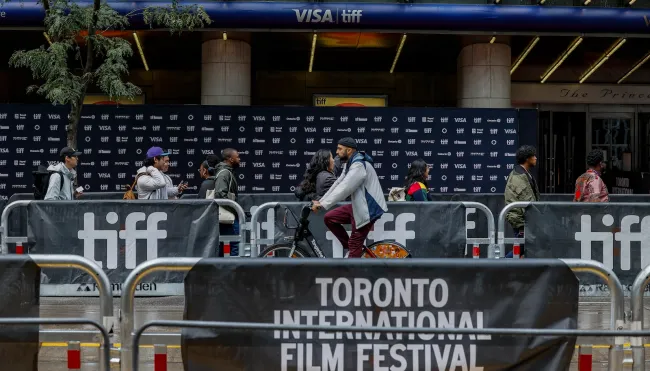
For years, the Toronto International Film Festival had been a film market in name only. Plenty of deals were made at TIFF, including last year with what turned out to be the most lucrative festival acquisition in history, “Obsession.” Sellers and buyers alike know what TIFF is.
But for the first time ever, the TIFF Market has been formalized. Festival director Cameron Bailey told us during a recent appearance on our “Screen Talk” podcast that TIFF will host roughly 200 private market screenings of titles not playing in the festival, a huge step up from the around 50 to 100 screenings in past years. Over 6,000 market delegates are attending, up about 1,000 from last year, and hundreds of those are sellers who haven’t attended TIFF in a decade and are flying overseas to be in Toronto. TIFF itself unveiled 50 titles as part of an international financing forum, and that just scratches the surface of other packages being announced.


Yet with all the formalities, there’s still a lot of uncertainty about just what the TIFF Market will look like.
International film sales agents are pretty ingrained in the timelines of the market calendar. Sellers gear up all year for Cannes assembling packages and then shopping them on the market, then all the Europeans take the summer off. They regroup again in the fall and take the time assembling new packages to introduce at the American Film Market late in the year before the industry goes on holiday again or at Berlin early in the next year. Shooting schedules work around the market ebbs and flows.
But wouldn’t it be great if you could secure pre-sales for a film in September and then get something ready to shoot by November? And while you might introduce your commercial, popcorn Jason Statham shark movie at AFM, wouldn’t it be great to make use of this lull in the calendar and not wait until February at Berlin to introduce anything involving an auteur?
That is exactly what Toronto is trying to build, but it’s easier said than done.
“For this market to grow, it’s going to have some challenges. It’s so close to the summer and to the holidays, and packaging is going to be a little bit of a challenge that it’s going to have to get over. But we’ll continue to do our thing on our side,” Capstone Pictures and Aura’s Christian Mercuri told IndieWire. “We’re going to use Toronto as we always have, and if things are ready to announce, we will. It’s still healthy enough of that type of market … as it pertains to acquisitions, there really is no other Toronto.”
IndieWire spoke with several domestic and international sales agents who acknowledged the void TIFF is trying to address with the market while also wondering how realistic it is to expect packages to be put together quick enough right out of the summer.
That’s not a dig on what TIFF has put together specifically. The festival has invited hundreds of sellers and is paying for many to attend. Agents who used to have to book screening rooms, office space, and more on their own are now having it all provided for them.
Sellers with finished films that didn’t earn a slot in the festival itself are now able to host private market screenings of some still big commercial films. TIFF even gives the option of opening up those private screenings to help sellers warm the room for buyers. The added element of having premieres and stars in the area gives everything more energy and excitement.

Anna Godas of international sales agent Dogwoof is introducing “Freeing Flipper” at the TIFF market, a documentary about the trainer of the dolphins for the “Flipper” TV series who turned activist fighting to free all dolphins from captivity and who became a central figure in the 2009 documentary “The Cove.” For Godas, establishing the connection North American buyers have with “Flipper” was crucial, and Toronto was a great means to do that in a way that simply didn’t exist before.
“I think it’s the beginning of that, and I know quite a few buyers that are thinking that way,” Godas said. “It’s a new launch pad for some of our films that, to tell you the truth, we were all really wanting.”
The question is whether all those added eyeballs, all those buyers and sellers taking meetings or seeing other footage, detracts from the dozens of films playing in the festival itself. One trade-off that may have some unexpected impacts is that there are fewer Press & Industry screenings, often just one for a film instead of two, in order to accommodate the added market screenings. It could mean buyers have a harder time catching all the films they want to screen, slowing everything down and forcing people to watch from links after the fact. Or it could force buyers to attend more of the public screenings, which anyone who saw “Obsession” in the Royal Alexandria would tell you was the best way to see that movie.
One domestic distributor said they’re there to screen movies and a whole lot of them, and it’s “going to be tough” to devote time to other meetings with partners for packages. Gotta find a moment to eat some time.
“We can’t really let it get in the way because there’s only one chance to see that movie for the first time,” Marc Goldberg of Aura said. “Toronto is renowned for probably the market of all markets where there’s the most commercial opportunities for the domestic market. So myself and my team won’t be scrambling to get to meetings when there’s a lot of good movies to see, and I’m not sure much will change that in the future. But at the same time, we’re open to see how things how things change. The parameters are pretty set in stone though. You can only be in one place at one time.”

The bigger question may be what the impact of the TIFF Market is on AFM. Will the industry need both? TIFF for now is inviting buyers and sellers to attend, but will they still come in a few years when they stop footing the bill? Will people choose between the two markets, especially if the product on hand at each market is similar? Veteran sales agent Pia Patatian of Noora Films says it’s “impossible” for European and Asian buyers to fly in twice in two months, and something long term might have to change.
“It’s complicated. I think TIFF will ‘win’ against AFM, if they change the date,” Patatian said. “Buyers, they love to go to TIFF because they screen movies. This is the only difference between TIFF and AFM, but the date of the AFM is much better for them. It gives us time to package those movies, and it’s at the end of the season, and there’s nothing else after AFM. I think something will change.”
Other domestic agents however said AFM “isn’t going anywhere,” and the domestic distributor spoke highly of how many packages they tend to acquire out of AFM as a crucial part of their future slate. After the major hiccup of relocating to Las Vegas for a year, AFM returned to Los Angeles and gave everyone a chance to take all the local meetings they always need with a single U.S. trip, and the reviews for the new AFM market and its venue were glowing.
Yvette Zhuang and Zach Glueck of upstart sales agent Manifest Pictures say that TIFF historically has been the place for wrap-up sales post-Cannes, but it could be a fantastic market to launch a title. One possibility, they explain, is that TIFF can become the stepping stone on the road to AFM, where buyers introduce one more muscular project and then introduce greater volume at AFM. There’s optimism there will be room for both.
“We’ll take any opportunity to sell anything if we can. If we have the time and attention of buyers, we’re going to maximize it,” Glueck said.