“If the rule you followed brought you to this, of what use was the rule?” It’s never a good thing when you spend most of a movie thinking about a line of dialogue its lead actor said in another, much better movie, but those words — the closest thing Anton Chigurh has to a credo in “No Country for Old Men” — came back to me like a bad case of déjà vu every time Javier Bardem’s character suffered another ponderous setback in Florian Zeller’s “Bunker.”
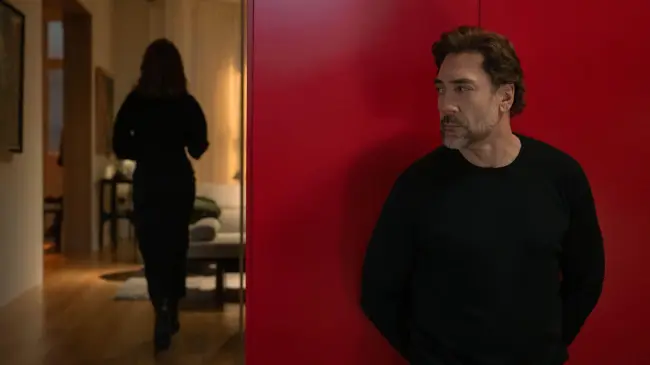
A paranoid drama that’s as airless and unsatisfying as the dead marriage that it dissects, the film stars Bardem as Miguel, the hottest architect on Earth in more ways than one. His career has greatly benefited as a result of his decision to relocate his family from their home in Spain to the minimalist glass mansion he’s designed for them in the heart of a gentrified London neighborhood, but the more accomplished he gets, the more isolated he appears to become.


His marriage to literary executive Sofia (a sorely under-written role played by Bardem’s real-life wife Penélope Cruz) has withered in the growing shadow of his celebrity profile. He can barely communicate with his phone-addicted teenage daughter, he doesn’t have any time to play with the younger one who’s nearing the end of her cutest years, and his every waking thought is consumed by the window-sized hole that his next-door neighbor (Stephen Graham) has just hammered into the wall that separates their properties. That’s when Miguel receives a heavily NDA-ed offer to design a doomsday bunker for a famous tech billionaire who’s even richer and more detached from the rest of humanity than he is (Paul Dano, whose deeply unnerving one-scene performance cuts to the core of Silicon Valley nihilism with a sharpness that makes him so much scarier than any of the other Zuckerberg-coded villains who’ve seeped into movies over the last 15 years).
If the success they’ve achieved has brought them to this, of what use was the success?
After “The Father” (extraordinary) and “The Son” (not), Zellner has returned with a characteristically bleak vision of the holy ghost; in this case, the invisible specter of fear that causes so many of the modern world’s richest and/or most accomplished people to isolate themselves from the rest of humanity in response to their good fortune. Similar to both of the writer-director’s previous films, the hermetically sealed “Bunker” hinges upon how the architecture of psychology is reflected by the psychology of architecture — it’s fascinated by how people express themselves through the spaces they inhabit and vice-versa. The “organic minimalism” of the mansion that Miguel has designed for his family reveals his utopian desire for light and transparency, but the house’s austere interior, hostile swatches of color, and walled-off garden betray the same closed-off severity that has started to distance Miguel from even his wife and kids.
What do you get for the man who has everything? The impossible peace of mind that no one is going to take it away from him. In a movie that doesn’t leave enough oxygen for laughter, the fact that Miguel is confused why Dano’s character wants to build himself a giant hole in the ground — secure enough to inure him against social collapse, ecological devastation, and even his own bodyguards — is maybe the closest thing we get to a decent joke.
Alas, for all of his brilliance, Miguel struggles to recognize the emergence of his own paranoia, let alone to identify its source. Zellner takes pains to ensure that no one else has the same problem. As heavy-handed as the glassy Volker Bertelmann piano score that often SLAMS on the keys like a jump-scare when the movie cuts to a new scene, “Bunker” is every bit as transparent as Miguel and Sofia’s house — a remarkable set built for the movie on a Madrid soundstage by production designer Alain Bainée. Perhaps it stands to reason that this movie is likewise much easier to see clearly from the outside in than it is from the inside out, but Miguel’s persistent obliviousness to his own mind proves maddening in the face of Zellner’s ham-fisted symbolism.
One example: Early in the film, the architect and his wife smirk at a series of identical black canvases in a London gallery, only to be informed that each of the pieces was unique and bursting with life before the artist smothered their beauty under a layer of colorless paint. Miguel, whose all-black wardrobe affects the uniform of a modern intellectual, might as well be standing in front of a mirror, but the haughty look on his face suggests that he can’t see himself in it (the despondent Sofia is drawn to a painting of a couple spooning in bed, but her husband doesn’t seem to take the hint). Later, after Miguel has been totally consumed by that petty disagreement with the neighbor who blasts a small chasm into his garden wall, the tarp that Graham’s character uses to cover the hole will look identical to the black paintings at the gallery, and even then Miguel will need a more visceral wake-up call before he’s shocked into self-awareness. In the meantime, his insatiable paranoia will be exacerbated by the missing family cat, and his decision to let the alarm company booby trap the house with fog bombs will literally blow up in his face.
Much of the story’s marital friction hinges on the fact that Sofia doesn’t want Miguel to accept the bunker project, no matter how big the commission might be; not only would the job would take her husband to Hawaii for months on end, it’s also premised on an every-man-for-himself end times ethos that runs counter to the principles they’re meant to share as a couple.
The “right” and “wrong” choices are plain as day, and so Zeller relies on Graham’s character to confuse the terms. Volatile, headstrong, and brimming with wild-eyed passive-aggression, the actor’s performance heightens the wall situation from a neighborly dispute to the stuff of a biblical trial. In fairness to the lad, if Javier Bardem and Penélope Cruz moved into a massive glass box right next to the rundown flat my working class family had been clinging to for generations as the neighborhood transformed around them, I would probably feel the urge to peek in on their lives as well. Of course, Graham’s job is to muddy the waters — to play up the socioeconomic biases of his screen persona so that viewers are willing to at least entertain the idea that Miguel has valid reason to be so afraid of everything. It’s yeoman’s work, but the “Adolescence” star is awfully good at it, even if his character is reduced to a moralizing punchline in the movie’s eye-roll of a payoff.
While the righteous and ever-watchable Bardem does as much with his implosive role as any actor could, Graham is this film’s most valuable asset, and it’s largely because of him that “Bunker” is fringed with an eerie tension from almost the moment it starts. It’s largely because of that tension, in turn, that the movie is able to disguise itself as a labored social thriller instead of a lunkheaded morality play, as Zeller’s well-crafted patina of suspense allows his script to power through its weaker subplots and threadbare existential concerns. Sofia’s PR tour with a flirtatious young author (Patrick Schwarzenegger), for examples, proves to be some very thin gruel, and it’s no surprise when the movie gives up on the character’s frustrated desires in favor of using her to shout its themes at Miguel, just in case anyone in the last row failed to pick up on the idea that their house has become a bunker unto itself. It’s bunkers within bunkers here — bunkers all the way down.
Zeller frames this film as a love story, and is eager — if maybe not quite eager enough — to mine a meta-textual thrill from the casting of such a famous real-life couple to play house for him. In a sense, we are watching Bardem and Cruz go about their day-to-day lives inside a massive glass box, and the challenge “Bunker” presents to them is to not shirk away from each other and themselves as a consequence of being so visible. It’s a challenge that Bardem in particular has confronted head-on with his inspiring commitment to anti-genocide advocacy, and, to the extent that it matters, this movie benefits from using actors who are so unafraid to own the courage of their convictions.
It would matter a bit more, I suspect, if the love story created for Bardem and Cruz to play out on screen was even the least bit evocative of that same vitality, even in a faded form, but — as Zeller’s film is prone to pondering — does anything really matter in the end? The tech bro is the pharaoh of our times, but the underground ark he’s hoping to build for himself has a better chance of surviving whatever comes next than he does.
None of this will be of much concern to Miguel and Sofia, or to us, in 100 years, and it’s rare for even the healthiest of marriages to last even half that long. The key to making the most of life’s bounty, Miguel learns, is to treat everything with the fragility it demands instead of spending your time fortifying it against the inevitable. To open windows instead of digging holes. By the time he learns that, however, most audiences will likely be far more concerned with looking for the nearest door.
Grade: C
“Bunker” premiered at the 2026 Venice Film Festival. Sony Pictures Classics will release it in theaters in the United States.