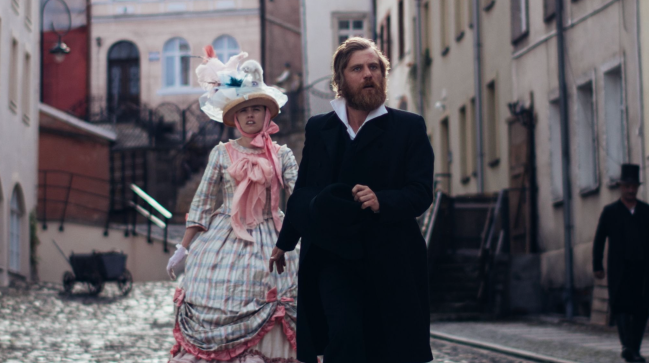
Broadly speaking, great works of Russian literature have a tendency to combine painfully austere themes with strangely rich imaginations. That rapturous clash, filtered through the paranoia of a guilt-driven crime thriller, helped make Fyodor Dostoevsky’s serialized 1866 novel “Crime and Punishment” a global sensation. But at the start of “The Idiot(s)” — Małgorzata Szumowska and Michał Englert’s semi-surreal account of the Russian author’s disastrous European honeymoon — success sends Dostoevsky (Johnny Flynn) into a fit of writer’s block that threatens to doom him and his new wife, Anna (Aimee Lou Wood).
At least as their marriage is presented here, the Dostoevskys probably shouldn’t stay together quite as long as they do. And even packaged as a multilingual fantasy, draped in some of the most outrageously lush production design choices this side of Joe Wright’s “Anna Karenina,” the making of “The Idiot” is nearly as frustrating to watch on film as it must have been to put on the page.


Szumowska and Englert make that misery work for them, to a point. Their ambitious film begins as the newlyweds arrive in Baden, where Fyodor’s fame attracts fellow travelers — including rival Russian novelist Ivan Turgenev (Christian Friedel). The suspense that draws these particular elitists toward the Dostoevskys is the same tension that made “Crime and Punishment” magnetic for contemporary audiences, and “The Idiot(s)” echoes the queasy allure of watching someone rationalize his way toward disaster.
Fyodor, meanwhile, struggles to transform his inner turmoil into the literal “Idiot,” an intimidating totem that eventually became a dense exploration of the writer’s views on innocence, jealousy, romance, and goodness. He proves as antagonistic as his fiction in “The Idiot(s),” repeatedly gambling away what little money he and Anna have while his wife scrambles to keep them solvent.
“Pain and suffering purify the soul,” he contends, as the titular idiots submit themselves for an unfathomable amount of both across an ultimately punishing two hours. Fantasies from the perspectives of husband and wife interrupt that decline, forming an almost circus-like pattern of mutual destruction. As Anna covers for Fyodor’s addiction and increasingly unstable professional behavior, her devotion starts to look poisonous for them both.
Visions of executing her husband dance through her head with wonderful humor throughout. Still, she stays — and Wood punctuates her best scenes by swinging wildly in tone alongside the script. Grounded in tragedy and yet evoking a consistent sense of wonder, the lady of the house looks less like a mirror for her husband than a magnifying glass held over his genius and grotesquerie. (“Tell me I’m a bad Russian,” he coos in one of many bizarre kink scenes exploring the intimate side of the Dostoevskys’ relationship.)
Opposite her, Flynn does some of his best work when he is positively rotting in Fyodor’s existential anguish. At a gathering with other artists, a seemingly playful party game culminates in an excruciating monologue about child abuse. And to Flynn’s credit, Fyodor is profoundly hateable. That’s plainly the point, but Anna’s love for him provides “The Idiot(s)” with its most poignant tether to reality.
Of course, it’s not a straightforward historical account. The screenplay — credited to Szumowska, Englert, Kasper Bajon, and Bríd Arnstein — draws from Andrew D. Kaufman’s biography “The Gambler Wife,” as well as Anna’s diaries, memoirs, correspondence, and other historical research. The real Anna first worked for Dostoevsky as a stenographer who helped him complete “The Gambler” in 26 days. She did not officially co-write “The Idiot,” but she lived through its creation while managing Fyodor’s gambling, debts, epilepsy, and precarious career. Their first child also died during these years abroad.
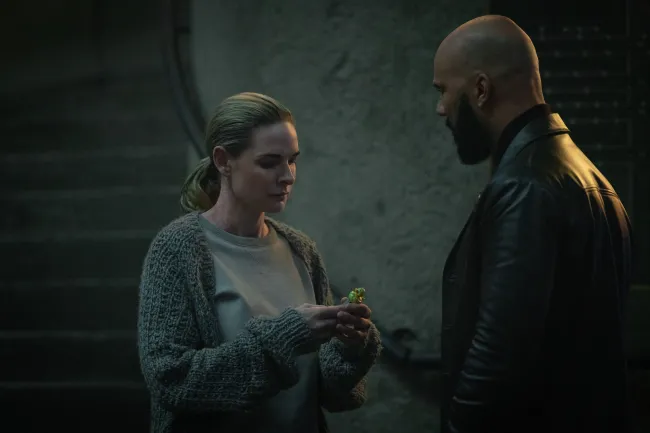
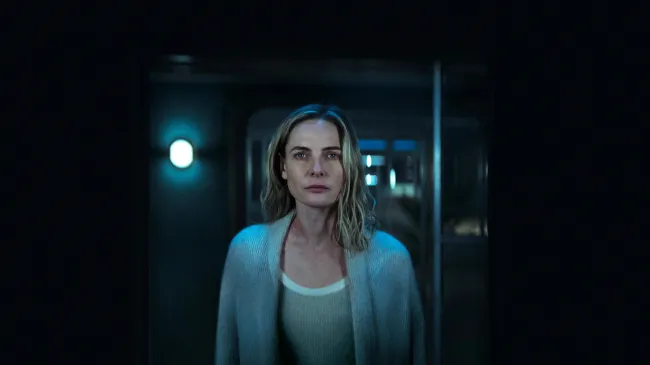
That distinction matters because “The Idiot(s)” knowingly mixes biography with manifestations of imagination. Vicky Krieps is a particular scene-stealer as the mysterious Natasha F, a spectral variation on “The Idiot” heroine Nastasya Filippovna who barely needs to speak to haunt the starring lovers’ marriage. That device makes this sideways biopic a particularly rewarding companion piece for devotees of the novel, but it also demands a daunting amount of prior knowledge.
Viewers unfamiliar with Dostoevsky may struggle to determine which women, flirtations, and betrayals belong to history — and which come from his fiction or are the original work of Szumowska and Englert entirely. That factual slipperiness might matter less if the psychology connected more deeply. But “The Idiot(s)” explores the novel’s themes without directly adapting or fully contextualizing them, leaving the intellectual exercise richer than many of the experience’s actual rewards.
The dizzying experience of imagining “The Idiot” will always exceed any attempt to render its spirit onscreen; this film never finds a substitute for the novel’s enormous interiority. That said, the surfaces are immaculate with Englert, serving as both co-director and cinematographer, moving through the Dostoevskys’ decline with astonishing care. Ewa Mroczkowska’s production design also turns dewy embankments, decadent interiors, and sunrises over cemeteries into visions of storybook-like decay.
There is no question that these years of suffering are, in their own way, beautiful. But the love enduring at their center feels so profoundly misguided that even this extravagant tribute, arriving more than 150 years later, cannot entirely defend it.
Grade: C+
“The Idiot(s)” premiered at the 2026 Telluride Film Festival.
Want to stay up to date on IndieWire’s film reviews and critical thoughts? Subscribe here to our newsletter, In Review by David Ehrlich, in which our Chief Film Critic and Head Reviews Editor rounds up the best new reviews and streaming picks along with some exclusive musings — all only available to subscribers.