Andrew Haigh is a master of restraint, a talent that he’s often weaponized against his own creations to beautiful and shattering effect. “All of Us Strangers,” his most powerful feature so far, achieved its singularly cosmic force by crushing Andrew Scott’s grief-stricken gay everyman under the weight of his own shame, the sharp but glancing angle of Haigh’s direction gradually freighting the character’s regrets with the gravity of a black hole.
Adapted from the Colm Tóibín novella of the same name (the rights to which Haigh reserved almost two decades ago, well before “Weekend” had first suggested that he might be a worthy steward of a famous author’s work), “A Long Winter” finds the English filmmaker a long way from home, but still on some very familiar terrain — and I don’t just mean the rugged American West, where he previously shot 2017’s “Lean on Pete.” Turning his attention to the fringes of a remote Colorado ghost town that seems adrift in a cold gray limbo between the heavens above and the world below, Haigh returns with another immaculately crafted and agonizingly repressed queer drama about the pains of self-preservation, the strength required to stand on one’s own two feet some day, and — most of all — the question of how people cope with their quiet desperation without compromising themselves to death along the way. Only this time, the director’s signature restraint does more to suffocate his protagonist than it does to set him free.


Much like its closeted young hero, the first-born son of a brittle family that’s been stuck in survival mode ever since the local mine shut down, the 1951-set “A Long Winter” is both sturdy as oak and withdrawn to the point of implosion. But Mike, in stark contrast to the even more diffident leads I’ve come to expect from Haigh, quickly makes clear that he refuses to be as reined in as the film around him (which in turn makes the film around him feel all the more constrictive).
Played by a resilient and clear-eyed Fred Hechinger, the enduring warmth of his performance a small miracle in a movie frigid enough to make “The Turin Horse” feel like a tropical breeze by comparison, Mike rejects the implication that he should be defined by his setting, or by how Haigh chooses to frame it. Here, his lead character isn’t dimensionalized by Haigh’s reserve so much as he’s at risk of being diminished by it. Easy as it is to root for Mike to slip out from his father’s petrified shadow and make his way to “the other side of the mountain,” as it were, Haigh’s film — despite brimming with exquisite detail and finely rendered feeling — is too snowed in to support him on that journey.

If nothing else, “A Long Winter” certainly offers a vivid portrait of where Mike is starting from. The film needs only a few shots to establish a palpable sense of place, as Xavier Dolan’s go-to cinematographer André Turpin renders the Rockies — played here by the mountains of Alberta — with a purgatorial sting that sinks deep into your bones as the story wears on.
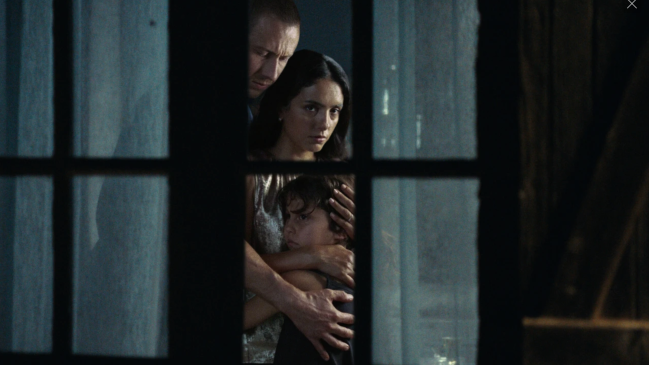
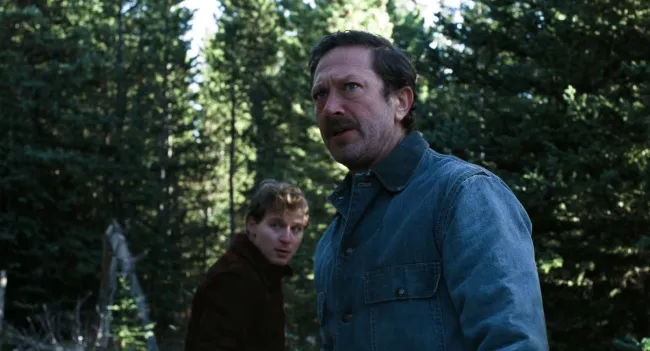
Mike first trudges into view wearing an entire L.L. Bean catalogue’s worth of flannel, and things get even frostier when he goes inside the house for supper. His pa Lester (a wounded Ebon Moss-Bachrach, showcasing a multi-faceted depth that his previous screen roles only allowed him to hint at) presides over the dinner table with a silencing chill, while his ma Louise (Caitríona Balfe), a defiantly cosmopolitan beauty who disappears into every glass she can find, prepares the food like a hostage who’s given up on more permanent hopes for escape. Mike’s younger brother Tommy (a Boy Scout-like Kit Connor) is the closest thing he has to a confidant, but he’s days away from shipping out to fight in Korea. He’ll probably die there, but we don’t get the sense that anyone is doing much living back at home. The house itself, a cold and creaky masterpiece of set work spearheaded by Emmanuel Fréchette, is more alive and expressive than any of the people in it, and we come to know every wooden step and leaky faucet of its design by the end of the film.
All the same, Mike claims to like things as they are. Skinning rabbits, chopping wood, and running interference between his parents. Living a dozen miles from their closest neighbor (who has a grudge with Lester), even further from the closest town (a downtrodden shell of its former self), and further still from any sort of hope — or temptation. Maybe he loves the familiar comfort of home, such as it is. Maybe he’s scared of learning about himself, and why his eyes linger on the hunky local cop who comes by after Louise suddenly disappears during the first major snowstorm of the season. Maybe he’s about to learn that such things aren’t mutually exclusive, or at least they shouldn’t be.
With Tommy in Korea and Louise vanished into thin air, Mike finds himself in direct confrontation with the questions that he’s managed to avoid for so long. The snows deepen, the power goes down for the entire season, and — as supplies dwindle in tandem with Lester’s patience — Mike begins to realize that he’s been stuck in survival mode for as long as he can remember. Coping is all that his family does up there, and he’s not the only one who’s keeping secrets.

Guileless but never without a burning if tentative sense of his own strength, Hechinger’s splendid performance keeps “A Long Winter” aglow during the frequent stretches when it threatens to freeze over. In a film that doles out plot with the stinginess of a precious resource, Mike’s probing challenges to his pa are what pass for major events, and while his frequent hikes through the snow quickly come to feel monotonous, there’s a terrific spark of frisson whenever he pushes back against Lester’s refusal to ask for help — one of several impulses that reflect his collapsing masculinity in the years since he lost his job at the mine. It’s to the movie’s great benefit that Moss-Bacharach doesn’t settle for the basic rage we’ve come to expect from such domineering movie dads, as his cuttingly self-protective moments of cruelty, all of them flashing across his ice-blue eyes, paint a sense of history that shouting would only serve to erode.
Nevertheless, there’s little tension in the tug-of-war between Mike’s opposite desires: that spring will come, and that winter will last forever. Haigh is reluctant — practically allergic to — prodding his characters towards personal growth, and Mike’s determination to assert himself so outpaces the filmmaker’s willingness to let him do so that at a certain point it feels like “A Long Winter” is more of an impediment to his self-becoming than it is a vehicle for it.
On the other hand, the film is, in some respects, well-served by eschewing the tropes of a typical coming-of-age-queerly tale. There are furtive glances, lustful dreams, and even a quick scene that hinges on an involuntary erection (a beat as underplayed as everything else here), but Mike’s sexuality is more a facet of the character’s burgeoning independence than it is its driving force. Ironically, that only clicks into focus when Lester hires a handsome indigenous boy named Jimmy (D’Pharaoh Woon-A-Tai) to be the woman of the house. Mike’s interest in him is obvious and seemingly mutual, but “A Long Winter” has no appetite for sex; instead, the film — delicately and without touching — positions Jimmy as a symbol that another world is closer than Mike thinks.
His ma was born just on the other side of the mountain, and spent every day of her marriage wishing that she could go back. “It wasn’t far,” she sighs before her disappearance, “but somehow it was.” It’s a distance that seemed to grow farther every day that Louise was stuck in that house, and one that Mike can only summon the courage to travel when he realizes that, per Haigh tradition, his parents were already ghosts by the time he grew up — that the grief he feels for Louise is better reserved for himself, and the life that he would forfeit if he stayed on the farm. As Jimmy’s abduction to Korea forces us to ask: What are any of these people really dying for? What use is there just waiting for the vultures to circle overhead? “Folks always find a way to cope,” Louise says. Perhaps that’s the problem, “A Long Winter” suggests, its warm embers of wisdom stuffed inside a dozen plaid layers of moribund grace.
Grade: B-
“A Long Winter” prremiered at the 2026 Telluride Film Festival. MUBI will release it in theaters at a later date.