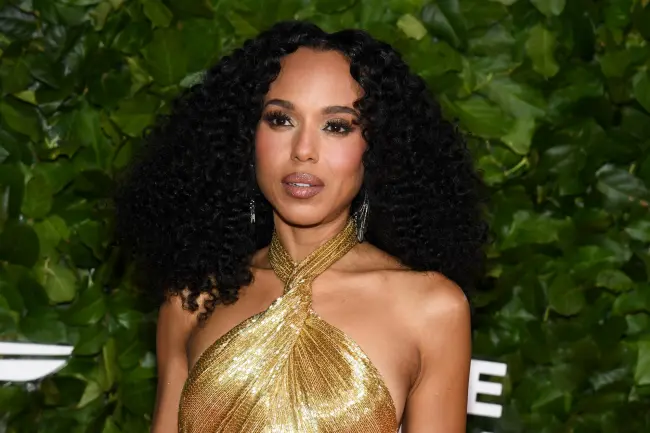
In 2012, Kerry Washington gave two of her most iconic performances — first on television in “Scandal,” a spring premiere that made its way to seven seasons and multiple Emmy nominations, then in movies when she played the female lead in Quentin Tarantino‘s Christmas release “Django Unchained.”
She looked back at both roles — and others, including her breakout performance in “Ray” and her most recent work in the Apple TV series “Imperfect Women” — last Friday night in a career retrospective conversation I moderated before the midnight screening of “Django Unchained” in Tarantino’s own theater, the New Beverly Cinema.
Washington remembered being excited — and frightened — by the audacity of Tarantino’s 1850s-set screenplay about a slave (Jamie Foxx) on a quest to rescue his wife (Washington) from the clutches of an evil plantation owner (Leonardo DiCaprio). “When I first read the script, I was terrified,” Washington said, “and I often feel like when I read something that both scares me and pulls me in, it’s the next thing I should be doing because it’s going to force me to grow.”


One of the big challenges for Washington, the rest of the cast, and Tarantino himself was telling their story in a way that would be true to the most shameful part of America’s history while also delivering the goods as an audience-pleasing action film — not an easy needle to thread.
“We all felt very passionately about telling this story in an audacious way, but also in a way that audiences would stay with us,” Washington said. “I understood from the beginning, when I read it, the nature of what Quentin was doing, that this film took place at a time when Black people were legally not allowed to be married and were considered three-fifths of a human being.”

That gravitas made the role of Broomhilda appealing to Washington, even though the character was mostly passive and a damsel in distress.
“Being the princess in the tower in this movie was an extraordinary act of forcing people to see our humanity, at a time when our humanity was denied. I knew that’s what Quentin was doing, and he and I talked about it, and it felt really important.” That said, Washington was still nervous about taking the job.
“There were a lot of actresses who wanted the role, but I think there were a lot of actresses who were like, ‘No fucking way,’” Washington said. The fact that “Django” would be a reunion with Jamie Foxx after “Ray,” where she played Ray Charles’ husband, helped alleviate some of Washington’s nerves. “Working on that movie changed my life, and I trusted Jamie so much. It felt like something I wanted to be a part of, and I’m grateful that I let my courage speak louder than my terror.”
Washington laughed, remembering Foxx’s response to her insistence on authenticity when they were shooting “Ray.” “Jamie Foxx always makes fun of me because when we were doing ‘Ray,’ there was a scene where our child had a birthday party, and the prop department kept bringing out lopsided cakes,” Washington said. “And Jamie was like, ‘What the fuck is wrong with these cakes?’ In my research, in talking to the real Della Bea Robinson, I had learned that she was a terrible baker, so I asked the prop department to make these imperfect cakes. And Jamie was like, ‘Are you kidding me?’”
Striving for authenticity was paramount on “Django,” where Washington got plenty of help not only from her research but also from simply being attuned to her surroundings while shooting.
“I read and reread a ton of slave narratives,” Washington said, “and we were shooting in Louisiana, where I spent a lot of time on real plantations. Not the ones that you could rent out for fancy weddings, but the ones that were committed to telling the true nature of the devastation, the atrocity of what slavery was in this country. We shot on an actual plantation, and it felt like we were staring at trees that were rooted in the blood of our ancestors.”
That environment made “Django Unchained” a tough shoot for everyone involved, and Washington and the other actors found different ways to cope with the history they were portraying.
“Jamie used to play gospel music in between takes, because it was so intense even for the background artists who were having to embody this part of our history that’s so painful and so dehumanizing,” Washington said, noting that she had two ways of escaping the weight of “wrapping my head around the institution, and how the institution lived in our bodies.”
The first way was to focus on an important aspect of her character: She had learned to speak German. “When the realities of slavery would get to be too much, I also was learning German every day, all day. And [costar] Christoph [Waltz] was very helpful,” Washington said, noting that the other thing that kept her busy was learning how to ride a horse. “I had never been on a horse before, and I had to have the kind of command that a house would explode and the horse wouldn’t run. So I took a lot of horseback riding lessons, and I really fell in love with my horse.”
“Django Unchained” was filled with grueling sequences, most notably a “hotbox” scene in which Broomhilda is locked naked in an underground box and then pulled out in a shot Washington said Tarantino modeled on a moment from “Dirty Harry.” “The scene was such a nightmare to shoot,” Washington said. “It was so horrifying, this woman locked naked in this box in the heat and starving for days. In preparation for the scene, I put myself on this very careful plan with my nutritionist to be very lean and look like I hadn’t eaten for days, and Quentin kept canceling the scene. It would be on the call sheet, and then he’d be like, ‘The weather’s not right.’”
Eventually, producer Pilar Savone, whom Washington met on “Django” and is now her producing partner, realized the toll the delays were taking and pushed to have the scene shot. “Pilar is the one who actually went to Quentin and said, ‘Unless it’s pouring, we have got to just let her do this scene,’” Washington said, noting that it was just one of several physically and emotionally grueling days.
“It’s hard to separate the physical challenges from the emotional challenges,” she said. “Whenever anybody asks about the whipping scenes, I know that because the two actors who were playing the slave masters were kind souls, that scene was as hard on them as it was on me. And there was so much love at the end of the day to try to be there for each other and say, ‘We’re stepping into these roles to tell a story that needs to be told. No, it’s not fun for anybody. It’s painful for all of us, but it feels necessary.’”

While Washington was shooting in New Orleans, “Scandal” premiered, making her an instant television star as political fixer Olivia Pope. Although the two characters couldn’t have been more different, Washington said Olivia and Broomhilda are linked in her mind.
“Those two characters really informed each other,” Washington said. “I don’t know that I would have felt as comfortable playing the powerlessness and the lack of agency that Broomhilda has if it hadn’t been bookended with playing the most powerful Black woman in the country.”
Playing Olivia Pope right before “Django” and right after “Django” was a liberating experience for the actress. “It really helped me to say I have permission to be all of who we are as Black women, and I’m not being pigeonholed,” Washington said. “I’m stepping into the full range of our experience as both a person who is deemed three-fifths of a human being in our Constitution and a person who is the most powerful person in the White House, other than the guy she’s sleeping with. I felt like Olivia Pope was Broomhilda’s wildest prayers come true, and that Olivia Pope could not have existed without the courage of somebody like Broomhilda, who was willing to fight for her freedom and escape the chains of slavery.”
The distinct differences between Broomhilda and Olivia Pope — “from hair texture to costume,” as Washington noted, pointing out that Olivia also had three-page monologues while Broomhilda barely spoke — speak to the range that Washington has continued to exhibit in the years since, both in the variety of her roles and their platforms. She’s comfortable moving between film and television, between episodic broadcast programs like “Scandal” and streaming limited series like “Imperfect Women,” and has also done acclaimed work on the stage in shows such as David Mamet’s “Race” and Christopher Demos-Brown’s “American Son.”
“I love challenging myself and doing new things and changing it up,” Washington said. “I’m always drawn to do something that’s different from the last thing I did, because I think it keeps me sharp and it keeps me interested. I am a curious person, so I gravitate towards things I don’t quite know or understand. But when it comes to choosing projects, often it’s, ‘Do I want to see this? Does it scare me a little bit? Do I feel like I can be additive? Do I feel like I can be proud of it?’ I think I’m now at a point where I really am focused on directors, because I want to be challenged. I want to work with people that will help me discover new things about myself.”
That’s why, in her role as executive producer on “Imperfect Women,” Washington gravitated toward directors like Oscar and Emmy-nominated filmmaker Lesli Linka Glatter (“Twin Peaks,” “Homeland”), who created the visual language for the series in the first episode before going on to direct episodes 4 and 5. For Washington, having a say in who directs — and in many other aspects of filmmaking that have more to do with what goes on behind the camera than in front of it — has made producing a priority.

“I really love producing because I’m a bit of a control freak,” Washington said. “As an actor, I never loved the feeling of being a pawn on a board. You feel like you’re sitting at home waiting for somebody to invite you to a party. I much prefer to throw my own parties, or at least be part of the party planning committee and have a say in what kind of party it is and who gets invited.”
Most challenging on a show like “Imperfect Women,” where Washington has to play every note on the emotional scale as a woman dealing with all the complex feelings and repercussions that follow a friend’s murder, she has to keep her eye on all the larger details while also doing some of the most challenging work of her career as an actor.
“There are times when I say to Pilar Savone, ‘You do not have access to me as a producer for the next 10 hours. I’m just going to be acting,’” Washington said, addressing the importance of sharing responsibilities with the producing partner she met on “Django.” “I have a real dialogue with Pilar because I still work with coaches. I work on material. I break my scenes down with early scene study; I’m very interested in understanding every line and the language and the motivation and the conflict and all of that. I like to be a nerd when it comes to the work as an actor. So having a strong producing partner is a big part of that.”
Meeting Savone on “Django” was just one of many ways the film changed Washington’s life, though at the time she was quite nervous about the potential reactions to it. “I knew that being the lead actress in a Quentin Tarantino film could be a career-changing moment,” Washington said. “I knew that this was the kind of film that if it worked, it could be a game changer for me and do that thing where suddenly you’re an overnight success even though you’ve already been acting for 20 years. But we were all terrified that this was not a guaranteed thing. I knew that the film would be huge because it was Quentin Tarantino, but I didn’t know if it would be a hugely terrible thing or a hugely wonderful thing.”
Even before the film opened to box-office success and multiple Oscar nominations (including wins for Christoph Waltz in Best Supporting Actor and Tarantino for his screenplay), Washington knew it had been worth the risk. “I believed in the story, and I believed in the cast, and I believed in Broomhilda,” Washington said. “I remember finishing shooting the film and calling a really dear friend of mine and him saying, ‘How did it go?’ And I was like, ‘There’s nothing I can’t do.’ That’s how I felt after I finished this movie. It really gave me wings.”
“Imperfect Women” is currently streaming on Apple TV.