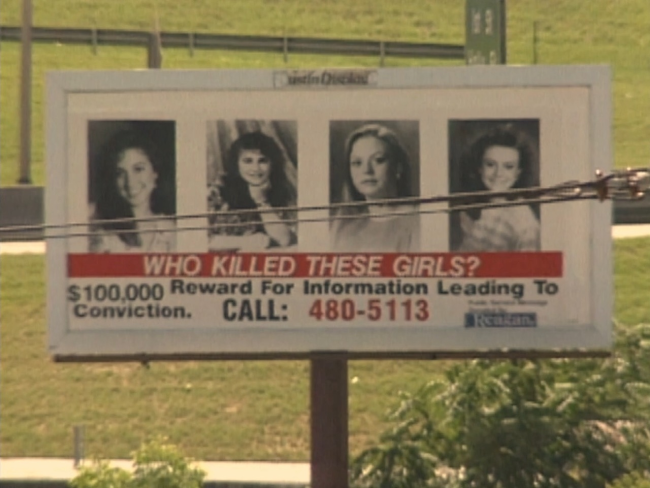

When HBO Documentary Films approached veteran non-fiction filmmaker Margaret Brown (“Descendant”) with the twice-Emmy nominated four-part series “The Yogurt Shop Murders” (A24, HBO), she was happy to stay home for once. The brutal unsolved murders of four teenage girls in December 1991 had been a subject of discussion in her own hometown of Austin, Texas for 34 years. Everyone had a theory about who was guilty. “People were obsessed with this crime,” said Brown on Zoom. “I cannot explain to you just how much it lived in the city.”
But Brown was also compelled by the years-long impact of this mystery on the grieving families of the victims, the frustrated detectives trying to solve the crime, and the four unfortunate men (Forrest Welborn, Robert Springsteen, Michael Scott, and Maurice Pierce) who were accused of murder. Three served prison sentences from three to ten years.


They were given a real reprieve, finally, when advances in DNA technology allowed Detective Dan Jackson to find a DNA match from under the nail of one of the victims. Serial killer Robert Eugene Brashers was long dead (and never appears in the first four episodes), but the DNA findings exonerated the falsely accused. When Brown’s pal Jackson confirmed the news, she was in Mobile, Alabama. She dropped her dog and car with her parents and flew to Austin. Two days later, she jumped into a follow-up fifth episode, catching up with all the players.
The first four episodes develop a strong non-fiction narrative about an unsolved crime. But the fifth episode changes the whole story. Brown and HBO had two days to decide what to do. “They pretty much were, ‘Let’s just go,’” said Brown. Jackson had already spoken in the fourth episode about hoping DNA would unlock the killer.
“There was the families, and then there’s the boys, who I’ve never talked to before,” said Brown. “I didn’t think they did it in the first place. Still, some people still thought they did it, and policemen were still harassing Forrest. We were shooting, and they were still harassing him. At one point, I had to say to Detective Dan, ‘People are harassing Forrest’ after the series had come out.”

One of the disturbing elements of the story is how little the victims’ families seem to care about the imprisoned men whose lives were destroyed. “I had to interview [the families] in the days after this happened,” said Brown. “They’ve been told for years that these boys did it. They were so in shock. This was the first time where we know who did it. Like their brain hasn’t adapted yet. Shawn Ayers says, ‘I didn’t have room for that yet.’ Like he’s still processing. His fucking sister was killed by a serial killer. People should have a lot more compassion for that.”
One reason the DNA match took so long was that the yogurt shop crime scene was set on fire and then doused with water. There was almost no DNA to collect. “They had microscopic amounts of DNA,” said Brown. “They had enough to do this, having the DNA from Brashers. That was the only way they could test it against what was under the fingernails. If they hadn’t had his DNA to test it against, they wouldn’t have had enough DNA. Because every time you test DNA, you use it up, you can’t retest.”
Another disturbing aspect of the case was its impact on the people trying to solve it. One homicide investigator, John Jones, gets so worked up at one point that he broke down in tears on camera. His life is in shreds. On the other hand, detective Paul Johnson, who wrung out false confessions from the four boys, never expresses any remorse.
“Also the jury is responsible,” said Brown. “Also the whole court system is responsible. Also the defense was given some faulty information. It’s systemic. It’s not just Paul Johnson. He doesn’t cop to it because if he admits that, he is responsible, so he’s not going to admit it. He wants to think of himself as a good person.”
The series is informed by a rich trove of archive material. The production had given her some material, but no one had really looked at it. Claire Huey is a documentary filmmaker who conducted interviews with the families soon after the murders, but never finished her own film. The first thing editor Mike Bloch found was when Huey asks one of the parents: “Can you talk about when your daughters were murdered?” And the woman answers.

“Not everyone wanted that to be the end of the first episode,” said Brown, “But I’ve never seen anything like this on TV before, and it’s so powerful, and the way she goes through it in real time and with humor and grace, and you are with her while she’s talking about it. It was incredible. We fought to have that because it’s not like your normal cliffhanger. Are people even going to tune back in again? It’s so mesmerizing. But it’s also pretty dark.”
While crime series have taken over the documentary field, films and series like “The Yogurt Shop Murders” or “The Perfect Neighbor” do provide positive outlets for the victims. “It’s complicated,” said Brown. “The whole time we were making it: ‘Can we somehow subvert the genre?’ I started listening to true crime podcasts when I was going to make this and two women said, ‘Raise a toast to murder,’ and I was like, ‘Fuck you! What is wrong with you?’ The bit that I did listen to felt like peering at it as an outsider and not acknowledging that we all can’t avoid pain, can’t avoid suffering. I did think at a certain point, ‘Should we even be making this, or is this just disgusting? Are we taking advantage of people to have a show on HBO?’ I don’t want to do that. That’s not why I make movies.”
Brown is clearly an empath who can read people in an astute way. Over four years, that was a lot to absorb. At a certain point, the filmmaker called HBO and requested therapy for herself and her crew, who she works with on all her films. “I do need to protect myself more,” she said. “My DP Justin [Zweifach] and I are kind of porous, and that’s what makes people trust us. At a certain point in the story, everyone working on it was calling me, like, ‘We have to quit. This is too much.’ My editor’s having nightmares. It’s seeping in, it was affecting people on the crew. And on the other hand, everyone has had trauma in their lives. There were people working on this project purposefully to work through some of their own stuff. The therapy helped a lot.”
Brown would do long, emotional interviews. On the fifth episode after she spoke to Brasher’s daughter Deborah, “I had to go and walk around the block in the middle. I felt for her so much, I thought I was going to throw up. I had to take a break.”
It was no surprise that Brashers wanted to talk. “Sometimes talking to an empathetic person is a way to work through things,” said Brown. “She wants the families to know that someone in that family cares, and it’s beautiful.”
As for the surviving murder suspects, Brown didn’t get to all of them. Springsteen, who served ten years, abstained. Pierce served three. “They’ve all been dragged through so much, and it’s overwhelming. I saw them being so traumatized and overwhelmed,” she said.
While he was arrested and detained, Forrest Welborn emerged more intact. Two juries refused to indict him. His bar in Austin is a place for people who don’t have anywhere to go on Thanksgiving or Christmas. “I love Forrest,” Brown said. “His mother makes food for everybody. He’s the nicest guy. He’s so kind. He’s so scarred.”