
It’s a well-known misconception that absolutely everyone who works in film and TV has earned Scrooge McDuck levels of wealth from doing it — they do not. But California state and the City of Los Angeles have long taken that for granted that, even when productions go elsewhere to shoot films or TV shows, they’ll come back to L.A. for post-production. No longer.
There’s a whole confluence of factors, a “perfect storm,” as editor Erik Anderson told IndieWire, that are accelerating the outsourcing of post work from California. There’s the end of the streaming wars on TV and tightening of budgets and changing of models, as well as corporate consolidation and the specter of AI eliminating white-collar work of all kinds. Every department that works on film and television has felt this pain, and post-production teams are no exception.
Post-production work has been slowly bleeding away over the last decade or so. But the situation has become so dire in the last three years that the California Post Alliance (CAPA) formed a year ago to advocate for a specific post-production tax credit in California, where the bulk of Hollywood’s post-production workforce is located. When that workforce has been having to stretch work or go without work for 13 months, 15 months, and decades-old guild members find that they have not worked enough union days to qualify for health insurance, the situation tips toward crisis.


And, of course, on top of all of that, there are tax credits designed to lure productions — and sometimes post-production — elsewhere.
“Other jurisdictions, such as Canada, UK, Ireland, Georgia and New York, have created stand-alone post-production programs and/or specific uplifts, to try to incentivize projects to move this work, with varying levels of success,” Sarah Westman-Liu, director of tax incentives and products at Entertainment Partners, wrote to IndieWire.
But according to Westman-Liu, the most successful post-specific tax programs have been in places where the local industry is already strong. Like the New York and New Jersey area, where, for instance, the second-highest number of members in the editors’ guild, IATSE 700 Local, are located.
“While incentives and/or lower-cost territories can be a sufficient draw for filming or VFX contracts, they may not move the needle enough for post-production work to be relocated. More often than not, even when a production is shot in another jurisdiction, the post-production work will still typically be brought back to L.A. (or sometimes N.Y.),” Westman-Liu said.
The squeeze on post-production in Los Angeles, then, likely has as much to do with fewer productions as it does with productions going elsewhere. There’s a visceral sense of that squeeze on the ground, too. “There’s fewer films being made, so there’s fewer things being cut,” editor Wendy Smith told IndieWire. “People started being able to cut their kids’ soccer games and stuff, so they think, ‘Oh, editing. I can do that.’ First, you have to have an eye. You can learn, but it’s a craft, you know? And it’s fun. And it’s very time-consuming. Editing is like a snowflake. They all look the same, but everybody does it differently.”
But that means anything California legislators can do to keep productions in L.A. will benefit post teams.
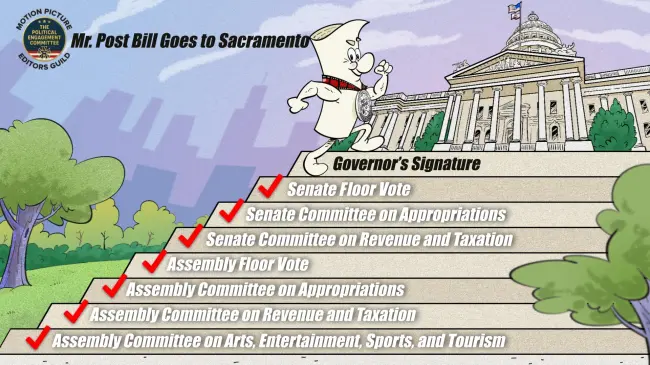
Enter a California post-specific tax credit, California Assembly Bill 2319, introduced by Assemblyman Nick Schultz. The bill passed through its last reading in the California State Senate on August 30. Gov. Gavin Newsom now has 30 days to sign it into law, although this year the bill only allocates $10 million to begin the program. Creating an appropriation for $100 million in tax incentive funding, which the bill’s sponsors and advocates hope for, will have to be something they fight for in next year’s budgeting cycle.
But both professional and civilian advocates of the bill have been blown away by how the post-production community rallied behind it. “Basically labor, government, advocacy groups, even studios — we ended up getting support from Fox, Sony, Warner Bros. and Disney — then the TV Academy, the Recording Academy, our craft guilds and unions, and our legislators all came together. It was truly a team effort,” Marielle Abaunza, CAPA president, told IndieWire.
Daniel Williamson, an editor and union steward in IATSE Local 700, which represents film editors, told IndieWire it was heartening to see AB 2319 move quickly toward becoming law. “I’ve never called state representatives before and to call them and advocate for the bill and be told by staffers that they’re getting tons of calls in? It definitely feels good to be surprised. We’re always so doom and gloom about good things happening, so something that seemed far-fetched, probably not gonna happen, moving fairly quickly, and hearing responsiveness from elected officials is always a nice surprise.”
“ This has been the most difficult but inspiring work that I’ve ever done because this organization was formed out of need. It was a desire to come up with a solution for a problem that we were all feeling and experiencing and seeing in our post-production community,” Abaunza said.
The AB 2319 campaign is perhaps as important to post-production artisans, in the short term, as a rallying point and sign of surprising optimism, a corrective to the idea that there is no future, no more career, to be had in the industry.
“ We self-train and pass on our knowledge to the next generation, and that’s now starting to cease. Because for me, when I’m approached by a young, hungry student, I don’t know what to say to them,” Anderson said. “ You can definitely shadow me, and I’ll teach you everything I know, but I don’t know if you’re gonna have a career. Maybe you’ll have five years in the business, and I don’t even know where the business is going.”
“ I feel like Los Angeles still has quite a large market share of productions that are being made, but I think that production share has decreased,” Williamson agreed. “Atlanta and New Jersey and New York — right now I keep hearing New York is apparently doing really well. But it’s also just really hard to tell. I wish that there was an alternative to just the carrot, right? I think we need tax incentives, and federal tax incentives would be a huge boon. But I would love to find some way [to keep productions in LA] because I don’t feel like our studios should be outsourcing our culture.”
For now, there’s the potential of a carrot in AB 2319. The rest will have to follow.