[Editor’s note: The following interview contains spoilers for “Toy Story 5.”]
Growing up, Kenna Harris would spend hours drawing and redrawing the scene from “Toy Story 2,” one of their favorite animated films, in which Jessie sits at a windowsill and tells Woody her traumatic experiences with her first owner, Emily. Harris’ passion for art eventually led them into an animation career and to join the Pixar staff, where they directed the “Luca” spinoff short “Ciao Alberto” and served as the “Inside Out 2” story supervisor.
At Pixar Braintrust meetings, where the studio’s creative team hashes out ideas for their upcoming projects, Harris met Andrew Stanton, who approached them with the first draft for the “Toy Story 5” script and gave them an offer they initially thought was a joke: to serve as his co-director on the film, which would explore more of Jessie’s backstory that captivated them as a child.


“‘Toy Story 2’ was a very important film for me. I remember seeing it in theaters. I was super impacted by its quality. I was like, ‘Wait a minute, movies can be good. This one is really good,’” Harris told IndieWire. “It’s so surreal to be a part of the franchise in this way, but also in a way, I didn’t ever feel too much pressure, because when you grow up with the characters, you know them so well, so it was like, ‘Oh yeah, these are my friends, and I’ll just write a movie about them, it’s no problem.’”
Harris accepted the co-directing position but also asked Stanton if they could contribute to the film’s writing process. The latest installment shifts focus from the dynamic between Woody and Buzz to Jessie, telling a story about the encroaching role of technology in children’s development. Stanton agreed to test Harris out, and quickly, the two found themselves in sync as creative partners — Harris refers to the director as “my best buddy and my older brother that I never had” — leading to Harris getting their first screenwriting credit on a feature film.
“It turns out me and Andrew Stanton have a weird psychic connection and can read each other’s minds,” Harris said. “There was this initial reasoning behind our pairing where folks were like, ‘Well, that’s good that Kenna is with Andrew, because he’ll provide all of the wisdom and experience, and Kenna will provide the fresh perspective.’ And there were aspects of that, but at the same time, right away, me and Andrew were always on the same page about what we find entertaining, what we loved about our childhoods, and how we played, and what we kind of instinctually wanted to explore dramatically on the film.”
Ahead of the film’s release, IndieWire spoke to Harris about the three-year process of bringing the “Toy Story” franchise back to cinemas, what was left on the cutting room floor, and why there should be more kisses in Pixar films.
This interview has been edited and condensed for clarity and length.
IndieWire: When you’re making a follow-up to a franchise as beloved as “Toy Story,” how do you think about making it feel fresh and new?
Kenna Harris: So much of it was all playful process with Andrew and with our story team, which is this equal mix of folks who have worked on almost every single “Toy Story,” and younger folks like me or younger than myself who have grown up with the characters. The nostalgia comes naturally. A lot of the things are baked into “Toy Story” DNA, you don’t have to work as hard for, but then the other side of it, of like, how do you keep it refreshing? A lot of it came from us that had been fans of the series for so long, declaring a wish list to Andrew, of, “Well, what if this happened, what if Woody has a bald spot and we make fun of him relentlessly?”
So was Woody having a bald spot your idea?
No, I was responsible for a lot of the Buzz and Jessie romance side of things. But it was our story lead Steph Waldo, during this infamous brainstorm that we had, who had drawn all these drawings of Woody with a bald spot and a little dad belly. There were other ideas, too, that didn’t make it into the film. We wanted to have him be sun-bleached from all the time he spent with the Lost Toys. But during this collaborative session… we were all like, “All right, yes, Woody’s going to be in this film, we love and respect him, but also, what if we really put him through the ringer?”

You mention the Buzz and Jessie romance. Were you the one who came up with the toy weddings that bookend the film?
A toy wedding started with a pitch from [the story department], which was just for Forky and Karen Beverly’s wedding, the first wedding in the film, as a way of representing Bonnie’s playtimes. The following wedding, the climactic wedding, came from a very vague place, where early on, on my own personal wish list, coming into the film with Andrew, I told him, “I don’t know what it is, I don’t know what’s making me feel this way, but we got to have Jessie and Buzz smooch. It’s gotta be big. I think it’ll be a part of, I don’t know how, a climactic action sequence.” He was on board, and from there we came up with ending the film with another wedding between Jessie and Buzz to celebrate not just Buzz and Jessie but the newfound friendship between Blaze and Bonnie. But I’m always a big campaigner for kisses in pretty much every Pixar film we make.
The toy weddings and the moments when we peer into the kids’ imaginations have a softer, pastel look. It’s strikingly different from what I think of as the Pixar house style. Visually, how did you create those moments?
From the get-go, we had this goal for Bonnie’s playtimes where we wanted to set them apart from the way that Andy’s playtimes used to feel, and so that, of course, came to visuals. Of course, we really illustrate her imagination quite literally. It feels artsy and craftsy, just like Bonnie is, but it also has this kind of mind’s-eye feeling versus the traditional cinematic look that Andy’s imagination had. Andy, in previous films, he was almost Spielberg-esque playing with his toys; there’s a clear throughline, where Bonnie is much more chaotic and a bit of a gremlin. It took a lot of work on our end because it’s a lot more natural for Pixar to make photorealistic things. You would think that’s the more difficult task, but if anything, Pixar can, in their sleep, make things look like the way they do in real life. We needed to put a special team together in order to make it happen, to build the right tools for those particular sequences. We were chasing after something that felt fleeting and ephemeral, so the second you move the camera things can disappear and change on a dime. You’re really playing like fast and loose with rules, and we got to pull back so much on detail. Everything has this kind of hand-drawn pastel feel, all these details that feel like she might have done the finishing touches on a lot of the set design.
The big driving hook of the film is that Woody and Buzz take a backseat while Jessie serves as the main character, and the story revisits her backstory, which we heard about in “Toy Story 2.” How did you figure out how to bring that arc to a close?
The thing that changed the most over the course of three years was how we wanted to tell Jessie’s story. On one hand, it required a lot of us diving into her and trying to ask ourselves, “What would I need if I had been in her shoes, if I felt so much burden and blame from being rejected by someone I loved in the past?” But another big key that unlocked things for us was when we found our central theme — this idea that even in the shortest amount of time, you might make an impact on someone, or have a relationship that changes everything, and you might not ever know that you gave that gift to someone. It was there where we started to go, “OK, what does Jessie need that reflects that kind of message?” In the last year of our production, we landed on the scene at the tree where she discovers Emily’s named her daughter Jessie. That felt satisfying, and like it was talking to the whole movie, and not just us writing fan fiction about Jessie. It was something that could hold a “Toy Story” film together.
That’s surprising to me that it took until the final year of production for that scene to be developed. What was in its place?
There were just different versions, essentially. When we’re making the film, “Toy Story 5,” in particular, we had roughly seven or eight screenings, so seven or eight times where you’re going up to bat and you’re showing an audience, and it’s all with the intent of getting feedback. Each time, we were trying different things with Jessie’s storyline, and it was always roughly had to do with Emily and Jessie getting resolution from that relationship, but the specifics were something that happened late in the game.

The biggest swing the film makes story-wise is the running side plot about the horde of Buzzes that doesn’t intersect with the main story until the third act. How did that arc develop and why did it feel in tune with the themes of the film?
50 Buzzes were in the first draft, which took me a little bit to be sold on, frankly. Andrew kept saying “No, they’re definitely in the movie,” and I was like, “Really? Are we sure about that, Mr. Stanton?” Once we started really getting a handle on Jessie and these themes around tech that we’re talking about, the balance of simple toys versus high tech, it became more and more clear what the Buzzes needed to deliver on.
My doubts were kind of quenched once I started watching the reels with these Buzz sequences, because Andrew always had a very clear vision for them, and they’re such strong examples of visual storytelling. They are breaks throughout the movie where you get to watch these characters with a very simple goal, and you see them in these funny ways chase after that goal. You’re not bogged down like we usually are in plenty of films, our films included, with the need for constant talking or the need for context. It’s really nice, cinematically, to have that as a refresher throughout the film, and then to have the Multi-Buzz — that’s what we always called them on the crew, the Multi-Buzz — they ultimately are a way that Buzz can come into his own as a deputy for Jessie, and represent this reverence that we have for Jessie. I’m glad we figured out how to do that, because at first screening I was like, “I have no idea how that’s gonna work.”
You mentioned these themes of high tech versus simple toys. How much did the team talk about the debate over the role technology plays in kids’ lives while you were making the film?
Early on in the making of the film, it was very apparent that all of us as filmmakers and as young people and as parents have very loaded emotions about tech right now. A lot of people’s instincts across the board were, ‘Can’t you just make Lilypad the villain and make her evil, and at the end, wouldn’t it be so great if we could just chuck her into a flaming pile of garbage, and all of our problems will be solved?” There were a lot of issues with that. It didn’t sound very exciting and it didn’t sound very fun to watch a “device is bad” movie. It also didn’t feel like an honest reflection of the truth of our lives right now, which is that we are stuck with our devices, there’s not really a way around it, and they’re a very important part of kids’ lives right now. There can be consequences to too much tech, but they’re how kids connect with each other and with their learning and with games. It was the connection aspect that really unlocked the rest of the film for us. That was where we started to go, “Oh, you know what toys do too, and what imagination does?” It connects us to our human desire to be curious and playful. It connects us to other people in this really authentic way. And in the same vein, we just wanted to show the nuances of how connections via devices.
There’s this dynamic early on in the film where the audience, seeing things from Jessie’s perspective, really hates Lily and sees her as a villain. But eventually, we see her as more nuanced. How’d you crack her arc in the film, where she goes from an antagonist to the toys to a collaborator?
It started off from this question around, “What does Lily want?” Right away, we’re kind of resting on this idea that she wants to do right by Bonnie, she wants to raise her kid correctly. She is coming at that with a very techie perspective. She’s got the data that shows what to do in all these different situations for Bonnie. She knows that what she’s made for is to connect Bonnie to friends, and clearly that’s what she needs if she’s lonely. And Lily can do that in seconds, she can outpace the toys in every single way, and all she really is lacking is experience, which Jessie and the toys have in spades. She’s lacking just time with Bonnie, and time to understand her kid, and how her kid just might not be like all the other kids in that data set.
Casting Greta Lee was huge for the development of Lilypad in the film, because characters of this nature, she’s a little bit of a control freak, you ask yourself as a storyteller, “How do we have fun with her, and how do we make her likable too, and warm?” And Greta was just so perfect. She nailed what I think really sounds like a device-like character, this clipped pace that feels a little bit binary and pre-programmed. But she’s also, it just struck me from the first recording onward, funny. She’s a very naturally funny person, and she also, as a person, was just so excited to dive into this character, because she also has young kids who are figuring out life with devices. Casting her really opened up, I think, the full range of appeal that Lilypad ultimately has in the movie.
Do you have a favorite moment or character that got cut from the film at some point during the process?
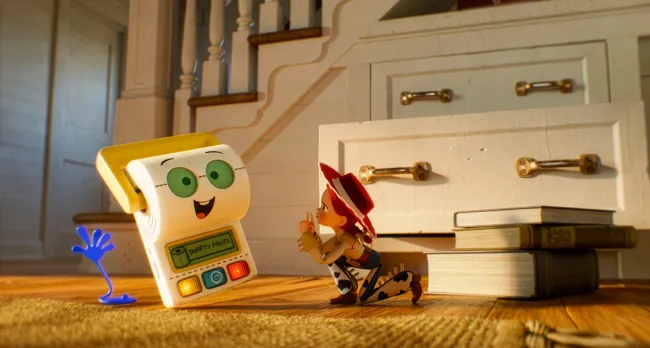
We had a cut Tamagotchi character who was supposed to be a part of the group of outdated tech with Smarty Pants, Atlas, and Snappy. For several practical business reasons — we figured we probably couldn’t get the deal approved — we had to cut him. But there’s a version of Blaze’s playtime with Jessie where Smarty served as the twist villain in her spy story, and kidnaps the Tamagotchi, who was a baby in the playtime. So we got Conan O’Brien to record this crazy line in a silly accent: “I’m going to do something very bad to this baby.” We had it all recorded and ready, and then finally, after screening it, we realized we needed to retool the playtime section. That’s one I mourn. It would have been so nice to keep.
“Toy Story 5” is now in theaters.