The first genuinely great episode of “Avatar: The Last Airbender” is its third: “The Southern Air Temple.” After the two-part pilot nimbly establishes the show’s central premise — an East-Asian-inspired fantasy universe where people can control the four classical elements via martial arts skills known as “bending,” a century-long campaign by the Fire Nation to conquer the world, and the messiah-coded Avatar figure who needs to save humanity — the follow-up, which sees main character Aang journey back to his home after a hundred years frozen in an iceberg, is where the show unlocks its emotional hook.
A 12-year-old boy who fled his home out of fear of the responsibilities that came with his position as the Avatar, Aang arrives at the long-deserted Temple blithely in denial over the extinction of his people, and focused more on chasing a cute flying lemur than on interrogating what’s changed since he was thawed from ice. His innocent demeanor only makes the episode’s climax, where he discovers the corpse of his beloved father figure rotting in the snow and enters an uncontrollable state of rage, all the more painful. Crucially, though, Aang still has time, after his friends Katara and Sokka calm him down, to find that lemur and take him along his journey to save the world as a pet.


Over the course of three seasons, “The Last Airbender” became one of TV’s most compelling dramas in part because it embraced the tension inherent in telling a story about war, genocide, and prejudice to an audience of children. A fusion between the goofiness of American cartoons and the adrenaline of Japanese action anime, “Avatar” didn’t shy away from the reality that its central characters, aged 12 to 16, were child soldiers attempting to fix a world broken by their elders, but it also allowed them to goof off like real kids. The show’s comedy only made its bleakest moments more upsetting and dramatic in contrast, while the drama made the visual gags and slapstick more charming. There was space for Aang to reckon with his guilt over the death of his people, and for him to adopt a really cute, silly winged lemur named Momo.
But where does the franchise go when the audience that first fell in love with it has aged beyond Aang and are now full-grown adults? That’s been a question plaguing “Avatar” past the original show’s finale in 2007. The flawed — but at times genius — “Legend of Korra” sequel series tried to age itself up for teens with a smattering of love triangles and angst, and found more success in its latter seasons by reckoning with the shades of grey Aang’s more clear-cut heroic arc didn’t fully acknowledge. The attempts to adapt the original series for live action, first by M. Night Shyamalan via his 2010 film and then by Netflix in 2024, sucked the whimsy and color out of this world in favor of dire, stuffy self-seriousness.
The latest attempt to expand on the franchise comes as “Avatar Aang: The Last Airbender,” a feature film that expands upon the lives of Aang and his beloved supporting cast past their victory over the Fire Nation in the finale, a time only really hinted at in “Korra.” Led by a creative team of veterans to this franchise — director Lauren Montgomery worked on the third season and was supervising producer on “The Legend of Korra,” while original creators Michael Dante DiMartino and Bryan Konietzko have story by credits — it’s clearly looking to meet old adult fans, now nostalgic for the show, where they currently are.
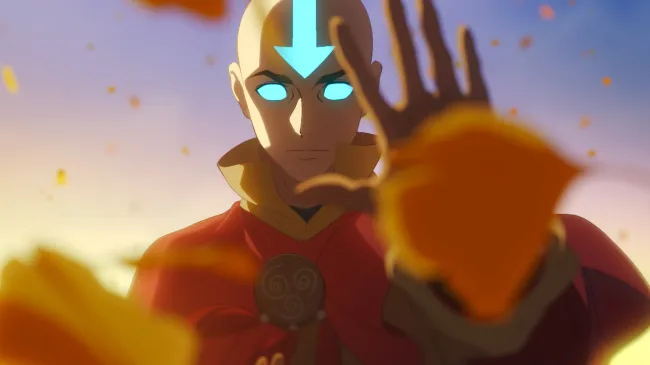
The result is a visually stunning work of animation, and one loaded with enough callbacks and references to the original that it will probably satisfy the show’s very devoted fanbase. But in aging up the characters, “Avatar Aang” loses touch with the charm that made the original show so beloved in the first place.
“Avatar Aang” arrives on Paramount+ — and New York and Los Angeles theaters, where it’s playing a very quick Oscar-qualifying run — after a tumultuous release history that includes an extremely widespread online leak of the entire film in April 2026, and a canceled wide theatrical release that shifted to streaming only. Fans at the time complained, but streaming feels sadly appropriate for the film, which — constrained by its status as a midpoint between two completed TV shows — tells a story of limited real emotional or material consequence for its characters. Like “The Mandalorian and Grogu” or a Disney direct-to-DVD sequel, the film often feels like a season of TV stuffed into an 80-minute runtime, without the space to flesh out the conflict into something with real meat and gravitas.

It picks up with Aang (voiced as an adult by Eric Nam) now a tall and disconcertingly buff young adult working to promote peace between the different nations by building a multicultural Republic City in which people of all nations are welcome, journeying again to the Southern Air Temple to find relics of his culture. There, he’s attacked by The Denied, a militia group of non-benders who feel like second-class citizens in this world seeking an old totem of a prior Avatar known as Sonam. The encounter sends Aang on a journey to investigate Sonam’s shadowy history and leads him to unearth Tagah (Dave Bautista), an ancient air nomad similarly frozen in ice for centuries, who reveals to Aang that they can bring airbending back to the world by finding Sonam’s mystical staff that bestows the talent upon non-benders.
There’s a lot of personal stakes in this setup for Aang, whose arc in the original series was always defined by his grief as the last remnant of a dead culture. But “Avatar Aang” feels hamstrung by its obligations to the series canon to avoid taking any risks or making revelations about the world that would interfere with all that “The Legend of Korra” already told us; it’s not a surprise that Aang’s attempt to bring air-bending back won’t go according to plan, or that the film will largely reset these characters back to exactly where they were at the start.
So instead of fleshing out real character arcs, “Avatar Aang” is mostly content to ping pong from action setpiece to action setpiece. Admittedly, the visual experience is the main reason to watch it; produced by Flying Bark Productions and Studio Mir on a sizable $90 million budget, “Avatar Aang” is a frequently jaw-dropping work of animation, combining crisp, clean 2D characters with seamless 3D backdrops to recreate the original show’s signature style in stunning HD. At times, the more grounded bending fights of the TV shows — which rooted the choreography heavily in real martial arts practices — are missed when the fights devolve into two super-powered characters throwing beams at each other a la a “Dragon Ball Z” episode, but at a time when traditional Western animated films are essentially nonexistent, it’s hard not to just want to sit and bask in the film’s beauty.
But the freshness of the animation only highlights how creatively stale the plot it’s bringing to life is. The conflict between Tagah’s isolationist approach to preserving his culture and Aang’s promotion of harmony between the nations has potential, but the rushed storyline never really gels their connection and eventual conflict into something dramatically satisfying or makes Tagah — despite a great voice performance from Bautista — into a compelling foil for the idealistic main hero. There are missed opportunities aplenty in the script from Tim Hedrick and Christopher Yost, particularly when it comes to The Denied, whose grievances against the bending world go entirely unexplored and unexplained. Almost the exact same storyline was found in “Korra” Season 1, and the film, like the show, fumbles it, never showing the apparent discrimination non-benders face that would cause a group like the Denied to form.
Elsewhere, the attempts to push the beloved main characters of the first series (minus Suki, inexplicably absent) into adulthood yield mostly disappointing results. Without the contrast between the weight of his station and his free-spirited youthful energy, Aang lacks much dimension as a protagonist, and the film’s scattershot plot does little to help cohere a portrait of who he is in this stage of life. His friends along for the ride suffer from limited time to make an impact; love interest Katara (Jessica Matten), a compelling, flawed character in the original, is mostly just there for moral support. Her brother Sokka (Román Zaragoza) serves as the sole source of the film’s comedy, while Toph (Dionne Quan) and Zuko (Steven Yeun) are there purely for the action scenes.
All the characters had their voices recast from the mostly child actor cast of the original, with a focus on casting performers of Asian and indigenous heritage to reflect the original show’s diversity and cultural influence; Quan, who voiced Kimi in the “Rugrats” franchise and was brought out of retirement for this project, is legally blind, reflecting Toph’s own disability. Some of the recasts work better than others. Zaragoza matches Jack DeSena’s original hyperactive vocal work perfectly and Nam does solid dramatic work as Aang, but Matten and Yeun struggle to replicate the iconic original performances of Mae Whitman and Dante Basco in their roles, and
But the biggest problem is that this voice cast isn’t really given the opportunity to have fun as these characters. For all its earnest exploration into adult topics, the original “Avatar” had a sense of whimsy and adventure that was completely and utterly charming, as vital an ingredient to the world-building as the Avatar mythos and the dark war crimes the kids were often forced to confront. “Avatar Aang,” diving headfirst into the lore, misses that vital ingredient, with its stray jokes — including a running gag about Sokka and Toph finding Tagah hot — veering more into self-satisfied Marvel-esque shtick. For most of its run, the film is po-faced serious anime business, with little space for the humor and heart that made “The Last Airbender” so special. Sure, “Avatar Aang” is ostensibly more adult — but sometimes, growing up isn’t all its cracked up to be.
GRADE: C+
“Avatar Aang: The Last Airbender” streams on Paramount+ and plays in Los Angeles and New York theaters on July 25.
Want to stay up to date on IndieWire’s film reviews and critical thoughts? Subscribe here to our newsletter In Review by David Ehrlich, in which our Chief Film Critic and Head Reviews Editor rounds up the best new reviews and streaming picks along with some exclusive musings — all only available to subscribers.