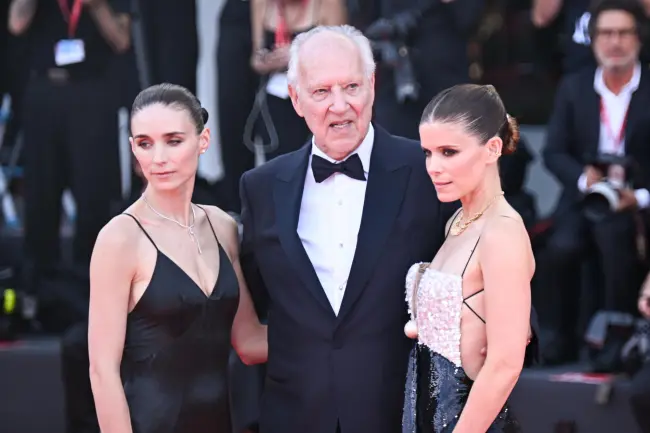
You’ve never seen a movie quite like “Bucking Fastard,” whose director, Werner Herzog, turned 84 while promoting it at the Venice Film Festival. Part bawdy sex comedy, part picaresque adventure, and fully an eccentric existential odyssey, the film stars real-life sisters Kate and Rooney Mara as nearly identical twins who speak, move, and desire in lockstep unison. Think of Joan (Kate) and Jean (Rooney) Holbrooke as a two-headed person with the same shared dreams. And the same shared love interest, a rakish charmer played by Orlando Bloom.
Herzog’s narrative features, whether “Bad Lieutenant: Port of Call New Orleans,” “Fitzcarraldo,” or “Heart of Glass” (where all the actors performed under hypnosis), always veer toward the unexpected. Predictably, not all audiences at Venice vibed with his latest. It’s an acquired taste, for sure, but one that cast a strange early spell on the festival as it seeks North American distribution. Herzog shot the film in February 2025 in both Ireland and inside a famed tourist-attraction cave in Slovenia, complete with a jaunty train car ride. “Bucking Fastard” also toured Telluride, and will next play Toronto and New York.

The film was originally invited to play out of competition at the Cannes Film Festival, an offering Herzog rejected because he wanted to give his stellar actresses a chance to win prizes. But there’s no bad blood with the festival, and now “Bucking Fastard” can compete for the panel of Venice jurors led by Maggie Gyllenhaal.
The day after the film’s world premiere, IndieWire sat down with Herzog — who fills any room with a warm gravitas — to talk about “Bucking Fastard,” why he has no plans to stop making movies, and his relationship with David Lynch, to whom this film is dedicated.
IndieWire: How are you feeling about the reactions to the movie? I wasn’t in the premiere. You were all a bit misty-eyed during the standing ovation.
Werner Herzog: It’s obvious that the audience loves [the Maras]. And they love Orlando Bloom and Domhnall Gleeson. Not a single one that is mediocre. So they’re all very, very good. They’re at their best. And somehow as a director, I’ve always managed to get the very, very best out of my actors. They’re always at their best. Klaus Kinski, Nicolas Cage. He says that was his best performance in his life [in “Bad Lieutenant”]. And way after the film that got him the Academy Award. So in a way, I always try to get the very, very best out of everyone, but it’s more than that. I try to get the best out of my audience.
You had rehearsals on this film for the first time. But you stopped a few days in when you realized how prepared Rooney and Kate already were. How did they achieve this synchronicity?
Normally it would be done through synchronizing your breathing. Like in stages of ancient Greek tragedies, you have the chorus that speaks in unison, and they normally assemble, stand in a circle, and breathe together, even touching their solar plexus. When they are synced up, they step out, and they speak in sync. It didn’t work with Kate and Rooney, but what worked — they discovered it by singing, I think, their earliest childhood song, and they would sing it, and then they would hum it, and then they’re almost inaudibly and they were in sync.
Directors normally do not do the slate board, but I always want to be the last one between my actors, to be the closest one and on the other side, the camera and lights and sound and whatever. And I heard them humming, and then it fades away, and I still knew a few more moments, and they would be in sync. And I sensed it because I was that close. I could touch them, so close. And when I knew now they’re in the rhythm, I would do the slate and move out.
What they achieve is remarkable.
They are really in the flow, and they’re so like one soul in two bodies. And they’re ingenious. I mean, what you see, the audience immediately knows it. They instantly know it. What you see, you have never seen on a screen before. It’s unprecedented. By the way, this is the reason I wanted to have a film in Venice. People say, “Cannes Film Festival overlooked it.” It’s not true. Cannes didn’t overlook it. They invited it into the official selection, but it turned out it would not be in competition. And I said, “I don’t need a competition. I’ve been in many; I don’t need an award. I’ve got awards, but the two sisters should be in a position where they can compete for best actress.”
Did Thierry Frémaux give an explanation as to why it was out of competition?
No, no. You see, don’t go after the festival directors. It’s a most joyless, thankless job on God’s wide earth. They have 3,000 films applying and they take 20. So 4,980 filmmakers are against you and don’t like you. No, no, it’s a difficult, very, very difficult task. I don’t mind at all, but I had to gamble. I declined the offer, and I said, “Well, hopefully Venice takes the film in competition.” And when they saw it, they were instantly, instantly taken by it. And so it’s a wonderful place to start to do the splashdown.

You hadn’t been in competition in Cannes since the 1980s. You’ve shown many of your fiction movies at Venice, like “Bad Lieutenant” and “Invincible” with Tim Roth.
And “My Son, My Son, What Have Ye Done?.” In one year I had two films in competition, which has never happened before in any of the festivals. Let’s put it this way. Cannes has been good to me and Venice has been very good to me. There’s no doubt.
You received the Venice Golden Lion last year.
I’ve declined it 20 times, and Venice, it would have been embarrassing to decline it. If a festival invites me, tries to lure me with a Lifetime Achievement Award, I duck in the trenches.
You are 83 at this point and in good health.
Tomorrow, 85! Oh, no, sorry, 84. Yeah.
How much longer do you want to keep making movies? How do you want to use the rest of the years creatively?
Well, while we are speaking here, I’m only a few days away from finishing the next one. I have a film practically finished already. I’m writing at the moment and I’m working on a book by the publishing house, Taschen, photos of all my films. It’s going to be big, and we have very, very good photos from 80 or so films. And so I try to finish one after the other. But it’s such a joy for me, what I do. And of course I know there are certain limitations, [like on] “Ghost Elephants,” which played here last year. I was in Namibia filming deep in the bush, and then part of the film takes place in Angola in the highlands.
And it meant the last 50 miles walking. And then each day, 10 hours nonstop running after elusive elephants. And I said, “I’m too old for this. I can hasten after an elephant maybe for an hour.” And Ariel [Isacovitch], who is the producer, but he’s my left and right hand, he went there with a camera team, and he had a very clear, precise bucket list. But I said to him, “If you discover something that fascinates you,” and he filmed a few things that were not on the list, and of course we were always in very close contact. So I was the director at home in my garden speaking to him in Angola.
With the movie being dedicated to David Lynch, you wanted to show him the film, and you weren’t able to before he died.
There was a deep respect for each other’s work, although we are so different in what our output is. I had the feeling, “Oh, he should be the first one to watch the film with me.” And I think one shouldn’t read too much into it. In the last years, contact with David was difficult because he had been moving completely into transcendental meditation. And, for example, speaking to him across a table, he would have a photo placed facing him on the table. I saw the backside of the photo, and the photo was of a guru, and he would have the picture of the guru, and beyond the picture of the guru, there was me. He wanted to talk about world peace and meditation, and I’m not into that. So it shifted.

Did it feel like a barrier?
Yes. He didn’t want to have a barrier, nor did I, but he was so much into it that he had to have a picture that he could face. And beyond that was his visitor, anyone. Yeah.
I think there probably isn’t too much to read into that dedication, but of course people will, right? And then they’ll try and think, “Oh, there’s an homage here.” But I don’t see that.
Well, David, quite often he said, “We should do something together.” And I told him the story of “My Son, My Son, What Have Ye Done,” and he said, “Ah, can I produce that?” But it was with some distance. He was not daily involved or anything like that. So no, it’s just if you try to read too much into it, you overload it.
A couple years ago at IDFA, I saw this movie “About a Hero,” which is this partly AI-generated hybrid documentary that tries to recreate the atmosphere of your films.
The intention of this young filmmaker was never to remake any [of my films], but making something in the spirit. And I immediately said, “You will fail. It is such a stupid idea. It’s phenomenally, abysmally stupid. I will not take part in it.” He wanted me to explain things and have my voice in it. I said, “You are alone. There’s such a thing as free speech, which I respect. So go ahead and fail.” And it is a failure, period.
It’s so standardized that AI can step in because there’s not real storytelling. It’s mimicry of something that has happened before. And I welcome AI to replace all the idiots who are into nothing but repeating, repeating, repeating until it’s ad nauseam. When it’s ad nauseam, please, please, please let AI step in and do the job.
This interview has been edited for brevity.