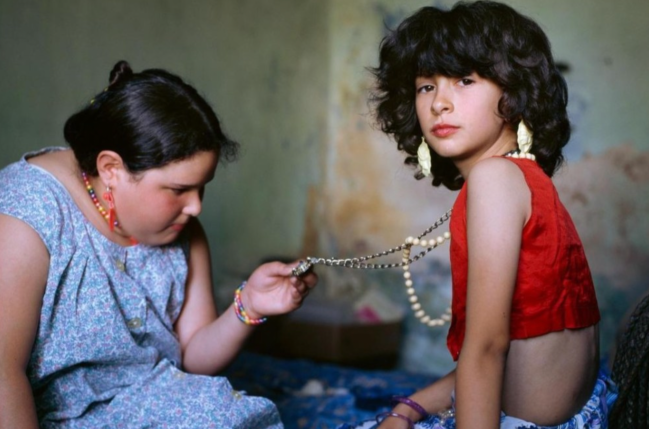
Photographer Alessandra Sanguinetti has published two books about Guillermina and Belinda, a cousin duo that she met in the Argentine Pampas in the late 1990s. The first book visually chronicles their transition from preadolescence into their teenaged years; the second spans into their mid-twenties. Her debut documentary, “The Illusion of an Everlasting Summer,” an intimate portrait of the cousins over 25 years, incorporates material from both prior works while also stretching further into the future, capturing the girls as they age into their mid-30s. It’s a film about the ebbs and flows of the cousins’ relationship, their trilateral relationship with Sanguinetti (whom they affectionately call Ale), and, per the nature of the project, the unrelenting passage of time.


The first half of “The Illusion of an Everlasting Summer” captures the girls roughly from ages nine through their early teens, a lively period when they’re at their most bubbly and least self-conscious. They routinely dance and play dress up; they frolic in the river and pour over old photographs. The two girls occasionally perform skits, like when Guillermina pretends to be the grief-stricken wife at the funeral of her husband with Belinda as the priest delivering the eulogy. (They can’t make it through the scene without laughing.) Sanguinetti encourages and even instigates their improvised make believe, lending a theatrical quality to their shared interactions.
The realities of rural life occasionally materialize in the margins of Guillermina and Belinda’s young lives. The girls live on the plains in an isolated community largely dominated by taciturn male farmers and hunters. In her film, Sanguinetti presents a subtle thread about the nature of western spaces defined by ossified traditions, the face of which is being altered by the specter of modernity. Sanguinetti frames Guillermina and Belinda’s presence as a joyful intervention into this world, one where play can coexist with labor. Their bouncy attitudes inevitably mold the vast open country in their own carefree image.
Of course, they can’t fully escape the influence of their environment. Guillermina believes men are naturally strong and gruff while women are largely weak; she wishes to get married and have children, but fears being abandoned by a future boyfriend. Meanwhile, Belinda expresses interest in acting and dance but also doesn’t want to leave the countryside. Her family informs her that, in order to stay, she either needs to pursue an agricultural job or marry a farm boy, of which there aren’t too many left.
These words tend to be slightly prophetic as “The Illusion of an Everlasting Summer” moves into its second half, which dashes through the next twenty years of their lives in an understated, yet affecting fashion. Sanguinetti and editor Andrés Tamborino refrain from signposting the girls’ stages of development. In one scene, Belinda has found a boyfriend, and in the next, she’s pregnant and still living in the countryside, albeit not near her family. Later, Guillermina expresses sadness that, between her work and Belinda’s children, they don’t see each other much anymore. In the next scene, Guillermina has a child of her own. Before long, Guillermina and Belinda each have children the same age as them when Sanguinetti began filming so many years ago.
Since Sanguinetti clearly trusts the power of her footage, she evades overly sentimental traps part and parcel with projects filmed over decades. She knows that it’s poignant to simply watch the girls slowly drift apart as they grow up without adding any extra formal emphasis to their journey. She understands that watching Belinda become more reserved and less outgoing as she settles into married life carries a tragic quality that doesn’t need to be underlined. It’s stirring to watch Guillermina and Belinda reunite in Paris as adults for a gallery show featuring Sanguinetti’s pictures of them because “The Illusion of an Everlasting Summer” never telegraphs such a warm turn in their lives. When they pose for a spread in Italian Vogue, a more professionalized version of their tween experiences dressing up in their family’s clothes, it feels like the culmination of an accidental, yet fruitful collaboration.
Sanguinetti’s cinematography balances striking compositions befitting her photography career with a more immediate verité style content to be as freewheeling as Guillermina and Belinda were as children. If “The Illusion of an Everlasting Summer” falters, it’s mostly in terms of pace. Sometimes, its editing has a hypnotic tenor, especially in certain languid stretches of community gathering, but other times, it can feel repetitive and tepid, like when Sanguinetti includes yet another dance sequence. The film’s broader tempo is presumably by design: the first half has a protracted feeling that reflects the expanse of childhood while the second half feels hasty, like how time moves as an adult. Yet, individual sequences can occasionally test one’s patience, even when we’re supposed to be locked into the rhythm of children.
At its best, however, “The Illusion of an Everlasting Summer” feels like an active dialogue between profiler and subject, with Sanguinetti’s camera acting as an intermediary that both records and shapes lives over time. Guillermina and Belinda are not inherently remarkable, but they become so through Sanguinetti’s eye, which lends them a mythos that elevates their lives to cinematic heights.
Grade: B
“The Illusion of an Everlasting Summer” premiered at the 2026 Locarno International Film Festival before screening at the Telluride Film Festival. It is currently seeking U.S. distribution.