“The Cable Guy” first knocked on our door 30 years ago this week — and with a TV reboot recently confirmed, it’s clear this screen-obsessed oddball simply refuses to leave popular culture.
Directed by Ben Stiller (who also stars in a dual, Menendez-brothers-esque true crime role) and produced by comedy mega-fan Judd Apatow, “The Cable Guy” has enjoyed an unusual journey. It was based on a script by LA Deputy District Attorney and part-time screenwriter Lou Holtz Jr. that quickly caught the attention of rising star Jim Carrey, who, at that time, was hot off “Ace Ventura,” “Dumb and Dumber,” and “The Mask.” That trio of 1994 megahits had propelled him to instant comedy legend status — and the newly minted star suddenly found himself in the unique position of being able to do whatever he wanted when it came to his next move.


Interestingly, his intentions weren’t to deliver more of the same. Instead, he decided to shock both his newfound fans and critics alike by diving into a role that blended his wild comedy skills with a dose of devilish menace. “The Cable Guy” saw Carrey play a TV-obsessed loner calling himself Chip Douglas. After striking up an awkward friendship with the recently dumped Steven Kovacs (Matthew Broderick), Chip takes it upon himself to become Steven’s new best pal — whether he likes it or not.
Featuring a who’s-who of late-‘90s comedy talent and providing the meet-cute for Apatow and his future wife Leslie Mann, Stiller’s film threw everything at the wall to create a bold and darkly comic thriller that defied expectations. However, upon release, both Hollywood and audiences weren’t too sure what to make of Carrey’s latest comedy vehicle, with his (then) record-setting $20 million payday being used as a headline-generating critical lightning rod.
However, in the three decades since its release, all that has disappeared into the ether like a long-forgotten social media post. Today, the trio’s funny, moody thriller has not only endured but has been heralded as an oddly prophetic vision of the troubling, doom-scrolling dystopia we now find ourselves in.
To celebrate its big birthday moment, key players from “The Cable Guy’s” creation — including Stiller, Apatow, Holtz, and producer Andrew Licht — spoke with IndieWire to reflect on its anything-goes creation, troubled release, and unexpected legacy.
The following interviews have been edited and condensed for brevity and length.
After noticing a cable guy making an unusually late house call, Los Angeles District Attorney and screenwriter Lou Holtz Jr. devised an idea for a new story — one that would find quick success in Hollywood.
Lou Holtz Jr. (screenwriter): In the mid-1980s, I was leaving my mom’s condo one night after 9 p.m. In the hallway, I saw a cable guy, which got me thinking, “I wonder what he’s doing here so late?” At that time, it was a known thing that at least a few cable guys would give you all the movie channels for free if you gave them a nice tip. That was a big deal to guys my age in their early 20s who were just getting their first apartments and didn’t have extra money to spare for movie channels. I remember thinking it would be funny to write something about a rogue cable guy — but I didn’t write anything at the time.
Judd Apatow (producer): I always loved those “What About Bob”-type movie premises. The ones where somebody moves in next door, maybe someone at work or a new person in your life who you think is a genial fellow at first, but later turns out to be your worst nightmare.
Holtz: Several years later, I went to a friend’s apartment to watch a Mike Tyson fight on HBO. My friend informed us that he tipped his cable guy the day before to give him HBO so we could watch the fight. I remember joking with him, saying something like, “What would you do if the cable guy showed up tonight uninvited with a six-pack of beer and said, ‘My plans for the Tyson fight fell through, so I figured I’d join you guys.’” My friend shrugged and said he didn’t know.
This made sense because on one hand, he didn’t really know his cable guy so didn’t want to socialize with him — but my friend also didn’t want to insult the cable guy and risk losing all of the movie channels. Common sense dictated that the issue would ultimately be decided by how annoying his particular cable guy was. I wondered to myself, “How much irritation would someone be willing to put up with in order to get free movie channels?” — and that’s when I knew I had a great idea for a movie.

Andrew Licht (producer): I’d known Lou for years and knew he was an exceptionally talented writer. Up to that point, he’d primarily written for television, and I’d been encouraging him to write a feature screenplay. One day, he called and told me he’d written a spec script and left it on my doorstep. I asked him what it was about, and he said, “Just read it.” I asked for the title, and he replied, “That’ll give it away.” I took the script home and read it that night. From the very first read, I knew it was a home run. It was original, funny, and exactly what we were looking for. You immediately understood the character, and the concept not only had enormous potential, but was realized.
Holtz: I was told by producers Andy Licht and Jeff Mueller that multiple studio executives liked my script, but because I was an unknown writer, studios would feel more secure buying it if we had an in-demand comedian attached to it. That took some time, but Licht and Mueller, who both did an amazing job of putting the project together early on and helping me, were able to get my script to Chris Farley and his team. After Chris Farley read it, loved it, and became attached to the project, there was a bidding war between multiple studios to buy my screenplay, which was ultimately purchased by Columbia Pictures.
Licht: “Tommy Boy” had just been released, and we were convinced that Chris Farley was the perfect “Cable Guy.” My producing partner, Jeff Mueller, and I sent the script to Chris’ manager. He loved it, agreed that Chris was right for the role, and suddenly we were off and running. Five studios were bidding for the project. That’s how the journey of “The Cable Guy” began.
Holtz: I wrote the part in a way so that multiple comedians could have played the role well. I remember specifically thinking about Jim Carrey, Chris Farley, Chris Elliott, and Michael Richards, knowing that all would have been great.
Licht: The film was ahead of its time and somewhat predicted a world where loneliness, media obsession, and technology blur human connection. The movie is about connection without intimacy, entertainment replacing real relationships, and the danger of people becoming emotionally shaped by media.
Holtz: The script sold in late April 1995. Three days after it sold, Columbia sent me to New York to spend four or five days with Chris Farley. The plan was to begin shooting the movie only two months later, beginning in July 1995 during Chris’ summer hiatus from “Saturday Night Live.” I was told that Columbia wanted to shoot the first two acts of my screenplay as is, but they wanted me to rewrite the third act to make it a bigger, broader comedy to suit Chris, which is why they sent me to New York to meet with him.
Everything went great when we were in New York together. However, I was later told by producers and studio executives that Paramount, the studio that made “Tommy Boy,” had an option for another Chris Farley movie, which was in Chris’ “Tommy Boy” contract. The question was whether Paramount had an option guaranteed for Chris’ next movie or just another movie in the future. Chris and his management team ultimately determined that they’d be open to making “Cable Guy” a year later in summer of 1996, but they needed to make another Paramount movie in summer of ‘95 [“Black Sheep”] due to his contract.
At that point, my script was sent by Columbia to Jim Carrey, who I was told loved my script and wanted to star in it, but Jim wanted a darker version from my first draft, and he wanted his good friend Judd Apatow to be a new producer on the movie and to handle any rewrites.
Ben Stiller (director, played Sam and Stan Sweet): Judd came to me with the movie and kind of brought me into it. I didn’t really know Jim that well before we started working on the film. We just felt excited about the idea of doing this weird, dark tone for the movie.
Apatow: Back then, there were a lot of horror movies with that kind of premise. It was kind of a common thing. I think all of the cliches [associated with them] made [me and Ben] laugh — then we thought, “Put Jim in that [scenario] with Matthew Broderick, and that would be really fun.”
Licht: Unfortunately, scheduling became an insurmountable obstacle. Chris had commitments to “SNL” that kept him busy through May 1996, while Sony was determined to release the film in June 1996. The production schedule simply couldn’t accommodate both. The chairman of Sony, Mark Canton, told us, “If you can get Jim Carrey, we’ll make the movie and release it in June.” At that point, Jim was coming off an extraordinary run of success, and once he became interested in the project, everything moved very quickly. What began as a film envisioned for Chris ultimately evolved into a very different but equally memorable vehicle for Jim.

With Carrey attached, the project was fast-tracked. After requesting a darker tone, Holtz delivered a handful of rewrites before Apatow took over. Ultimately, the producer reshaped various elements of the narrative but was denied a writing credit due to Writers’ Guild rules.
Apatow: I’d known Jim for a while, since we were doing stand-up in the clubs. The first time I saw him, I had this thought that “this is the funniest guy who ever lived”. I had a feeling about him, and we became very close friends. He hired me when I was very young out of his own pocket to write sketches with him for “In Living Color,” so he’d get on a little more. I’d help him a little with his stand-up, but he didn’t need much help. We hadn’t had a chance to do a big project together, so this was really fun. Jim hadn’t made that many comedies — they were just all gigantic at that point. He had a real burning fire to experiment and try new things.
Licht: Jim Carrey took a risk. He was at the peak of his fame after “Ace Ventura: Pet Detective,” “The “Mask,” and “Dumb and Dumber.” Instead of repeating himself, he leaned into something darker and more character-driven. What attracted him was probably the opportunity to surprise audiences. Chip Douglas wasn’t a lovable hero. He was lonely, damaged, manipulative, and at times frightening. Jim saw a chance to stretch creatively and explore darker territory while still using his extraordinary comedic gifts.
Apatow: It was such a formative experience for all of us because Jim was such a risk-taker. He had a real instinct that it was important for him to show people that he wasn’t going to do the same thing every time out — at a moment where he could have. He was always looking to stretch and figure out what he was made of.
Stiller: I was excited to do this darker buddy comedy genre idea and really take it down the road of these movies that were out at the time, like “Single White Female” and “Pacific Heights,” where it’s the obsession of one person with someone else. Having come up doing “The Ben Stiller Show,” I think Judd and I were looking at this like it was a chance for us to do something satiric in that genre.
Apatow: Very early on, we all sat down and talked about what to do. During the revisions of the script, [Jim] was very aggressive in the best way about all of the chances we could take in turning it from a normal comedy to a type of comedic thriller like “The Hand That Rocks The Cradle” or “Unlawful Entry.” That was the thing that started making the three of us laugh.
Stiller: Jim had this character, and I remember sitting with him and Judd and improvising ideas. Jim was doing “Ace Ventura 2” when we were developing the movie, and I remember going to visit him with Judd in Charleston or wherever they were filming. We’d be in his hotel room hanging out and riffing ideas.
Apatow: We all felt that something was changing in the media. Back then, it was the beginning of people realizing that we were about to combine our phone, computer, cable, and movies. It hadn’t quite happened yet — but it was [starting to]. In a way, the Cable Guy is the monster from the future who’s telling you that things are going to get really bad [laughs]. Part of the underpinning of this story was how this was going to make us all crazy and how we were going to lose our minds and attention spans. This thing that promises to bring us closer is actually going to make us try to kill each other — and that has come true.
Holtz: I never had a meeting or phone conversation with Jim or his team about my script. However, the studio relayed to me that because I was still officially under contract to do all rewrites prior to Jim’s and Judd’s contracts being finalized, the studio asked me to write some darker versions of my original script before departing from the project, which I did. The basic difference between my first draft that sold and my later drafts was that the Cable Guy character became less well-meaning in the third act and the Matthew Broderick character had to fight the Cable Guy harder, intellectually, to get him out of his life. My later drafts ended up being closer to the final film version than my first draft.

Licht: Judd brought a sharper emotional core to the story and expanded the relationship between Steven and Chip. Ben had an incredible instinct for balancing comedy and discomfort. Together, they pushed the material further into satire while making the characters more grounded and believable. The film became less of a traditional comedy and more of a dark character study.
Apatow: There’s a lot of scenes in the movie where Jim talks about the future. He says, “You can play video games with your friend in Vietnam!” — and you realize he’s a creature of having watched too much television. He doesn’t know how to have normal relationships, so he crosses all boundaries. He’s so needy that he’ll try to destroy your life if you reject him — I think that feels familiar to what’s happening right now with everyone losing their minds from being connected to their phones and social media. We’re losing some of what is important to have in order to be a good human being.
Licht: Today, with social media, streaming, and people living through screens, the movie feels more relevant than it did in 1996. At the time, people expected a broad Jim Carrey comedy. What Ben Stiller and our team made was darker, smarter, and more satirical than audiences were prepared for.
Apatow: Jim and Ben were always fascinated by the media and loved exploring it psychologically. Even though it’s really silly, we talked a lot about what it meant. We had Ben playing a satirical version of the Menendez brothers because that trial had just happened. I was a comedian and had no job for a long time, so I’d just sit home and watch the trial.
Stiller: Judd and I had both gone through break-ups, so we were channeling our own relationship issues into it, too. On a personal level, it was like [we were] working some of that stuff out [with] our own experiences of being probably very codependent in our relationships at that point. I think we’d both gone through similar experiences of breaking up with a girlfriend and being totally lost and vulnerable.
Production began in November 1995, with Stiller directing and playing dual roles in a Menendez brother-esque subplot. Joining the cast was Matthew Broderick as the Cable Guy’s unlucky customer and reluctant best pal Steven Kovacs, and future Mrs. Apatow Leslie Mann as his estranged fiancée Robin. However, at the center of the action was Carrey, delivering one of his darkest and most unpredictable performances so far.
Apatow: I said I’d direct when it first came up as an idea because I was just beginning to think that maybe I should put my hat in the ring. That was dismissed very quickly by all parties. Then they said, “What should we do?” I said, “Let’s ask Ben,” and thank God Ben was excited to do it.
Stiller: I was thinking about those dark obsession genre movies. I remember watching “The Tenant” and “Repulsion,” the Polanski movies, and using them as inspiration for the nightmare [scene]. It was exciting for me: the idea of trying to shoot it like a real film and include elements of tension and suspense.
Apatow: I remember Ben preparing very seriously. He developed this great blue color palette with Sharon Seymour, our production designer. Robert Brinkmann was our cinematographer. Ben and the two of them created a great style for the entire movie. When we were doing “The Ben Stiller Show,” and Ben was developing “Reality Bites” for Danny DeVito, Danny said to him, “You doing these sketches? You should experiment with the camera and go crazy because when else can you do that?” When we shot the movie, I thought, “Oh, this is the result of all the knowledge he gained from shooting an enormous amount of cinematic sketches.”
Licht: Ben Stiller’s visual style was deliberate and cinematic. He balanced comedy with psychological tension. That was the biggest creative challenge. If it became too dark, audiences would stop laughing. If it became too broad, the emotional stakes disappeared.
Apatow: Jim was so hot that the whole process of getting into production was very fast. [The studio] wanted a specific summer [release] date, so post-[production] was very short. As a result, we were able to do all these things we wanted to do because there wasn’t time to do any reshoots or address notes.
Stiller: Jim really had carte blanche in terms of what he wanted to do. I think being less aware of all the things that go into making a big summer movie… we were blissfully ignorant of all that and [just] saying “Let’s have a spider walk across Jim’s face. Let’s just go for it.”
Apatow: Everyone was afraid the movie was too dark. There was a really funny scene where Matthew’s in his car driving really fast and Jim’s on top [of it]. Matthew turns the wheel hard to the right, and Jim flies off, spinning on the floor when he lands. Then, he just leaps to his feet and starts running like the Terminator [laughs]. There was another scene where Jim has Matthew in the mud. He has a drill and is going to drill into his forehead. We certainly had conversations about whether we should’ve left one of those in. Did we panic and take them out?

Stiller: [Jim] loved making us laugh. As a director, I feel like your job is to kind of be an audience for the actors and to react. You have to feel what you think is funny and go with that. It became a thing where Jim would do multiple takes. I loved watching Jim do that character.
Apatow: [The lisp] was definitely Jim’s idea. He had some characters that he did on “In Living Color” that spoke in a similar way. I remember Jim’s manager looked at our first dailies and said, “Is he gonna do that lisp the whole time?” I said, “Yeah!” He was like “Oh no…” But it also made him more childlike, which was the main intention of it.
Licht: Matthew Broderick grounding the movie was essential. The film works because his character reacts like a normal person trapped in escalating chaos. Matthew was the perfect counterbalance. He understood that the more grounded and authentic Steven remained, the funnier and more unsettling Chip became. Watching Jim and Matthew work together was fascinating because they approached scenes very differently, yet their styles complemented each other beautifully. Their dynamic is really the engine that drives the film.
Apatow: We grew up watching [Matthew]. I’d seen him on Broadway, and “Ferris Bueller” and “WarGames” were big parts of our childhood. At that time, he hadn’t played many parts as an adult. I think there were a few years where he was caught in between the high school version and the adult Matthew version. I remember when we first started working with him I thought, “Oh, he’s a handsome leading man now. This is the beginning of a whole new era of Matthew.”
Stiller: Jim would go and go and go and do like 20 or 30 takes, trying ideas. We’ve laughed about it over the years, but I remember Matthew just observing Jim. There was sort of like a meta aspect to it [laughs]. He was watching Jim do these crazy things and was so perfect reacting to them.
Apatow: It was a very difficult part because it’s all reactive. Jim is going crazy in his face all day long and Matthew has to try to keep the movie from floating away and just being insane. I remember one day after a long run of Jim just going off on him, Matthew said to me afterwards, “I’m running out of ways to react to this…” It was so exciting to work with somebody we respected as much as him. We couldn’t even believe he was there.
Stiller: We were looking at it like it was a comedy but also like it should work as a real movie too. When I look back on the movie, there’s both things going on — there’s these really satiric nods to the genre, like Jack Black playing [Matthew’s] best friend… maybe we were sometimes trying to have our cake and eat it too. I really feel like that’s where we were at when I was 30; probably trying to do too much and pull it all off.
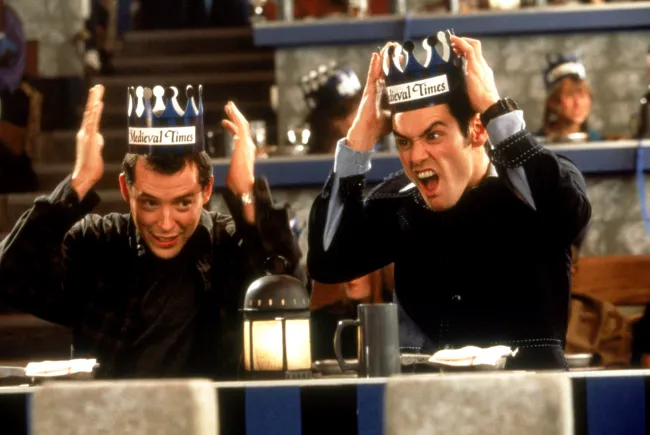
Apatow: We talked about having everyone in the movie that we thought was the future of our comedy world. Andy Dick and Janeane Garofalo work at Medieval Times. Bob Odenkirk was in the porno password sequence, and we were gigantic fans of Jack Black, who had just started doing Tenacious D.
“Bottle Rocket” was just about to come out. We’d seen footage of it and auditioned Owen [Wilson], and he had a terrible audition. Ben was like, “I don’t know if we can hire him…” I was like ‘He’s the guy from ‘Bottle Rocket’ — we have to hire him!” They’ve collaborated a zillion times since.
Leslie Mann, who later became my wife, came in and auditioned [ultimately playing Robin]. I watched that audition the other day because it’s online and she’s reading with me. The first time I met Leslie, I’m doing an impression of Jim Carrey with a lisp. Our meet-cute is online.

Underneath Carrey’s wild performance, the actor was keen to inject an unlikely slice of empathy into a very flawed character. Looking back, it was an artistic decision that set the scene for the actor’s varied future project choices.
Stiller: [Jim] was also giving it this layer of loneliness. The idea that this is a guy who just really wants to connect and have a friend. I think that was always in Jim’s mind during this movie. At that point, he was really excited to do something that had an emotional undertone in it. Like the scenes in his van where he’s watching TV by himself. That’s what he’s always been interested in. He’s a very unique actor.
Leitch: Jim could have played it safe, but he wanted to challenge audiences. What surprised me most was the sadness he brought to the character. Everyone expected Jim to be funny. What nobody expected was how much vulnerability he could bring to Chip. Underneath all the outrageous behavior was a lonely man desperate for connection. Jim found that humanity, and I think that’s one of the reasons the film has endured.
Apatow: Porno Password was something Jim used to do with his family. That was his idea that we put that in the movie.
Stiller: We were thinking of where you could do an extended scene where you could have fun and at that point, Medieval Times was a popular thing in Southern California. To me, the part I love in that sequence is that we were able to do this ridiculous “Star Trek” tribute [laughs]. It’s kind of indulgent and so nerdy for “Star Trek” fans, the fact that we even committed to that so much… Jim had the idea to hum the score while he’s fighting because all his character did was watch TV his whole life — it was inside of him. The idea that Jim’s character would have the score in his head and is living out an episode of “Star Trek”… then [we thought] it’d be cool to have the actual score come on. I remember being really excited about that.
Licht: [Medieval Times] was the perfect setting because it amplified the absurdity of Chip’s worldview while giving Jim an incredible playground to perform in. The combination of the over-the-top environment, the escalating tension between the characters, and Jim’s fearless commitment made it comedy gold. That sequence has become one of the defining moments of the film. When we finished shooting it, Jim turned to me and said it was the funniest scene he had ever filmed. Coming from someone who had already made “Ace Ventura,” “The Mask,” and “Dumb and Dumber,” that was saying something.
Apatow: The studio was yelling at us about any budget overruns. I remember Gary Martin, the [former] head of Sony Production, this very strong, tough guy was yelling at me because we were going long while shooting the Medieval Times sequence — but we weren’t done yet. He said to me, “Pull the plug.” I said “no”, took the battery out of my phone, threw it across a field, and we just kept shooting. It actually traumatized me to the point where I’ve never gone over budget on any movie since 1996 because I’m so scared of getting yelled at by Gary Martin — and he’s no longer with us.
Stiller: Judd is great at deflecting studio notes. Even when we were doing “The Ben Stiller Show,” and he was like 24 or 25, he was getting into arguments with the head of the network. We were just going forward, making the movie we wanted to make and having fun.
Apatow: [At the end of the movie, Jim] thought he should jump, land on the satellite’s needle, and die. He fought for it, but the studio certainly was not going for that. We came up with this other idea where we think he’s dead, and in classic thriller form, he opens his eyes and lives to fight another day.

“The Cable Guy” debuted on 14 June 1996. While it was a financial success, it wasn’t what fans or critics expected from a Jim Carrey movie, with many taking issue with his $20 million payday.
Stiller: By the time the movie came out, the way it was promoted and where Jim was at in his career… it wasn’t held as some sort of triumph or anything [laughs]. I remember loving making the movie, and then it wasn’t as much fun when it came out because people seemed to have very specific reactions to it.
Licht: The movie had a tone that was difficult to market because it didn’t fit a neat category and was not what audiences were expecting from Jim Carrey at the time. I remember thinking we had made something genuinely original. Whether people loved it or hated it, they were going to talk about it. In Hollywood, that’s often the sign that you’ve created something distinctive. It didn’t feel like any other studio comedy of that era.
Apatow: There were certainly debates about how dark it should be, but there wasn’t a lot of time to try different variations. Ben wanted to be very consistent with the tone. The movie has a very real thriller score — it isn’t making it lighter for you. I think that’s partly why, when you watch it for the first time, it’s genuinely scary at times. We’d watch it in editing and know Jim’s not going to hurt anybody, but if you’ve never seen it before, you think he might kill somebody. It was loaded in a way that we probably didn’t anticipate.
Licht: Jim becoming the first actor paid $20 million became a huge media narrative. That seemed to overshadow the conversation about the movie itself. It became part of Hollywood history. The salary became the headline but creatively the film was taking real risks.
Apatow: Ben and I didn’t know any better about the stakes of it. We were just excited to make a movie with someone we looked up to and to have all the toys to really go for it because neither of us had had a big summer movie in theatres. I think that’s why we were willing to do so many crazy things. We were sure it was going to be a gigantic hit because it’s Jim, Ben’s directing is amazing, and people are going to love that it’s so new and original. When it came out, we were so surprised that some of the critics we admired went after us because we thought they’d appreciate the creative effort. That threw us for a loop.
Stiller: I remember being at the premiere at [Grauman’s] Chinese Theatre. Afterwards, there was a sort of hushed silence, and one of the directors of a movie Jim had done recently kind of gave me this look like, “What the hell was that?” [Laughs] Up until that point, the whole thing was so much fun, then it was like coming down to reality.
Apatow: I remember leaving to go to the premiere, and someone handed me two faxes. They were reviews from Time and Newsweek, and they were both so terrible. I could barely breathe during the whole premiere because I just felt what was about to happen to us.
Licht: The transformation has been remarkable. What was once viewed as an oddity is now widely regarded as one of the most interesting studio comedies of the 1990s. Younger audiences, in particular, seem to appreciate how ahead of its time it was. The themes of loneliness, media obsession, parasocial relationships, and our dependence on technology feel even more relevant today than they did in 1996. That’s one of the reasons the film continues to find new audiences and why people are still talking about it 30 years later.
Apatow: Looking back, it’s all ridiculous. The movie cost $47 million and grossed over $100 million around the world, but at the time, there was so much pressure on Jim to have every movie be record-shattering that people talked about it like it was a misfire. Then, slowly, we realized people just loved it. When it hit DVD, it seemed like everyone caught up with it and appreciated it — but in the moment, it was tough.
Stiller: I feel that throughout my career, making movies, you’re always so focused on when the movie comes out; you want people to like it and for it to do well, and of course, all of that’s out of your control. That was kind of the first time that I’d had the experience of really feeling that, just in terms of it not getting a great reception. It’s interesting because in making the movie, I was never thinking that way. Maybe it’s because we were so young. We just thought, “OK, let’s just go and do this crazy thing.”
Apatow: I do think both Jim and Ben helped break down those barriers [for comedians doing more dramatic work]. After this, Jim went on to do “Eternal Sunshine of the Spotless Mind” and “The Truman Show.” Ben was in the movie “Your Friends and Neighbors,” which is a really dark, troubling movie. Afterwards, it did become a world where Adam Sandler can be in “Spanglish” and “Uncut Gems” and a lot of people were able to travel back and forth from comedy and other genres. The audience now knows that you can’t pigeonhole everybody.
Holtz: It is personally gratifying to know that when I was 31 years old and working full-time as a deputy D.A., I had the discipline to spend my tiny amount of free time on evenings and weekends writing something that I believed in. It’s not easy giving up all hobbies and saying no to every social invitation for months in order to stay home and grind away on a screenplay which was a long shot to sell — especially coming from an unknown writer. It serves as a great example to my three kids of how important it is to believe in yourself.
Apatow: Obviously, it was the most important moment of my life because I met my wife Leslie and we’ve gone on to be married for a very long time and have a great family. Creatively, I learned so much from Ben. He’s always been a visionary and will not accept anything less than capturing his vision. Jim’s one of my closest friends, and to have been there at the moment of lift-off, seeing his genius up close, and to have made something we’re so proud of that took courage to stand by — as the years go by, it’s more meaningful. When you’re young, you think anything is possible. I just remember our blind belief in ourselves no matter how mad everyone was at us. We knew what we were doing. Then, decades later, people are like, “Actually, that one’s pretty good.” [Laughs] Any time anything doesn’t disappear in the culture, it’s such a big win.