
Derek Jarman (1942-1994) was one of a kind. His name conjures both an ingenious canon within British art house cinema and a trailblazing position within gay activist history. His eleven feature films — which, among other things, gave us Tilda Swinton — have been endlessly ripe for rediscovery during the decades since his death.
These films are inextricably bound up in his casually brilliant sociopolitical voice and none more so than swan song “Blue.” Made while he was dying from AIDS, it is a chronicle of his own deterioration as well as a furious poetic elegy for loved ones taken too soon.
“Queer Edward II,” the debut feature by Theo Rollason, captures what made Jarman special; an extraordinary achievement, considering the extent of his legacy. What’s more, the documentary is a feat of storytelling in its own right, calling to mind the refined journalistic sculptures of Laura Poitras (and not just because Joe Bini assisted in the edit here). Evoking Golden Lion winner “All The Beauty and the Bloodshed,” Rollason and editor Nicole Halova elegantly synthesize many diffuse narrative strands building to a cri de coeur that finds ragged emotional power amid all this precise construction.


Indeed, by the third act, a diligent archival documentary becomes humanist lightning in a bottle, illuminating the similarities between the ’90s and now. From the presence of a state that attacks the dignity and rights of minorities to the counter-presence of protesters putting their bodies on the line to demand equality, it’s the same old song. Rollason does not explicate these parallels as all footage is rooted in the same period, there is simply a loaded familiarity to certain images and the audience is trusted to make that link.
An opening title card reads: “February 1991, Derek Jarman is adapting a 400 year old play that will speak to the homophobia of the moment.”
The title in question is “Edward II,” Jarman’s subversive spin on Christopher Marlow’s 16th century play about the only openly gay monarch in British history whose story ended in death and betrayal. After taking the throne, King Edward (Steven Waddington) installs his lover Piers Gaveston (Andrew Tiernan) and rejects Queen Isabella (Tilda Swinton) who sets in motion his downfall.
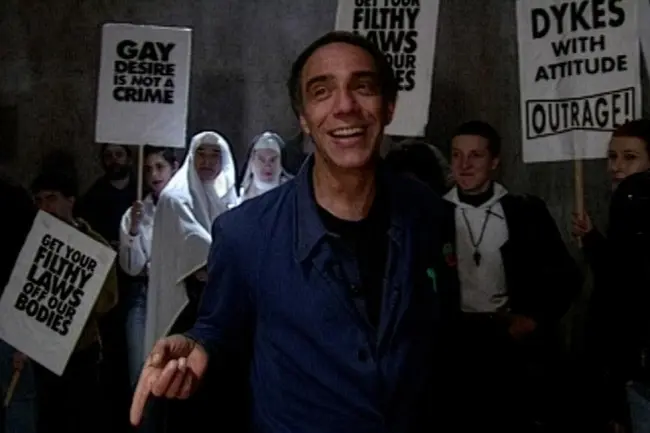
Jarman’s film updates the 1594 play with anachronistic touches such as Sandy Powell’s mix of period and modern costuming, Annie Lennox singing Cole Porter’s “Everytime We Say Goodbye” and — fatefully — casting members of Outrage! as protesters. During the shoot at Berkshire’s Bray Studios (with Cliff Richard recording a session next door) Jarman invited Seamus McGarvey (before he was Seamus McGarvey!) to film whatever and interview whomever he wanted, resulting in the sort of frank workplace portraiture that would make Frederick Wiseman proud.
But it does the film a disservice to call it a behind-the-scenes documentary for its breadth of intrigue brings it in line with delicious, filmset based fiction dramas. It calls to mind Fassbinder’s “Beware of a Holy Whore,” Truffaut’s “Day for Night and even the TV series (and soon to be movie), “Call My Agent.” The wry observation that making movies is about problem solving is given exasperated English representation as McGarvey’s camera observes members of the production team going through a range of trials. These span paying extras out of pocket due to the low budget and — eventually — dealing with calls from tabloid journalists when Outrage! mounts an impromptu protest. (To be more specific than this amounts to a spoiler).
OutRage’s major cause then was to protest Clause 25 of the 1991 UK Criminal Justice Bill. If brought into law it would criminalize consensual sex acts between gay men in public, making these punishable by the same amount of jail time as rape. Deftly chosen snippets of archive footage illustrate the righteous fury and defiant sexuality of gay rights activists on the streets. Media excerpts situate Jarman’s visible advocacy as a spokesperson for the community. He is breathtakingly poised in conversation with mainstay of British television, Jonathan Ross (an ally, if a crudely spoken one).
The novelty value for a British audience of seeing a young Ross, and also a young Jeremy Paxman, is underscored by sorrow. They got to grow old in public while Derek Jarman is long gone. Already diagnosed with HIV by the time of this production, he speaks candidly to camera about living for longer than anticipated.
Back in Bray Studios, the contrast in stakes between “making a movie” and “protesting for your besieged community” are presented without judgment. They simply coexist as separate but equal forces. Bridging the gap is Jarman himself. He cuts a moving figure, refusing to disavow a group whose cause is his cause, even if their direct action adds to the production team’s firefighting to-do list. When he speaks, he makes having integrity look simple.
It feels instructive today. Filmmaking as a frictionless capitalist business model is a more overbearing idea than ever and artists upholding personal values exist within a hostile environment. Almost every day, a news story about a film professional whose decision to prioritize trans solidarity or Palestinian solidarity brings a rash of reactionary takes. Watching Derek Jarman calmly express fidelity to Outrage! without compromising his desire to finish this film is an emboldening reminder of what it looks like to be an artist.
“He’s the first true artist I’ve ever met” says one member of the “Edward II” production team in an off-the-cuff description that deserves to be heard in full. To live legibly as a queer artist in a climate of burgeoning authoritarianism unifies the filmmaker and their subject. This is a vivid portrait of an icon of New Queer Cinema that tends to the key biographical facts of his life while imbuing it with personal urgency that comes from Rollason’s deep affinity.
Although working in a very different visual and tonal register, “Queer Edward II” also belongs in the same breath as Los Javis’ melodramatic juggernaut “La Bola Negra.” Both films express loving kinship with formative queer cultural figures who died of unnatural causes and both use a text from that artist to cohere themes across three time periods. In this case, Edward II’s reign in the 14th century, “Edward II”’s production in 1991 and “Queer Edward II”’s release in 2026.
The way that Rollason converses with Jarman is in carefully chosen details. They never insert themselves, but through every editorial decision, a position is taken. At the top of the film, Jarman says, “I think queer cinema has to be sexy. Queer boys are much sexier than gay boys.” In light of this, the extra word in this film title offers celebratory recognition.
Grade: A-
“Queer Edward II” premiered at the 2026 Venice Film Festival. It is currently seeking U.S. distribution.