We live in a world where pretty much anything can be rendered photorealistically, from animals to aliens to Avatars. That puts pressure on documentary filmmakers, especially those who focus on the natural world, to craft imagery that does more than look glossy or large-scale enough for a screensaver. Great nature docs use dynamic, idiosyncratic imagery to make us feel like we’re in nature rather than absorbing content.
Sophie Darlington has been filming big African cats since the ‘90s and is still perfecting new ways to tell visually authentic stories of the Animal Kingdom. The director of photography’s latest series, “Lion,” is a four-part show from the BBC and National Geographic. Made with the imprimatur of live-action “Lion King” director Jon Favreau and a dusting of the iconic Hans Zimmer score for good measure, it follows a single lion, Kio, as he grows from cub to king of a pride in Kenya — and all the trials and tribulations in between.


According to Darlington, capturing imperfections and improvisations is key to creating a sense of the camera on the ground, as lions are the ultimate opportunists and can, as she told IndieWire, “go from Garfield to Muhammad Ali in about three seconds.”
Plus, the cinematographers all needed to stay far enough away to avoid influencing the lions’ behavior while still capturing immediate, close-up imagery of their subjects. What Ian McKellen identified as true for actors is equally true for Kio the lion: the portal to emotion on film is through the eyes.
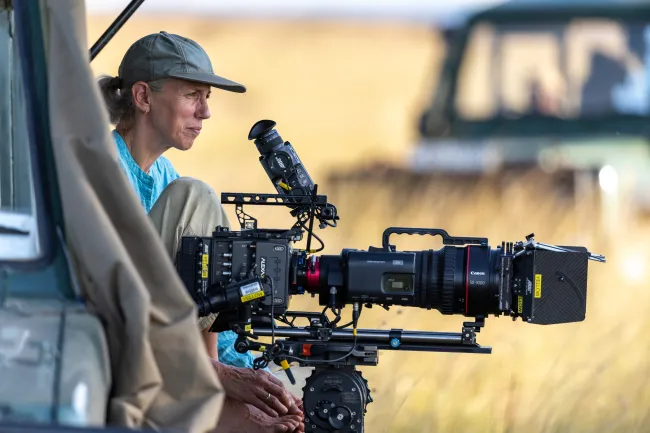
“By getting into their eyeline, we’re getting into their world. So we had low mounts that we used, where you’d sit on the side of the car as kind of a bolt-on. And we had a little modesty curtain so we didn’t scare the lions, because, believe it or not, lions are much more scared of us than we are of them,” Darlington said.

Then the challenge was to be on the spot for anything and everything their subjects might do — like lying flat in a car bed, every day, often for 16 hours or longer. “I had a Ronford-Baker Atlas 50, which is Roger Deakins’ head of choice. I copied him because, well, he’s kinda cool,” Darlington joked about their gear package. “ It gives you the absolute weight and the smoothness and the torque that you need when you’re filming a lion. You need to be able to follow very smoothly with ultra-long lenses.”
Everything from the camera heads to the long lenses to the 2:1 aspect ratio, which Darlington credits with making the imagery feel more cinematic than a docudrama-like 16:9, helps create a sense of immersion. But while Darlington and her team kept improving their approach, especially with the drone work on “Lion,” they never let shiny new tools distract them from the storytelling.
“ It was all about long takes and the lion’s eyeline. Immerse yourself in that lion’s world. Immerse yourself in the beauty of the Masai Mara. Let that character, that place? Let them sing, and make it as organic and as natural from the grade through to the movements. Hopefully nothing makes you go, ‘Oh, I wonder what camera they used there?’” Darlington said.

The grading process was one of the places where Darlington and colorist Daniel Gill really wanted the image to look grounded and authentic, not polished and Instagram-filtered. The true color of a lion is, according to Darlington, about the same as digestive biscuits, depending on whether you’re buying the cookies in the UK or the U.S. In fact, the team had a full biscuit guide to ensure the lions always looked just right—never supernatural or oversaturated.
“I sat there and went, ‘Right, Dan, here’s the deal: digestives, Hobnobs, maybe a Rich Tea. Never Ginger Nut. There’s one category where there is this incredible yellow light at dawn and dusk, maybe then we can go Ginger Nut. But any other hint of Ginger Nut that gets in, I’m upset. We’d kill ourselves laughing about heading into Ginger Nut territory,” Darlington said. “But in all seriousness, it was about keeping [the lions] authentic and real.”

That authenticity is crucial, both to Darlington’s work as a whole and to “Lion” in particular. Almost no documentaries follow the lives of young male lions because they leave their mothers’ pride and tend to go into hiding as juveniles, scavenging and moving at night, along with ranging across the border from Kenya into Tanzania.
“As the story was beginning to unfold, I was like, ‘Oh my God. You stayed around! Not only did you stay around but you’ve moved in with the pride that we filmed on previous productions and know really, really well,” Darlington said. “[Kio] was actually 10 minutes from our camp at the very end. It was like, ‘Yay, you read the script.’”
When something kind of miraculous or serendipitous happens, however, the goal is to make sure it doesn’t feel scripted. “ In this time of lack of authenticity, to be in a story that’s real, that’s authentic, that has taken years to craft and isn’t perfect…. There are moments where I want things to be different, but actually they’re real, and that makes them kind of amazing,” Darlington said.
“Lion” is airing on National Geographic and will stream on Disney+.