Last year, during a panel with her fellow head writers at “Jimmy Kimmel Live!,” executive producer Molly McNearney said her partner, the show’s host, is “so good at just being flexible and pivoting, and I love us all getting in a room and just [saying] ‘OK, what are we doing now?’”
What a difference a year makes. During this most recent season of the ABC late night talk show, currently nominated for six Emmys, including Outstanding Variety Series, Outstanding Writing for a Variety Series, and Outstanding Directing for a Variety Series, was faced with its biggest “What now?” moment yet via an indefinite hiatus.


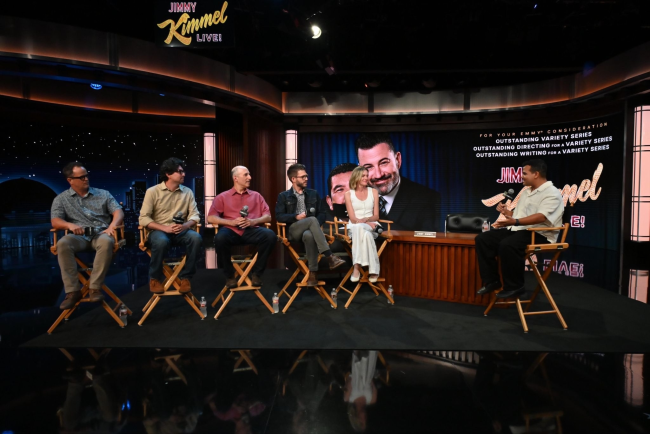
At a new panel with “Jimmy Kimmel Live!” writer/producers McNearney, Danny Ricker, Gary Greenberg, Josh Halloway, and director Andy Fisher, taking place at the show’s Hollywood studio, the group shared what it was like to go through having the show pulled from the air for a week in September 2025, after Kimmel faced the wrath of the FCC over a comment he made on the show about the man who killed political commentator Charlie Kirk. And, more importantly, how they all banded together to write and produce the highly anticipated first episode back, which garnered over 6.2 million viewers, despite not being available in a quarter of the country.
“The thought that that would’ve been our last show really upset us because we have great plans and ideas for if and when that happens,” said McNearney, describing her initial feelings about the show going dark for an unknown amount of time at that point in mid-September. “We wanted to make sure we got to write our own ending and do it the way that we want to and celebrate with the people who mean so much to us. So we were trying really hard to keep people’s spirits up where we could, but we didn’t want to also mismanage expectations because we genuinely had no idea if we were coming back.”
Ricker, her fellow head writer and co-executive producer, describing the unique experience, said, “I’ve never been more thankful to work with such a, not just supportive group of people, but just funny group of people because I think there’s a gallows humor that happens in a time like that. And I think that’s probably the hardest we’ve ever laughed just because it was like church laughs for three days being like, ‘Isn’t this crazy?’ And I mean, when we left here, there were news helicopters outside. It was a weird situation. And I’m just glad I was with these people and everyone who works here because it would’ve been a lot scarier without everybody.”
One difference about the monologue from the September 23 episode, where “Jimmy Kimmel Live!” returned from the hiatus, is that the host wrote “95 to 99 percent” of his opening monologue according to Halloway, a co-head writer and supervising producer on the show, who often spearheads the team of writers that work with Kimmel daily on the opening segment.
Ricker recalls a group of the writers and Kimmel eating sushi at his house the night before. “We hadn’t really talked business yet,” Ricker said. “And we were like, ‘So do you know what you want to say tomorrow?’ And he goes, ‘Oh, I kind of wrote a thing.’ And he’s like, ‘I’ll send it to you.’ And it was probably 85 percent of what you saw in the air. And we’re like, ‘You asshole, this is so good.’”
McNearney compares the monologue to two other famous ones Kimmel has written, one about their newborn having to undergo an emergency heart surgery, the other about the death of his friend and band leader Cleto. They all three stand as examples of how the show becoming more personal has been very resonant with viewers. “The reason that monologue felt so authentic was exactly for that reason, is that that was actually how he felt,” said Ricker. “It wasn’t how 20 people felt. It was how he specifically wanted to address the situation.”
Where the rest of the writing team really came in, during the uncharacteristically 30-minute long segment, was working on a last minute bit in the back half where Kimmel speaks to an FCC commissioner played by Oscar winner Robert De Niro.
“It was weird, there was so much going on that day. We’re like, ‘Oh yeah, maybe Robert De Niro will do this thing.’ And we had our field team that’s amazing, [they] had a hotel room in New York where he was, set up the set dressing, everything, all the props. And we’re like, ‘OK, Robert De Niro’s in the car and he might go to the hotel.’ And we’re all here going like, ‘OK, great,’” said Ricker. “That was less than 30 minutes before that big show we were doing.”
“What was important to us with that show was we wanted to do that first part [of the monologue], but also we wanted to do our show. We want to still be doing our show. And to have a bit like that, that we could do, it still felt like an episode of our show,” said Halloway. “It just required a lot of fast writing on the part of the staff too.”

Greenberg, another co-head writer and supervising producer, joked “God bless Robert DeNiro. How old is that guy? He had just been filming ‘Meet the Fockers 7’ or whatever it was. And literally he gets off of there, goes there and is in front of the prompter, reads it, and then boom, on the air.”
Director Fisher recalls not knowing he would be directing the screen legend until day-of, but his long experience on the show, starting off as an editor, has given him enough preparation to roll with the punches. “Editing in real time, live, and just existing in a reactive space where it’s like, ‘Yes, there is a script. Yes, we’re working off of this. This is our ultimate goal, but something else could happen,’” he said, speaking about what he has learned working on the show. “Being prepared for that and just being more fluid with it, even though it’s like being familiar enough with the material that you can improvise, move around and kind of come back in if something goes off the rails.”
“The ability to be flexible like that is so important in our type of show. And I think there’s a lot of people, myself included, who just would’ve wilted under the pressure Andy was under to get all that done,” said Ricker, referring to their work on the comeback episode. “But we did it and it went great. And it was just a bit over Zoom, but it looked like a real thing we shot. And so that’s one of my favorite days here is where I go home, I go, ‘We did a lot of shit today. And it all went well.’”
The continued support the show has gotten from viewers post-hiatus has not gone unnoticed by McNearney. “It used to be that Jimmy would be at a coffee shop and someone would say, ‘Where’s Guillermo?’ Or ‘Where’s Matt Damon?’ And now it is people coming up to him with their eyes full of tears saying, ‘Thank you for trying to save democracy,’” she said. “I don’t think we’ve changed the way we’ve done things. It became overwhelmingly important to us in that moment that we continue to tell the truth every night and try to make people laugh.”
Watch the full conversation with “Jimmy Kimmel Live!” writers McNearney, Ricker, Greenberg, and Halloway, and director Fisher in the video above.