In a darkened room, 3,000 fans are chanting one name, and one name alone, in unison: “Lestat! Lestat! Lestat!”
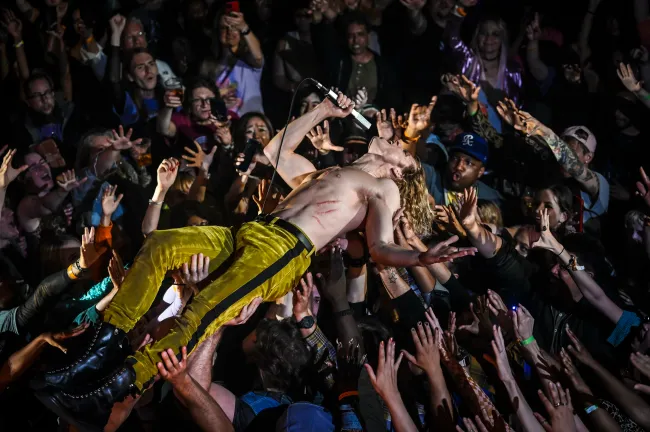
Smoke fills the stage of New York’s Beacon Theatre and the musicians enter, led by composer Daniel Hart, and begin playing the opening chords of the breakout hit for the self-named band The Vampire Lestat, “Long Face.” That’s when the chaotic vampire (or is he?) himself enters, strutting like a pussycat while pulling faces at the crowd, who, if possible, start cheering even louder than before.
Carefully, purposefully, Lestat turns toward the audience, curling his fingers around the microphone, the scars he got from killing a pack of wolves in his youth (or did he?) visible on his mostly bare chest. “Ooh-ooh, wah-ahh,” Lestat sings, the lyrics to the hit halfway between a come-on and the coo of a baby. If possible, the crowd erupts even bigger than before.


None of this is real, of course. Or maybe it is.
What definitely happened on June 2 in New York City at the iconic Beacon, which once played host regularly to the Allman Brothers, Bob Dylan, and Steely Dan (among others), is that AMC’s adaptation of Anne Rice’s “Vampire Chronicles,” now titled “The Vampire Lestat” premiered and then followed it up with an in-character performance from star Sam Reid, rocking out the songs that will appear in the upcoming seven-episode season.
But that’s just half of it.
“Well, the way that we’ve been looking at it, because it’s all been so meta. … Lestat has a TV show, and then he also has a band,” Reid told IndieWire in advance of the performance. “So if he’s out in the real world, this is him promoting his TV show, but also, this is his band. We’re trying to have some sort of way to distinguish so we can play with that meta level. Otherwise, it can get a bit confusing.”
Admittedly, it still is a little confusing — par for the course for the purposefully conflicting narratives of the two seasons of “Interview with The Vampire” that preceded “The Vampire Lestat,” as well as the upcoming season itself. And the special, one-night only event was meta in the best sense, speaking to a series that repeatedly turns in on itself, providing conflicting narratives and crafting what showrunner Rolin Jones told IndieWire is “the usual seven layer burrito that we build for ourselves.”
It started with fans packing the outside of the Beacon earlier in the night, surrounding the venue dressed in everything from corsets and black lipstick to shirts for “The Lost Boys” (never wear the band shirt to the concert, don’t you know). One fan packed in an enclosure by the stage door held a bloody rose, hoping to catch a glimpse of the cast of the critically acclaimed AMC hit.
Inside, as the step and repeat cleared out and the cast entered, both the packed orchestra and two balconies screeched whenever a member of the cast entered. Could Eric Bogosian, who plays the interviewer-turned-vampire Daniel Molloy have imagined back in his Off-Broadway days that thousands of goth or goth-adjacent teens would be losing their minds when he entered a room? Probably not, but everyone from Bogosian to new star Sheila Atim, who plays Akasha, the Queen of the Damned, and even AMC execs got the same treatment.
So did the premiere episode of the series, which includes multiple musical numbers from The Vampire Lestat performed live. The main event was the nearly-30 minute live performance by Reid, backed up by Hart and a full rock band, as they ran down some of the music that has been blowing up online.
As one of those wildly-popular-with-teens AMC execs touted before the screening, the songs have been getting “millions of streams.” The set started with “Long Face,” before moving into the thus-far unreleased “Big Bad Wolf,” the soulful ballad “Your Biggest Fan,” “The Loneliness,” another unidentified unreleased song, and finally “Butterscotch Bitch.”
In between, there was plenty of commentary throughout from “Lestat” as he derided the publication of “Interview with the Vampire” — a big plot point that kicks off the action of this new season — went through multiple outfit changes, and basically proved that if Reid wants to tour as Lestat for real … he can.

“I’m excited for people to hear [show composer] Daniel [Hart]’s music, and he has songs that they’ve not heard before,” Reid said. “I’m excited also about showing people the way that we’re going to do the set. It shows the progression of Lestat and his music and it does do a little mini arc of the show as well. … The way that the songs are getting released now, the way that marketing works, they’re not necessarily fully supporting how we actually use them in the show. Doing the live [show] will actually give a bit more of a context to how the songs work in the context of the story.”
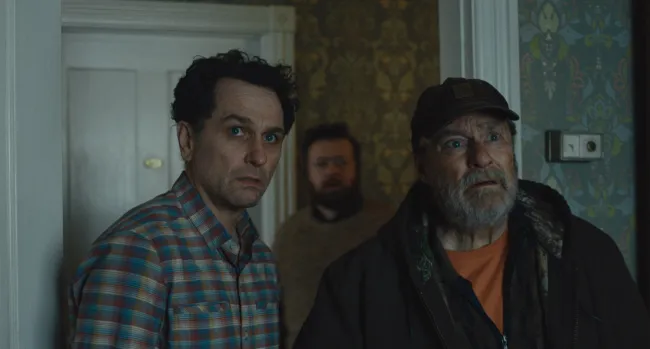
On the surface, “Interview with the Vampire” — now titled “The Vampire Lestat,” though really it’s very much Season 3 of the series — is “just” another entry in the Immortal Universe, AMC’s adaptations of Anne Rice’s books that includes “The Mayfair Witches” and “Talamasca: The Secret Order.” But what Jones and company did with the first two seasons was new, recontextualizing and reimagining the narrative Rice set down years ago of angsty vampire Louis de Pointe du Lac (Jacob Anderson) telling his story to interviewer Daniel Molloy.
While staying faithful to the gothic tone and thrust of the story, the second book in the series once again turned the narrative in on itself by front-loading the perspective of chaos personified, Louis’ tortured and torturous lover, Lestat de Lioncourt. Only this time, it’s also a rock musical, as Lestat aims to tell his side of the story recounted in the recently published book … by embarking on a North American rock and roll tour.
Alongside original songs and covers, the new season also revamps (no pun intended) the visual language of the series to embrace the music video chaos of life on tour with Lestat. “There was this famous dissonance between Book One and Book Two, even when they were novels, and we wanted to be respectful of that,” Jones said during a Zoom call. “There’s a new person telling the story, and that should dictate not only the plot, but the form and how we do it.”
Rather than this depicting Lestat’s victory tour, “The Vampire Lestat” takes the tact that while audiences are packed and hungry for what the rock vampire is dishing out, both in front of and behind the scenes he’s becoming even more unhinged than usual. “It’s not only [that it] should feel like Lestat is going through an absolute nervous breakdown, [but he’s] having some really, really, even for him, bad, bad months, and then this detached retelling of it on top of it, too,” Jones said.
Seasons 1 and 2 were about Louis correcting the original interview he conducted with a younger Daniel, adding bits and ultimately coming to shocking realizations he had suppressed, thanks to the machinations of Louis’ new lover, the jealous Armand (Assad Zaman). With a “new guy in charge,” Jones explained, the story this season needed to be told in new ways.
And yes, there are characters you know, including Louis, Armand, and notably Daniel, who is now working as a filmmaker aiming to go to Cannes and/or win an Academy Award off Lestat’s tour doc. But Lestat gets his own cast and characters to support him. That packed burrito, along with the frenetic visuals of the season, are all for one purpose: to keep Lestat watching.
“We would say, if we’re going to build seven episodes, Lestat has to watch them, and we have to prevent him from walking out and saying, ‘You guys didn’t understand me at all,’ or ‘You guys are boring,’” Jones said. In order to make sure “Lestat” was enraptured, they looked to classic NYC club CBGB, and “all the tattered photos and graffiti. … There should be [this] grotty beauty to this year’s thing. And it should slink like he does. It should move like a bipolar panther. It’s not two guys sitting in a room going, ‘You tell me, and then I’ll tell you exactly what happened.’”

For Reid, moving from supporting Louis’ story to anchoring his own has been a journey of five years — which has never stopped. The actor recalled how the show started during the COVID lockdown in Australia, with everything being done over Zoom, from the auditions to script reads. During the production of the first season, most of the New Orleans-based crew had masks on. “I barely saw people’s faces,” Reid said. “It was a very mysterious time.”
Initially, Reid wasn’t sure what to think of the innovative show (“this is crazy,” is the exact phrase the actor used). But since then, Reid lauded “constant” conversations he and the other cast have had with Jones and writer Hannah Moscovitch, as well as a near non-stop press tour that has made the whole unit extremely close. “In the early stages, it was sort of like we’re still navigating what the show was, or trying to understand what their vision was for it, whereas now I’m like … whatever you want to do, I believe in you,” he said.
And this year? The show believes in Lestat — and believes Lestat.
Though Reid noted that there has to be some accuracy in Louis’ portrayal of Lestat in the first two seasons “for you to fully buy their love story,” when we meet Louis in Season 1, “he’s very angry. He’s got a lot of misinformation. And there’s a lot of violence in the way that he portrays Lestat’s mega-love bombing that happens to him.”
Naturally, Anderson sees things a slightly different way. For him, “Louis is a part of me now,” and when Season 2 ended, the actor attempted to purge the character from his system by spending a day as himself in New Orleans, grabbing a few stones from the Bywater (a neighborhood in the city) and scattering them around town in a “ceremonial thing.” That turned out to be helpful because, in Season 3, “Louis, seen through the eyes of Lestat, is very different,” Anderson explained. “I got to say goodbye to Louis’ version of Louis.”
When Louis is describing things in the first two seasons during his interviews with Daniel Molloy, “Whatever you’re going to get [is] a deeply subjective angle,” Anderson said. “Lestat is less eloquent, and that’s reflected in the way that Louis speaks, for instance, in Season 3. You see this strange version of him … Lestat knows Louis. To an extent he might have a different interpretation of who he is, but he knows him.”
Whichever part of the cast narrative you believe, Season 3 is Lestat getting to tell his side through a series of recordings, in his own words and voice. “When he’s telling his own story, he is also very capable of pointing out his own flaws and showing the uglier parts of himself, or the complicated parts of himself,” Reid said. “Lestat has a bit more self-awareness and is aware of his own destructive nature on his own life.”
Over the course of this season, you will see Lestat “deal with the repercussions of that, and he also makes the audience sit there with the more uncomfortable parts of his of his existence, because he’s unpacking his centuries old life, coming from a catalyst of sexual trauma, which then in turn [makes] him into a hyper-sexual being,” Reid said.
As music infuses every moment of the new season, regular show composer Hart was part of the writing staff, working hand in hand with Jones and company to help craft the story of the season. ”He joined in,” Jones said, “but he also had free power to get up and walk out the room, and we wrote it in a house. And he had a garage space over here, and he would just go, the muse would hit him, and he would walk off. And then two days later, he’d have a song. … A couple of times, we ended up structuring episodes around it.”
Adding that there was “a lot more road mapping with these scripts than usual,” Jones explained how they would have “giant holes in some places” that would eventually be filled with songs that helped bridge the emotional gaps, while allowing things to be “contradictory” and “messy.”
Once the scripts and music were in place, it was time to hit the stage, and that brought massive challenges of its own particularly as Reid and his band actually performed the songs in front of live audiences, in real music spaces, often for hours at a time — something that more than likely set the stage for the live gig at the New York premiere. But during production, Jones had to make some “painful choices. … There’s a couple things that we didn’t get to shoot because, you know, here’s the calendar, here’s how many days you can shoot. You have to be generous on these musical days, because they’re really, really involved.”
For example: you can’t just “point a camera at Mr. 26-inch waist the whole time,” Jones quipped. Instead, they’re trying to tell a story through the song, and through the scene, meaning beyond getting the live performance in a club atmosphere, they needed to be both “succinct” with the story and “all over the place” with the camera.

One other important aspect was crafting Lestat’s stage presence. Though he did look at many rock stars for inspiration, Lestat is very much his “own thing, physicality-wise. But what I kept coming back to was David Bowie. … Bowie had this alien presence,” Reid said. “It’s such an overwhelming experience to watch, because you’re aware that you’re in the presence of this other being.”
Bowie helped lay a foundation, but as Reid noted, Lestat on stage is his own thing. “He’s performing how he thinks the world sees him,” Reid said. “I wanted him to feel like he was performing a rock star; what he thought a rock star should be. … He’s a proud monster, and he won’t manipulate an audience into loving him or liking him. He wants to earn that for himself.”
As for the actual logistics of performing, the production would attempt a song or two a day, depending on the schedule and the venue. There was a real audience of extras who — given the amount of times the song would be played — would often learn the whole song. “The band rehearsed their asses off every single week or in production,” Reid said. “They were rehearsing, rehearsing, rehearsing, and I could go to them when I could fit them in around my schedule so we could do the whole song. We would shoot the whole song, with the actual crowd, mostly in a real theater.”
While Reid called it a “fun, wild experience,” the extra wrinkle is that Lestat is a vampire. So, in addition to the performance from a live band, the audience full of extras, cameras on them, as well as cameras from Molloy’s documentary film crew on stage and in the audience, “there’s flying and there’s stunts, and there’s points of view, sweeping, swooshing around, and I’ve got to be looking at different points and marks and and there’s rigs.”
One person who isn’t singing those songs back, at least not initially? Louis, who attends one of Lestat’s concerts in the earlier episodes, but purposefully does not react to it. Or, at least, not outwardly reacting.
However, for Anderson in real life, it was a joy to watch. “Sam was just Sam and the band are performing live so they could do the whole song, or they could do sections of the song [so] you could just jump in and out,” Anderson recalled, “[and] some of these songs in particular are like heavy bangers that I sing to myself now. It’s a free show I just get to watch.”
All this adds up to an extremely complicated season of television to film. One way of potentially simplifying the season that never happened? Filming the whole thing on phones. “Rolin, at one point, he was like, ‘The whole thing is gonna be filmed on an iPhone, which we didn’t do,” Reid recalled, adding, “Thank God.”
“You look at the budget, and you look at the scale of what Anne wrote, and it’s really large,” Jones said. “My first suggestion was, well, you know, we’ll just do it like ‘Cloverfield’ or something like that. … There wasn’t an appetite for that at the good old AMC.”
Instead (probably rightfully so), AMC wanted to make sure that “The Vampire Lestat” wasn’t hiding the good stuff, but rather showing it. “In theory, at that point, if we had done it that way, we might have been able to sell arena rock and we could have maybe gotten the large, Taylor Swift version of this,” Jones said.
But with phones nixed, another interesting story idea presented itself: That Lestat is maybe not that popular. Or at least, not as popular as he would like to be, or thinks he is. “The reality of is, if you wanted to start a rock n’ roll band in 2025, you’ve got no fucking shot,” Jones said. “The meditation on failure became the thing that we were most interested in.”
“He’s eating a lot of humble pie,” Reid added, “because it’s not like he’s selling out stadiums or anything like that. He’s actually playing small, scrappy gigs in weird regional towns, which is a humbling and surprising place to put The Vampire Lestat. … this figure who, in everyone else’s version of him, is operating at this massive scale.”

Even though Lestat is maxing out at 2,000 seat venues (when we pointed out that Reid filling the 3,000-seat Beacon in real life is bigger than Lestat on the show, he laughed), he’s still got a massive tour bus for his band, complete with an enormous gold bedroom area with an open shower in the middle (and yes, it gets used. A lot.) That bus, beyond being a fun setting, was also utilitarian.
Since most of the season takes place with Lestat’s band on tour, if you want to sell a band going from Toronto to other cities in North America, “you can’t reuse sets because there are different cities over the time. So [the bus is] our one set that we could write multiple scenes in,” Jones explained.
For inspiration, they looked at Mariah Carey’s tour bus and others, then imagined that Lestat gave the front half a massive makeover and didn’t spend a lot of time worrying about the “downstairs,” where the rest of his band lives. The look reflects that, with “mostly chaos and grime and grunginess on the bottom and primary colors on the top.” The whole bus was built out with a combination of LED screens and “some really, really smart programming” to make it look like it was traveling to various locations, but led to something Jones feels is “very singular.”
For diehard fans, Jones highly recommends “doing still frames and seeing how much detail is in it. There’s a lot of very strange shit on that bus that doesn’t necessarily get talked about.”
While the bus is the major new set of the season, another vitally important aspect is the addition of Gabriella (Jennifer Ehle), Lestat’s mother. Fans of the books have long wondered about their disturbing relationship, which has the subtext of incest. “There’s a very explicit and confusing scene in the books very early on when they’re human, which we show,” Reid said. “It’s been expanded upon and made more appropriate for filming, but it’s there in the books.”
When asked about that, Jones laughed. “When I read it, I was like, ‘Well, I know what’s going on,’” he recalled. “It didn’t seem like subtext to me. It seemed quite like text when I read it, and the responsible way to do it is to get out in front of it. Because if it’s a reveal, and that’s everything it is, then it is just for shock value. … That’s the given circumstances of this relationship. Now get in there and see how multi-layered, effed up that is.”
The show has long dealt with the complicated relationship between Lestat’s abuse in the past — from his mother, as well as Magnus (Damien Atkins), the vampire who turned him — and his own abusive behavior in the present of the TV series, notably towards Louis. And with Gabriella present, yes, that’s certainly something the show will deal with, as well as Lestat’s confusing memories around what happened.
“You can narrate one thing, but you can also feel something different,” Reid explained. “That’s the joy of having unreliable narrators. … You understand Lestat a lot better when you get to understand his relationship with his mother. He doesn’t fully understand his relationship with his mother. It’s a very, very complex and messy thing that has set him up for a lot of failure in his life.”
Thankfully for Reid, he had Ehle to work off. “She’s an extraordinary actor,” Reid said. “She was so fearless, and she came in and we did a lot of our stuff early together. … We got to really spend the first couple of weeks on the show developing that relationship and trying to work out what it is. For me, it’s really fun to have a character who can destabilize Lestat in the way that Gabriella can. It’s different [from] his relationship with Louis. There’s a darkness to it that he even hides it from himself. … We’re definitely deep, deep into incest territory, but there’s quite an interesting commentary about it that we get to by the end of the show, which I think will feel earned.”

“It’s not three hours of intense therapy with everybody. It’s given circumstances, what can be provocative. And how do you find beauty out of all of it? And how do you find levity?,” Jones added. “It’s really important this year, levity, because that’s how [Lestat] deals with life. It’s not only that he’s producing laughs, but he has this uncontrollable laughter that Anne wrote in as part of the character that I think he sees, whether it’s the landscape of America or whether it’s the Molloy in front of him … the absurdity of it is very visceral for him.”
(Of note, perhaps, during the live show, “Lestat” paused to laugh between songs, which drew some of the most appreciative audience screams of the night.)
So, what about Louis and Lestat?
“We are operating in tandem,” Reid said of the duo, who spend significant amounts of time apart in the series, but always feel connected. “The heart of the show is this love story, and how these two characters will find their way back to each other. As the show expands and expands and expands, it’s, how is this love story dealing with the repercussions of the events previously, and the previous seasons?”
Noting that he and Anderson are good friends with an “easy rapport,” Reid added that while they have a joyful experience together, flipping to Lestat in lead — versus previous seasons in which nearly every scene Lestat appeared in also featured Anderson’s Louis — allowed him to discover new things about his character as he interacted with new characters. “Louis and Lestat give each other a certain dynamic, and then you add new dynamics, and then we come back to each other having learned those dynamics, working with the other actors,” he said. “The show is a gift that keeps giving.”
Also giving? The fans. It’s not entirely a coincidence that Jones sees a connection between the diehard fans following Lestat on tour, the fanbase for Anne Rice’s world as a whole, and the AMC shows in particular.
Reid compared the intense fanbase for the TV show with the one Lestat has, to the point that Lestat in the show calls his fans “The Beautiful Unwell,” something real fans have taken on in real life. And of those extras at the concert scenes this season, some were already fans of the series, adding an extra layer of meta-commentary.
“In the beginning, it was very nerve-wracking, because you didn’t want to damage these dreams that people had connected to the source material,” Reid said. “But as the show has evolved, and as people have … found a new appreciation for the Anne Rice world through our show, or just the show, and not the books at all. … There has been a lot of cross-contamination and it’s an amazing thing to feel so connected to.”
Anderson agreed, noting that fans having “complicated feelings through this show” and turning those feelings into “something positive, turn it into something artistic and creative” is a nice parallel to what he and the rest of the cast and crew are trying to do themselves: create “beautiful art.”
“We’ve had a conversation with fans right from the beginning, because they have this book that a lot of our fans have memorized to the comma,” Jones said. “And our job is to try to make something that would keep this fresh and keep them not ahead of it. Otherwise they’re just going, ‘How do they cast this?’ ‘How do they do this?’ And that would be a very dull experience. So this year, having that conversation, it’s an extension of what we did. … They have the book. They already read the book for the first time or the twelfth time. They have expectations about what should be there. And it’s not that we don’t deliver that stuff. We just deliver it sometimes in a different way.”
“The writers never do fan service, but they’re aware of the psychology of the online generation, and it means that they can, particularly with this season, talk to them directly, and start making more direct commentary about the contemporary age,” Reid added. “Because now we’re in the modern times, and it’s why Lestat is quite a nihilistic figure; because we are living in this nihilistic time.”
There are hints in the first few episodes of the new season that the scope and scale of the narrative may blow far past where one might expect from Lestat’s little rock show. And, yes, the books get bigger as they go, including more ghosts, and witches and monsters beyond vampires. “But actually, even in the absurdity and the grandness of the scale, Rolin and Hannah have an incredible way of bringing it back down to a human experience, and that’s why it’s actually very relatable,” Reid said.
Anderson agreed, adding that “in true Anne Rice fashion, the epic is the intimate. The intimate is the epic. This is a very intimate season of television. We’re very much in Lestat’s mind.”
Added Reid, “Lestat’s world is chaotic, but at the core of it is a shared human experience, and it’s very, very moving.” That’s music to our ears.
“The Vampire Lestat” premieres Sunday, June 7 on AMC and AMC+.