When Laura Kittrell was first tasked with creating a “Legally Blonde” prequel, the showrunner told IndieWire that she looked at a calendar and thought, “Well, if the movie takes place [in 2001], it must be 1995, so where can we put her that feels like the most specific to the time period but also doesn’t feel too similar to Harvard? Grunge-era Seattle felt like the perfect choice.”
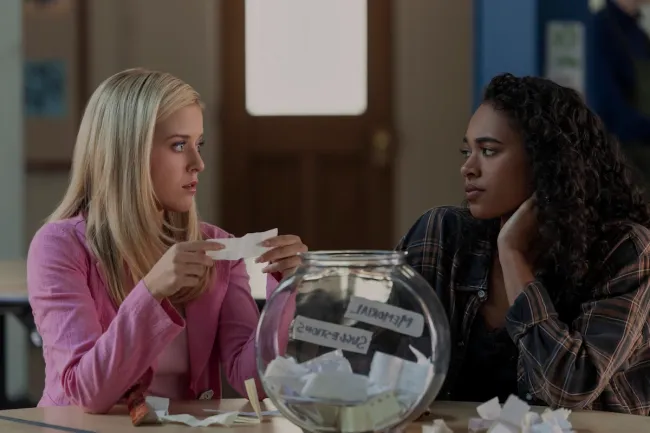
Prime Video’s “Elle,” which dropped its entire first season on July 1, centers on the Bel Air social butterfly originated by Reese Witherspoon (who is an executive producer on the series), played here by relative newcomer Lexi Minetree in a perfect homage to the film. When her parents — the wonderful June Diane Raphael and Tom Everett Scott — fall into professional reputational strife, the family is forced to relocate to Seattle to rebuild their lives.


Though the original movie is the quintessential fish-out-of-water tale, with Elle Woods having to find the courage inside herself to make it as a law student at stuffy Harvard, this redux was born out of a necessity to not just redo “Clueless,” “Which is something that exists and is perfect and they have that cornered,” Kittrell told IndieWire.
“Thinking about the pink and the surface elements of the movie … all of that is important to what the world is, but I think the reason that it’s had the staying power and the reason it’s so important to so many people is the character and what she’s like when she’s standing up to adversity and people who misunderstand her when she’s put in this underdog position,” she continued.
Kittrell’s co-showrunner, veteran writer Caroline Dries, said they did not want to remake “Legally Blonde,” but instead use the source material as inspiration to reverse into the movie. The iconic bunny costume moment, when Elle is tricked into showing up to a non-costume party wearing a Playboy bunny get-up, was the catalyst for exploring how Elle was able to shake that humiliation off.
“There was something in her past that allowed her to be comfortable in her skin at that moment,” Dries said. “What happened? So let’s tell that story. That’s an example of using the movie to back into a foundational moment in Elle’s life.”
During the peak of grunge, Seattle was the perfect choice then to amplify Elle’s unlikely underdog status, but instead of being the sullen outcast amidst a sea of shiny happy people, Elle sticks out like conformist Barbie at the countercultural rally. That gave costume designer Sara Byblow and music supervisor Brienne Rose the perfect canvas on which to play with the style and sound of the era.
While “Legally Blonde” is timeless in terms of its fashion (a rare feat for pop culture from the early 2000s!), Byblow wanted to make sure that “Elle” felt unmistakably of its generation because, she said, “In my mind, the ’90s is the best era for clothing!”

She did this by scouring yearbooks from 1995 in both Seattle and Bel Air high schools, as well as drawing from the pop culture icons who would have graced the posters on Elle’s walls, such as Claudia Schiffer, whose pastel mini skirts and textured sweaters from her 1994 campaigns for Chanel and Versace, certainly inform Elle’s Cali girl style.
In a moment from the finale, it would appear that Elle invents Versace’s safety pin dress for Heather Locklear, a direct reference to the dress the “Melrose Place”actress actually wore to the 1995 Golden Globes.
Gwen Stefani’s seemingly subversive (but actually appropriative) pop punk palatable feminism-lite was another touchstone for Elle. Therefore No Doubt’s breakthrough hit, 1995’s “Just a Girl” was an apt choice for Elle’s Seattle karaoke debut where, as with the bunny costume, she shows up in a bikini to a (skateboard) pool party.
It joins other riot grrrl and feminist punk-adjacent anthems such as Bikini Kill’s “Rebel Girl,” “Cornflake Girl” by Tori Amos, and Garbage’s “I’m Only Happy When It Rains,” which serves as “Elle”’s theme song. “Garbage was our perfect happy medium,” Rose told IndieWire. “They were a band that appealed to so many people even though stylistically they didn’t come from a poppy place.”
Ultimately, Rose “didn’t want to lose [Elle’s] identity. In high school, you’re really susceptible to what your peers listen to; you’re way more influenced by your surroundings.” So Elle might feasibly meld the Madonna and Mariah Carey she’s listening to at the outset of the season with the Seattle grunge ethos to arrive at the happy medium of Garbage and No Doubt, which feel more her speed. “We [used music] almost like a map” to chart Elle’s journey, added Rose.

That pick-and-mix mentality doesn’t go over well with Elle’s classmates. “Seattle isn’t a costume,” Kimberly (Chandler Kinney), Elle’s mean girl foe, admonishes her when Elle bedazzles a Nirvana smiley face t-shirt — “the second worst thing to happen” to the band since Kurt Cobain’s suicide the previous year, Kimberly contends. For that reason, Byblow and Rose tread a fine line, focusing on authenticity in the form of band t-shirts of that time and place, such as Kimberley repping Bam Bam, the lead singer of which, the late Tina Bell, was one of the first women of color in grunge.
Each creator spoke effusively about the collaborative environment of “Elle.” Whereas one might assume that a period piece would be all throwbacks, Byblow actually collaborated with the skate brand Vans to create a custom pink plaid print for the shirt Elle’s reluctant new bestie Liz (Gabrielle Policano) gifts her in the finale, at a performance of an original song by Sleater-Kinney commissioned especially for “Elle.” Rose also worked with composer Anna Waronker, who fronted the Los Angeles band That Dog and produced several other original songs on “Elle.”
There are some Easter eggs for keen-eyed “Legally Blonde” fans, from the dialogue (“I didn’t receive the summer reading list”), to the storylines (Elle gets a taste for the law when she thwarts school management corruption using the “simple and finite” rules of hair care), to the fashion (the heart shoes and red Bottega Veneta bag, which here belong to Elle’s mom).

(“Elle” also has the distinction of being James van der Beek’s final role in a full-circle moment that put the actor back in high school where we first met him on another 1990s high school show, “Dawson’s Creek.” “His character is instrumental to our plotline,” said Dries. “He loved being this frumpy character with the bad mustache and the bad fashion. He added so much to the role.”)
“Elle” has already completed filming its second season, which Prime Video renewed earlier this year. As the first season only deals with one semester of high school, “Elle” has a lot of runway if it were to continue for even more installments.
Kittrell, Dries, Rose, and Byblow aren’t getting ahead of themselves just yet, remaining tight-lipped about where Season 2 will take Elle, but we’re on the precipice of another exciting time in pop culture history: the arrival of the Spice Girls in 1996 and their co-opting of riot grrrl messaging into the mass marketed girl power. Sounds like the perfect backdrop for Elle to continue her feminist journey alongside her newfound Seattle tribe.
And, as the movie is set at post-graduate Harvard Law School, we could feasibly get “Elle: The College Years,” chronicling her time as a Delta Nu sorority sister at UCLA…
Season 1 of “Elle” is now streaming on Prime Video.