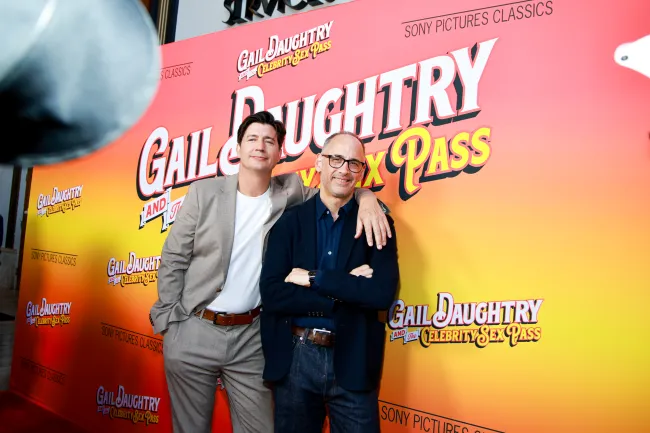
The absurdist comedy of director David Wain has long been associated with the sketch comedy of The State, with members of the ‘90s alt comedy troupe (including Wain) filling out his film‘s casts. While a guest on IndieWire’s Filmmaker Toolkit Podcast, along with his “Gail Daughtry and the Celebrity Sex Pass” co-writer Ken Marino, Wain discussed wanting his films “to feel slapdash” but, in reality, are consistently steered by a well-structured screenplay hiding beneath the surface.
“The goal is it feels sort of breezy and off the cuff, but if you look at it just one more layer, you see that we’ve really put in a lot of effort and thought,” said Wain. “It’s not nearly as much improv as one might think based on the feel of the material. We’ve figured it out in the script.”


In their new film, the bones of the narrative come from Wain and co-writer Ken Marino borrowing from “The Wizard of Oz.” There are nods to the 1939 classic — the name Gail Daughtry (Zoey Deutch) is a near-reverse of Dorothy Gale (Judy Garland) — but it’s more Dorothy’s journey itself that directly influenced the film. Instead of being dropped in Oz and searching for the Wizard, an equally innocent Gail leaves Kansas for Los Angeles to find her celebrity sex pass, Jon Hamm, and along the way is helped by a cast of Hollywood rejects not unlike the Cowardly Lion, Tin Man, and Scarecrow.
“It started with thinking, what are of different variety of types of people that would each have a reason to want to find Jon Hamm?,” said Marino, in discussing Gail’s ragtag crew. “We thought, ‘Who needs a brain? Who needs a heart? Who needs courage?’ It started with Ben [Wong’s] character, and we’re like, ‘Well, he thinks he needs a brain to be a big agent, but he doesn’t. He’s already got the tools for it.’ Vincent, my character, he’s a paparazzi guy who everybody thinks is heartless, but he’s got a bigger heart and he will help all his friends consistently.”

Having a strong, forward thrust of the Hamm search allowed the co-writers room for Wain’s trademark absurdist detours. In “Wet Hot American Summer,” there was a famous counselors’ trip into the town, in which the montage sequence turns into a completely different movie, complete with mayhem and a heroin-infested drug den, before returning to the more wholesome vibes of awkward kids trying to hook up on the last day of camp. “Gail Daughtry” takes similar detours.
“Once in a while, when it does grind to a halt on purpose, or go into a left turn that means nothing, it is itself purposeful,” said Wain. “People looked at ‘Wet Hot American Summer’ like it’s just a strung-together series of skits, but I think people who appreciate it see that it’s really not. It’s put together in a certain way.”
From the start, Hollywood was to play an Oz-like importance to Marino and Wain, who insisted and fought to shoot in Los Angeles. The film’s opening was filmed on an LA backlot set, capturing Gail’s idyllic small town of Willowbrook, Kansas in true movie fashion, before transitioning to seeing Hollywood sites through the Midwesterner’s wide-eyed excitement, until Gail starts to see the less glamorous behind the scenes world of the movie business.
“Then [Los Angeles] becomes a little bit bloodier, a little dirtier, a little grimier, and the climax takes place at the old Western town,” said Wain of the film’s second half.
It was an ambitious shoot, especially considering that the schedule was limited to 21 production days. With such a tight schedule, there was even less room “to find the scene” on set. Here again, the screenplay — made tighter with each new round of rewrites and table reads — was vital, Wain and Marino know they can lean into a collection of performers and friends well-versed in the comedy universe.
“They get the music of the comedy,” explained Wain. “And we rely heavily on the people we’ve worked with and know get the tone and get the kind of vibe of what we’re going for.”
Before writing their first draft, Marino and Wain didn’t check in with Hamm and his “Mad Men” co-star John Slattery — both of whose participation, playing satirical versions of themselves, was a prerequisite for the story — but there was an equal comfort level. They’d worked with Slattery before, and Don Draper himself was well-known in their comedy circles.
“[Hamm] was always a comedy nerd from day one,” said Wain. “ I actually semi-lived with him for a period right before he was on ‘Mad Men.’ We’ve both been buddies with him for a long time, but he has always been a super fan of all comedy.”
As Marino pointed out, their friends and themselves are becoming “old farts,” and the story did require new blood, like Wong and Deutch, but the two collaborators said after decades in the business, when meeting actors it’s become much easier for them to quickly identify who gets their vibe and will work in their world.

For as much work and belief they put into the script as the guiding force, post-production is, according to Wain, “a very additive and creative process,” actively adding dialogue, ADR, and applying a cold eye to their jokes. The film was edited by John Daigle in Wain’s Los Angeles home, which was also the site for regular living room screenings with friends and collaborators.
“I think one of the things about the way we’ve worked over the years is we’re just very brutal with our material, nothing’s sacred, and we put it through the wringer and try to get the best thing,” said Wain.
According to Marino, even once “Gail Daughtry” was cut down to 140 minutes, he and Wain were of the strong belief it should be 90: “We just kept chopping it down and finding new ways to kind of make it move and make it faster and funnier, just cutting to the funniest stuff and saying goodbye to some of the babies.”
Added Wain, remarking on the perspective he gains on their punchlines after seeing them countless times in post: “My litmus test is if it’s still making me laugh the 10,000th time, then we got something, and I’ve have felt like that.” He added, “Those jokes that we just always thought were good, but they [don’t consistently] land, you’re like, ‘Alright, take it out.’”
A Sony Pictures Classic release, “Gail Daughtry and the Celebrity Sex Pass” is now in theaters.
To hear Wain and Marino’s full interview, make sure you subscribe to the Filmmaker Toolkit podcast on Apple, Spotify, or your favorite podcast platform.