[Editor’s note: The following review contains spoilers for “Euphoria” Season 3, Episode 8, “In God We Trust” — the finale — including the ending.]
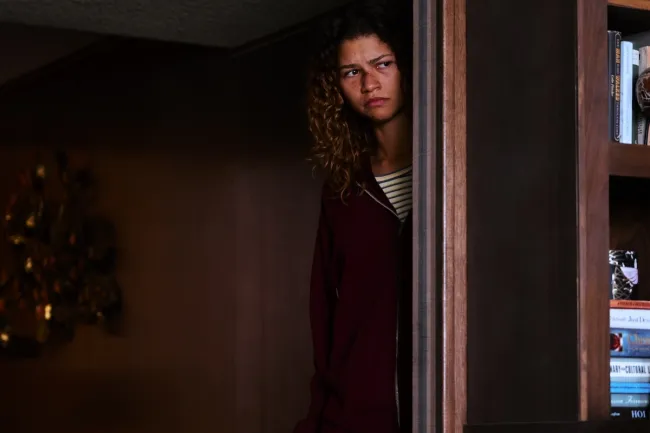
Near the midway point of “Euphoria‘s” series finale, when Rue (Zendaya) sees her mother, Leslie (Nika King) for the first time in years, a look flashes across her face so happy it’s heartbreaking. Director of photography Marcell Rev’s soft lighting accents her teary-eyed smile, drawing out her hope to return to a place she feared was forever out of reach. The moment is the direct culmination of Rue being kept out of her teenage bedroom and that haunted hallway throughout Season 3. From time to time, Rue would say she wanted to go back, but even without the exposition, her world outside of those walls is horrific enough to make them feel like salvation.


But then Leslie raises her hand, and it’s clear salvation is already out of reach. Leslie sitting alone in the dark reading the Bible is strange enough staging, even before Rue comes around the corner, but the way she silently responds to her daughter’s long-awaited yet complicated arrival is simply too hokey to believe. No wonder, seconds later, the scene cuts to what’s really going on: Rue is back on Ali’s (Colman Domingo) couch, overdosing on Percocet left for her on purpose by Alamo Brown (Adewale Akinnuoye-Agbaje) and having a vision of the peaceful reunion she’ll never obtain.
Zendaya has always been great at these scenes. Her smile in the fantasy is one of relief and clarity, which cuts so hard after watching the dread pile up before Leslie notices her. Then her smile on the couch is goofy and childlike, as if she’s only experience a level of happiness totally disconnected from reality. As it sets in that Rue is about to die, the euphoria she feels is simultaneously pure and tainted — a contradiction forced upon her by the drug that was Rue’s undoing.
To say that’s where “Euphoria” should’ve ended would be both true and insufficient. Yes, the one through-line across creator, writer, and director Sam Levinson‘s salacious HBO drama is death: Rue is constantly on the edge, be it back when she was doing hard drugs at high school parties in the early days or running drugs across the border in more recent episodes. As an addict, she’s trapped in a loop, and there’s no clean way out.
Except… that’s not enough. Pointing out the cycle of addiction while making vague gestures toward the systems that support widespread Fentanyl use doesn’t mean the surrounding story has a point of its own. That’s not a reason to spend all this time — especially a bloated, boring third season that ended with a bloated, boring finale (that still somehow only found time for a single, silent scene with Jules?) — watching young people suffer. It’s not enough to prop up a season (and arguably, a series) that has nothing to contribute to the issue other than fury and pessimism.
And it sure feels like Levinson knows it’s not enough after those ridiculous final 40 minutes.

“Euphoria’s” perspective leaps from Rue to Ali (aka Martin) when she dies, and he gets to give two revealing speeches about what it all might mean. (If you’re going to go this route, you better hire Domingo to sell it.) The first, at his last Narcotics Anonymous meeting, sees him admitting, “I used to believe the world would be a better place if people could empathize with addiction. … Maybe empathy isn’t all that helpful after all. … Maybe the real disease is that people no longer know the difference between right and wrong. I don’t care what your struggles may be. If you poison kids for money, you’re evil. Plain and simple.”
This sure sounds like the “anger” phase of grief, huh? Well, ol’ Martin here decides the best way he can be of service is to put on his old military uniform, saw off a shotgun, and head to the Silver Slipper. Therein, Levinson’s awkward Western motif comes to its inevitable conclusion with a standoff between Black Hat and no hat, evil and used-to-be-good, Ali and Alamo. Who wins is never really in doubt, nor does Levinson milk much tension out of the extended sequence (despite multiple armed guards surrounding Ali pretty much the whole time). So when Alamo meets his maker, the real question is what does it mean for Ali to be the one who introduced them?
Turns out, not much. He goes to visit the Miller family — the farmers who Rue crashed with in the Season 3 premiere — and says he’s there on behalf of his daughter. Mr. Miller invites him inside to talk a while, and then asks Martin to say grace for their shared meal. “I pray today for those whose eyes have grown weak with sorry, whose soul and body are weighed down by grief, and whose strength is failing,” Martin says. “Lord, pour out your mercy upon them. Let your face shine upon them, and save them, in your unfailing love. Thank you, Rue. Let her memory be a blessing.”
And then, the symbolically empty chair at the end of the table is filled with Rue’s literal ghost. “Amen,” she says, that famous smile spreading across her face.
So, what does this ending tell us? Had Martin gone straight to the Millers after relapsing (he admits to having a drink after Rue’s death), the closing scene would’ve made a little more sense. Everyone stumbles. Everyone needs help sometimes. Everyone will ask for help, or needs to ask for help, and all we can do is give back whatever we can. He’d be on a pilgrimage to reinvigorate the empathy he lost after writing Rue’s name in his book of the dead.
Except… there’s no indication Martin is repenting for his murderous vigilante rampage. There on that ugly little desert farm, is he once again humbling himself before a higher power, or is he going to keep hunting down anyone who poisons kids for money and is, therefore, evil? Is he trying to find peace in the place Rue described as the most peaceful place on Earth, or is he trying to make peace with the exception he’s carved out for himself in the Ten Commandments? “Thou shalt not kill unless you think they’re really, truly evil?”

I am not here to defend Alamo Brown, nor to argue in favor of always turning the other cheek. The bad man had to go, and I’m glad the bad man is gone. But what “Euphoria” tries to do in its spectacular failure of a finale is have its cake and eat it, too. On the one hand, there is the empty but “honest” portrayal of Rue’s most likely fate. On the other, there is the overwrought but far-fetched revenge for her death. Are we really supposed to invest equally in both outcomes? Are we even supposed to believe both outcomes are part of the same show? These scenes are diametrically opposed in style and content, only capable of sitting together if the outlandish latter moment also ended with a twist, or at least the possibility of one — where Martin’s big shootout was a fantasy, too.
Such an admission never comes, and we’re left to believe that’s what really happened to Alamo, Bishop (Darrell Britt-Gibson), and Maddy (Alexa Demie). (I do like the latter two as a couple.) We’re left with Cassie (Sydney Sweeney) all alone in her modern-day brothel, and Lexi (Maude Apatow) once again taking the moral high ground without fully grasping why. (Side note: The contempt shown for these two women is ridiculous, and their closing conversation about the Bible is the final straw. “That’s the heart of it, I think,” Lexi says. “Bad things happened. So why have anxiety about it? What good does it do? No matter what you have to keep going. That’s the point of it, I think.” …what? Her takeaway from what I can only assume was a light skim of the Good Book is that God endorses nihilism? And Cassie can’t even follow along! “What does this have to do with the Bible?”)
These character endnotes, whether they’re read as youthful naiveté or an insulting interpretation of youthful naiveté, contribute to the finale’s bitter aftertaste. While the ending hopes you mistake the lingering foulness for sorrow over the main character’s passing, the feeling is more likely rooted in disappointment. After three seasons and a four-year wait for the final episodes, “Euphoria” can’t even muster the courage to commit to its own honest ending. Instead, it admits to one fantasy while trying to sell you on another.
What a hustle.
Grade: D
“Euphoria” Season 3 is available on HBO and HBO Max.