One of the most uniquely beguiling, sexy, and unexpectedly uplifting gay films to come out in a year filled with the usual onscreen direness and dirge, “Drunken Noodles” is the third feature from Argentine-turned-Brooklynite filmmaker Lucio Castro. You may recall the wounding time slippages of his directorial debut “End of the Century” from 2019, wherein a “Before Sunrise”-style romance gets the Cubist-painting treatment, and a casual gay encounter resonates across multiple timelines.
His next feature, the 2025 Berlinale premiere “After His Death,” an autumnal grief drama starring his friend Mia Maestro alongside Lee Pace as an enigmatic cultlike musician, is one you probably didn’t see because it hasn’t left the festival circuit. Yet. (Stateside distribution is coming, Castro told us.)


Then came “Drunken Noodles,” which applies the warm mysticism of early Apichatpong Weerasethakul to another gay love story, one that feels closer to the New Queer Cinema of the 1990s or the breezy talkiness of ’80s and ’90s Éric Rohmer.
“Always Rohmer,” Castro told IndieWire over lunch ahead of his new film‘s release, when asked about references. “I like the simplicity of Rohmer’s dialogue,” even while “it’s very white people problems,” like wondering in which European city you’re going to spend the summer. For “Drunken Noodles,” he was most inspired by Rohmer’s “Four Adventures of Reinette and Mirabelle,” a picaresque quartet of sketches about a mischievous female friendship in Paris.
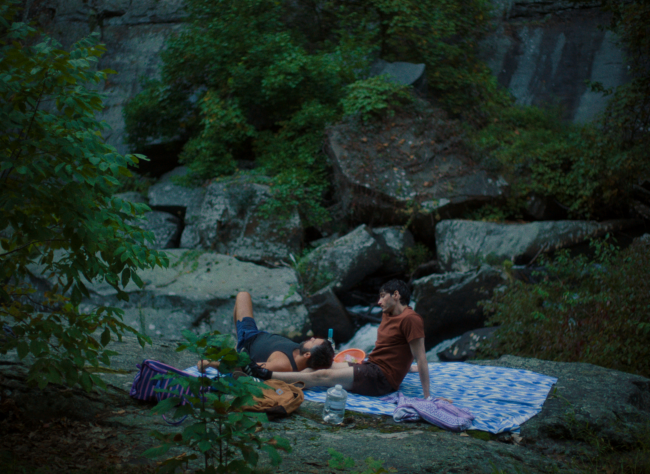
And “Drunken Noodles” unfolds in the haze of two discrete summers, in both the streets of New York City and the forest wood of upstate New York, as art student Adnan (newcomer Laith Khalifeh) has a series of intimate, even supernatural, time-and-space-warping intellectual and sexual encounters. One revolves around an artist named Sal (Ezriel Kornel), based on the real artist Sal Salandra, a New York-based needlework “painter” who embroiders homoerotic images that inspire several “Drunken Noodles” set pieces.
“I had gone to his house in 2021 with the intention of doing a documentary, but I found when I was asking him questions, I was performing,” Castro said, who decided to use Salandra’s work as the basis for a narrative feature instead. “I’m not a documentarian really, so I’m more interested in lying about it, and the truth that comes from that.” Fantasy, Castro said, as an approach to storytelling is “very innately queer, especially male queer … that drive could also be turned into something horny, [about] desire, openness, curiosity.”
The film is now in limited release from Strand, more than a year after premiering in the ACID section at the 2025 Cannes Film Festival; Castro and his producers had submitted “Drunken Noodles” to other sections, “but ACID said yes first,” and turned out to be the best decision for the film, which IndieWire called one of Cannes’ best.
“It’s a smaller section. They are so supportive,” the filmmaker said. Feedback since has been roundly positive, especially among gay audiences looking to relive the highs and glisteningly tender eroticism of “End of the Century.” (One Letterboxd user called “Drunken Noodles” “inland empire for twinks who refuse to get off of sniffies.”)

While one timeline of “Drunken Noodles” finds Adnan hooking up with a DoorDash delivery driver (Joél Isaac) and looking to exchange maybe more than just bodily fluids, another flashes back to a dead-ending relationship with an ex (Matthew Risch) that takes an eerie turn.
“I found the actors before I wrote. I found locations and actors before I wrote the movie to see what I could play with,” said Castro, who found several of his young and beautifully lit and blocked actors via the Backstage casting portal. The camera, too, is just as complicit in desiring Adnan, but it’s not exploitative.
“We shot it in Williamsburg, which is the least romantic neighborhood in the world,” said Castro, whose own apartment serves as the artist home Adnan is housesitting in. “It’s very easy to make beautiful images with a 16mm camera, but I like the challenge of doing it in digital, in a part of the city that’s not maybe the most photogenic.” Castro again works with cinematographer Barton Cortright to craft lush images that certainly evoke the illusion of celluloid, lending the movie a nostalgic, charmingly retro take on sexuality and an idyllic view of open-air cruising.
“New York is a city that’s crowded, but it’s also a really intimate city, a city where you can find your own little place,” said Castro, who moved to New York City at the end of the 1990s, graduating with a fashion degree from Parsons. “Getting a visa for film is a bit difficult, so I started to go into design.”

Soon, he’s headed back Argentina to shoot a movie in his home country for the first time — and what is “by far my most personal film,” one that looks more closely at the “big, tragic death” that changed his life when he was around 21, which might help explain the streak of fatalism running through all the director’s work. But he also promises the film will be humorous, and will explore relationships outside a queer lens.
“Right before, my dad was really depressed. He was in the military, a really complicated story, and had access to guns. Very few people could get guns. He could. He was a really intelligent guy. He was a nuclear physicist but always bound to depression. My mom wanted to leave him, so you know, there was definitely something in the air,” he said.
“I finished an exam, went out partying, and came back at 6 a.m., and saw there was something eerie in the light,” said Castro, whose father killed himself and then Castro’s mother in 1997.
“I never knew what to do with that. It’s so strong, it’s so self-contained as a dramatic event,” said Castro, who goes back to Argentina a couple of weeks a year and ends up observing “how that death and the old life and everything starts changing and mutating in every visit.”
“Drunken Noodles” is now playing at New York’s IFC Center and will continue to expand in the United States.