“I am a tone of voice.”
These words, presented on screen but not spoken, begin Beatrice Gibson’s “At Night.” They belong to poet Alice Notley, whose feminist epic “The Descent of Alette” serves as the basis for Gibson’s debut feature. The poem is famous for its non-traditional grammar, being full of quotation marks interwoven between every couple words for hundreds of stanzas.
The aformented choice in punctuation evaporates when Notley reads aloud from the poem, secretly batching the words in near-subliminal ways.
Gibson is no stranger to quotation. Her previous work has included the words of CA Conrad and Eileen Myles. In addition to “Alette,” “At Night” derives itself in part from Kathy Acker’s “Don Quixote.” Shots of the underground recall the “man in the subway” from Notley’s poem, but this is not so much an adaptation as a continuation of that original project.


At first, the film follows B (played by Gibson herself) as she scouts locations for a film — maybe this one, maybe the next one, maybe one that will never exist. She is away from her partner and daughter. This process leaves her despondent. In a voicemail, B laments that she has not yet found what she’s looking for, only good images. “It is easy to make good images,” she remarks glibly. And the film, wonderfully shot by Ben Rivers, is beautiful. The nocturnal photography spills out from dive bars into back-alleys, transforms nondescript storefronts into a magic garden of forgotten infrastructure.
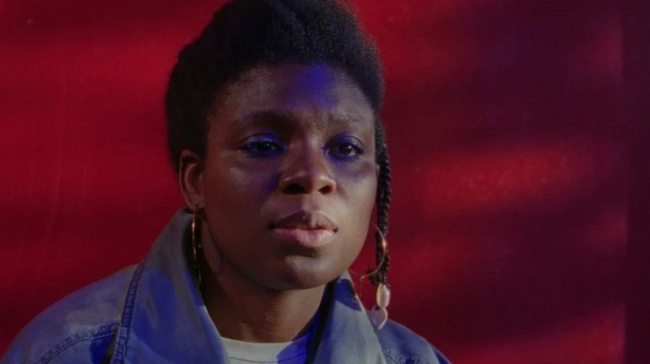
Amidst these liminal spaces, B runs into Didi (Diocouda Diaoune), an immigrant and single Black mother living in social housing. B and Didi were close once, though racial and class discrepancies compounded fundamental tensions in their relationship. This comes to the fore when they find themselves stuck at a convenience store. B expresses self-flagellating guilt over her success, given how much Didi has been struggling. Her friend counters: “You think you win, and you think I lose…but I don’t see the point of playing a game where you’re always winning.”
The women do not reach some fantastical reconciliation, instead forced to sit with their melancholy as the night extends past the corner shop, towards new streets and old friends. “At Night” eventually expands into a chorus of six women. They are artists, psychologists, mothers, wives, immigrants, sex workers. None of them appear to be professional actors. The central set piece of the film is a ten minute conversation between these women at a restaurant. As they exchange stories about their sex life, their reproductive health, how their gender intersects with their experience of race and class, a handheld camera whips between the women, lagging slightly behind; it gives the impression that this collectively authored, autofictional conversation were spontaneously captured, like one might find in a Frederick Wiseman film. Most striking are several passing comments about being seen naked under a bedroom’s “big light,” this universal but oft-invisible feature of domestic infrasture.
This film, as consciously devised in pre-production as it might have been, does successfully pull of the feel of a non-fiction work. A large portion of the film is taken up by street videography, and at a certain point, the rehearsal process behind the discussions here starts to feel incidental. This is all true, in a sense.
Besides, what these women say to one another is much less important than how they say it. Gibson captures is the kind of intimate speech that would be legible even without subtitles. The women involved with “At Night” have loved one another so deeply and for so long that it might be still possible to see them. Notley herself was apparently meant to appear in the film, and the on-screen absence of an elderly woman is certainly felt. But her unmistakable voice carries throughout, echoing as if it exists diegetically and not inserted via narration. There are other noises, too: the sound of a film camera, ambient field recordings of conversations too muffled to hear. Music plays a major role in the soundscape; Elvin Brandi’s brilliant score mimicking the screech of the metro, and the film essentially climaxes with a sincerely Lynchian performance from accordionist and singer Adam Christensen.
Christensen’s inclusion is notable, considering how it breaks with expectations. An outwardly queer artist who makes music under the alter ego Madam, Gibson deliberately gives him the same attentive edit as he discusses getting harassed for his deviant gender expression. If “At Night” is about anything, it is about this search for something unifying behind being a woman. Gibson longs to create or discover a space where women can coexist, no matter their identity or material conditions. She does not find it.
There is no such thing as a monolithic womanhood. Any hope that they might find refuge in the divine feminine, or some gender-separatist sanctuary, dissolves upon the light’s contact with the lens. “At Night” is an invitation to wander through these contradictory images of womanhood as Gibson attempts to assemble them into a single collage. It reminiscent of the second half to the Notley quote from before, a fragment that goes as follows: “Warming, shifting, pausing, changing, including, asserting, exulting, including, including, turning and including.”
Grade: B+
“At Night” screened at the 2026 Toronto International Film Festival after previously premiering at Locarno. It is currently seeking U.S. distribution.