The inclusion of packaging plants matters as much as the fabrication plants.
Advanced packaging is the step that stacks a processor beside high-bandwidth memory so the two can move data fast enough to run large AI models.
Until now, that final step has happened almost entirely in Asia.
However, building both fabs and packaging plants in Phoenix means a Nvidia (NVDA) or Apple (AAPL) chip could be made one day from start to finish on American soil.
The new plants will use 2-nanometer technology and below, which is TSMC’s most advanced production process.
That detail is crucial because it indicates that America is no longer getting last-generation chips as a consolation prize.
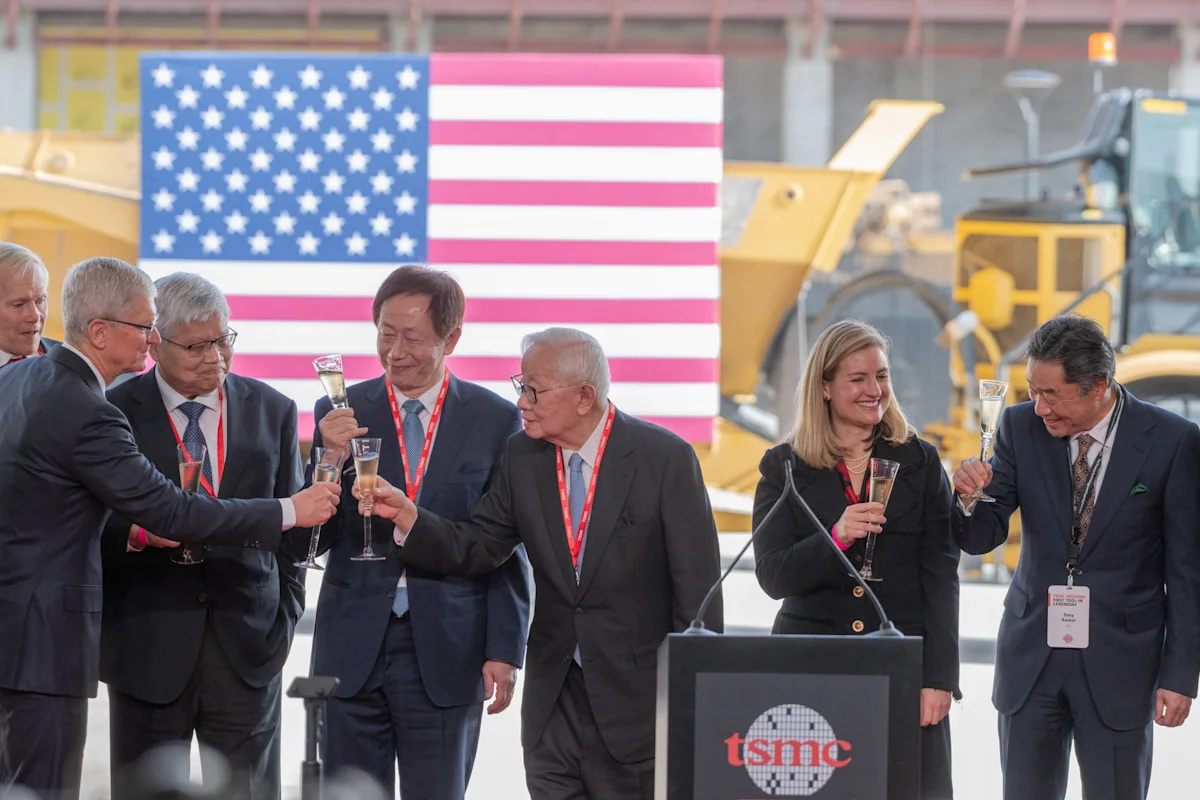
TSMC’s Arizona buildout will grow to 12 facilities under the company’s record $265 billion US investment plan.BING-JHEN HONG / Getty Images
Tariff deal pulls Taiwan’s chip money to Phoenix
The TSMC commitment sits on top of a trade framework reached between the US and Taiwan in January.
According to CNBC, Taiwanese chip and technology firms pledged at least $250 billion of direct US investment.
Taipei’s government also added another $250 billion in credit guarantees.
In return, Washington capped its reciprocal tariff on Taiwanese goods at 15%, down from the 20% Trump had imposed and well below the 32% first announced.
Reuters reported that the final agreement was signed in February, adding that Taiwan’s schedule for cutting tariffs on nearly all American goods was included.
The effort paid off. Commerce Secretary Howard Lutnick has said Taiwanese chip firms that decline to build in the US risk a 100% tariff.
How the $265 billion stacked up:
$65 billion: The original Arizona commitment, expanded under the Biden administration alongside a $6.6 billion CHIPS Act grant.
$100 billion: Announced with Trump in March 2025, covering three fabs, two packaging plants, and an R&D center.
$100 billion: Confirmed July 16, 2026, on the second-quarter earnings call.
Why TSMC stock fell despite record profit, historic deal
Here is the part that surprised investors.
TSMC delivered one of its best quarters in history, yet the stock dropped anyway.
According to the company’s SEC filing, second-quarter revenue reached $40.20 billion, up 33.7% from the previous year.
Taiwan Semiconductor also reported a gross margin of 67.7% and net income of NT$706.56 billion. That’s roughly $22 billion, up 77.4%.
The company’s management also lifted full-year revenue growth guidance to slightly above 40% in dollar terms, up from more than 30%.
However, shares closed on Thursday at $409.74, down 2.34%, and kept falling on Friday, trading near $397 in the premarket.
The reason for the drop is the spending line, not the demand line.
The capex bill investors are now pricing into TSM shares
TSMC raised its 2026 capital budget to between $60 billion and $64 billion, up from the previous $52 billion to $56 billion range.
That’s roughly a 15% increase at the midpoint, arriving in the same report as a fresh $100 billion US commitment.
Capital expenditure is money spent building factories, and it comes out of cash flow long before those factories produce a single sellable wafer.
TSMC management predicted that overseas fabs will dilute gross margin by 2% to 3% in the early years and 3% to 4% later, since building in Arizona costs more than building in Hsinchu.
So investors are not doubting AI demand; they are charging TSMC for the years of spending it takes to satisfy that demand outside Taiwan.
The selloff was also sector-wide, following the same beat-and-fade pattern ASML saw a day earlier.
What still has to happen before Arizona changes the AI math
The $265 billion is a promise to spend, not money already spent, and the timeline is the least certain part of the announcement.
TSMC attached no construction schedule to the four new fabs, saying the pace will follow customer demand.
That flexibility protects the company if AI orders cool.
Four things that must go right for the buildout to pay off
Customers commit volume. Wei has said construction and ramp for the new fabs depend on customer needs, so orders drive shovels, not the other way around.
Arizona yields hold. The first Phoenix fab reached high-volume 4-nanometer production in late 2024, with yields comparable to Taiwan’s, according to TSMC. The second fab targets 3-nanometer volume production in the second half of 2027.
Margin dilution stays inside predictions. Anything worse than the 3% to 4% later-stage drag would reset the earnings math.
Free cash flow recovers. Cash generation is currently falling behind the factory bill, and that gap is what the market is watching.
What the TSMC deal means for your chip stock holdings
For investors holding semiconductor stocks, this week delivered two separate messages that are easy to mix up.
The first is national. America secured the leading-edge capacity it has chased since 2020.
Additionally, the supply chain risk concentrated in Taiwan gets smaller by the end of the decade.
The second is financial. TSMC is paying for that security with its own cash flow right now, and shareholders are footing the bill years before they see the payoff.
Practical takeaways:
Treat the capex raise as a demand confirmation, since companies do not commit $64 billion into a slowdown.
Watch free cash flow against capital expenditure in the third-quarter report, which is the cleanest read on whether the buildout is creating value faster than it consumes cash.
Note that Q2 net income was inflated by non-operating items, including a gain tied to Vanguard International shares, so operating income growth of 65.4% is the more honest number.
Remember, the concentration risk has not vanished yet, as more than 80% of advanced foundry revenue still sits in Taiwan today.
The Arizona expansion does not affect TSMC’s results this quarter; it shows up later in 2030, and investors who need the payoff sooner than that are the ones selling this week.
At constant exchange rates, the company recorded revenue growth of 10.7%. The results reflect continued international expansion and a growing contribution from digital sales. Mango’s […]