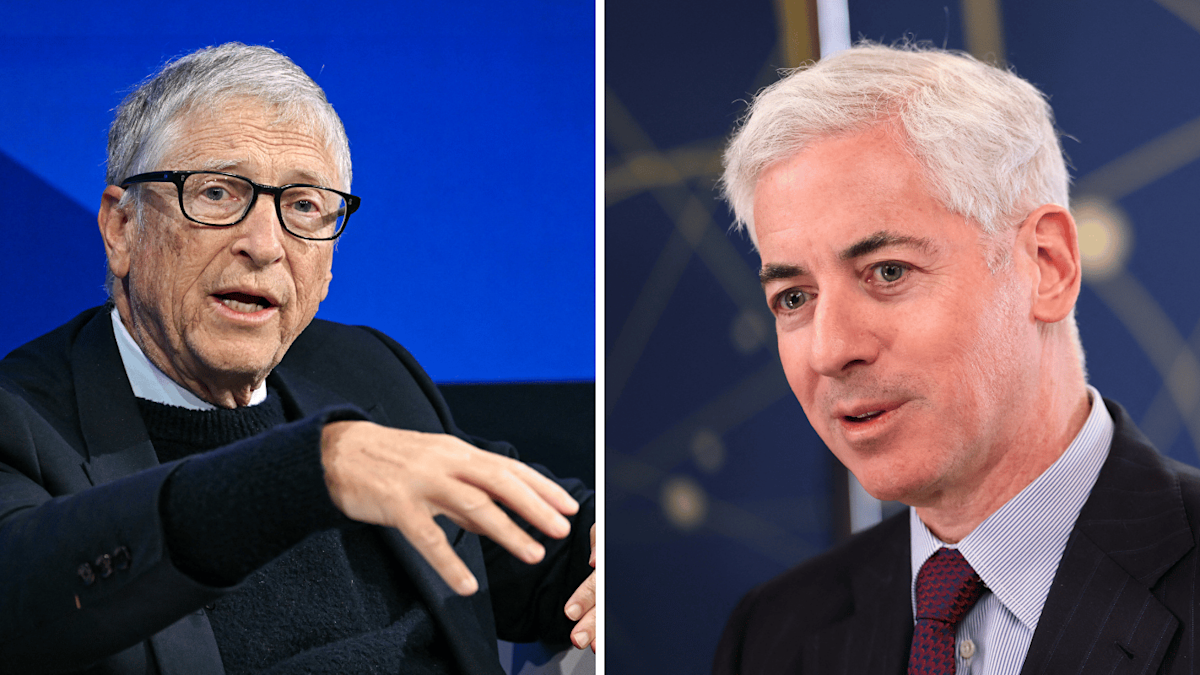
The Bill & Melinda Gates Foundation Trust disclosed on Friday that it sold its final 7.7 million shares of Microsoft (NASDAQ:MSFT) during the first quarter — a roughly $3.2 billion exit that ends a decades-long position in the company Gates co-founded (1).
A very different story had already broken that morning. Hours before the Gates filing hit the SEC, Bill Ackman’s Pershing Square Capital Management used a lengthy X post to announce a brand-new Microsoft position (2). Pershing’s 13F, filed later that evening, showed roughly 5.65 million shares worth around $2.09 billion at quarter-end (3).
Must Read
The following morning, Ackman explained he used Pershing’s Google (NASDAQ:GOOG) holdings to pay for it. “To be clear, our sale of $GOOG was not a bet against the company,” he wrote on X. “We are very bullish long term on Alphabet. But at current valuations and in light of our finite capital base, we used $GOOG as a source of funds for $MSFT” (4).
So why is Gates selling?
The 7.7 million-share sale is the final tranche of a multi-year sale. The Trust held roughly 28.5 million Microsoft shares at the end of Q1 2025, trimmed to 7.7 million by year-end, and zeroed out this quarter.
Gates announced in May 2025 that the foundation will sunset operations in 2045 and spend roughly $200 billion on charitable work over the next 20 years (5). A foundation winding down its endowment doesn’t have a choice but to sell — it has to fund the giveaway.
Why is Ackman bullish on Microsoft?
Pershing started stockpiling Microsoft in February, right after the company’s fiscal Q2 2026 earnings sent the stock tumbling (2). It kept buying through a stretch where Microsoft was down sharply on the year and well off its July 2025 record high.
Two worries had spooked the market:
First, Copilot adoption. Microsoft has converted only about 15 million of its 450 million paid Microsoft 365 commercial seats into paying Copilot users. Independent research showed Copilot’s market share fell from 18.8% in July 2025 to 11.5% by January 2026. That data prompted CEO Satya Nadella to reorganize the AI division in March and sideline the AI executive he paid $650 million to recruit.
Second, the AI capex bill. Microsoft is spending $190 billion on capital expenditure in 2026. Some investors think the math doesn’t work.
Ackman thinks they’re wrong on the capex part. Azure revenue grew 39% in constant currency last quarter. Microsoft’s AI business hit a $37 billion annualized run rate, up 123% year-over-year (8). He called the $190 billion “growth capex that should drive future revenue generation” rather than a margin threat (2).
He also thinks the market is undervaluing the core franchise. Microsoft 365 and Azure together throw off roughly 70% of Microsoft’s overall profits. M365 monthly ARPU sits around $20 — less than half what customers would pay for the underlying applications individually. Investors, he wrote, “underestimate the resilience of the M365 franchise given its deeply embedded role across enterprises and highly attractive price-value proposition” (2).
Then there’s the OpenAI stake. Microsoft owns roughly 27% of OpenAI economically. At the most recent funding round, that’s about $200 billion — or 7% of Microsoft’s market cap (2). Ackman says the share price doesn’t reflect any of it.
Pershing got in at roughly 21 times forward earnings. Ackman called that “broadly in line with the market multiple and well below Microsoft’s trading average over the last few years” (2).
Read More: Non-millionaires can now hoard property like the 1% — how to start with as little as $100
Not a rebalance
The Google side of the rotation is where the conviction shows.
Pershing held more than 6.1 million Alphabet Inc. Class C shares at the end of 2025. By the close of Q1, that was down to about 312,000 (6). A 95% cut, worth roughly $1.64 billion at quarter-end pricing. Class A holdings fell from around 678,000 shares to 32,000 over the same stretch. The remaining position was fully liquidated in Q2, according to a person familiar with the portfolio, as cited by Reuters (6).
Pershing had owned Google for three years at an average cost of about $94 a share. Class C was near $392 the Friday the 13F dropped (7). That’s roughly four times Ackman’s cost basis.
He rolled the proceeds straight into Microsoft, then went on X the following morning to make clear the sale wasn’t a call on Google’s prospects.
The takeaway for investors
Ackman zeroed out a three-year, multibillion-dollar Google position, picked up Microsoft at 21x forward earnings, and bet that the market has mispriced the enterprise franchise against its AI uncertainty. The Gates sale, while being reported on social media like a bear signal, is its own thing — a foundation funding $200 billion in giveaways. Selling Microsoft because of that would be misguided.
Ackman’s trade is the one with a thesis behind it. Copilot’s paid base is running at about 3% of its addressable seats. That gap is what he’s buying.
You May Also Like
Join 250,000+ readers and get Moneywise’s best stories and exclusive interviews first — clear insights curated and delivered weekly. Subscribe now.
Author’s note: 13F filings are lagged data and don’t constitute financial advice. I also do not currently hold shares of Microsoft or Google.
Article sources
We rely only on vetted sources and credible third-party reporting. For details, see our editorial ethics and guidelines.
Securities and Exchange Commission (1, 3); Bill Ackman on X (2, 4); Bill & Melinda Gates Foundation (5); Reuters (6); The Globe and Mail (7); Microsoft (8)
This article originally appeared on Moneywise.com under the title: Gates’ foundation sold all of its Microsoft shares. Bill Ackman is loading up on the stock. What is Wall Street missing?
This article provides information only and should not be construed as advice. It is provided without warranty of any kind.