
In late November 2020, as the pandemic winter set in and I had grown really, really bored of solitary walks through an eerily quiet New York City, I undertook something of a pilgrimage. A barred owl — fluffy and white, big and beautiful — had landed in Central Park a few weeks earlier and was skulking around in the North Woods, an area I had never been to before. Taking a long walk up that way to see a visiting owl sounded like a good way to break up the monotony, and while I had never identified as a “birder,” I’m a longtime animal lover.
When I arrived in the afternoon of November 21, I found an assembled mass of birders gazing at the owl, later known as “Barry,” nestled in a peaceful little glade to the south of the Great Hill. I couldn’t see her very well at first — again, not a birder, I didn’t even have binoculars — but when a helpful birder pointed her out, tucked behind some foliage, I had to laugh. She was so big! How could I have not seen her before? Of course, she’s right there! Two things happened in that moment that changed my life: the sudden realization that there is so much happening around us at all times, if only we could bother to look a little closer, and the onset of a profound affection for the endlessly helpful community of NYC birders I had stumbled into.


Barry was, in birding parlance, my “spark bird.” Her arrival in the city — she stayed in the park for 10 months, before dying in August 2021 due to a combination of factors that will become familiar soon enough — almost instantaneously turned me into a birder, and a particularly passionate Central Park birder to boot. She was soon joined by more visiting raptors (like Geraldine the great horned owl, or that Snowy Owl who I missed seeing and will forever regret, and a bunch of bald eagles), other migrating feathered friends, and scores of year-round park residents (sparrows, blue jays, cardinals, mourning doves, “the usuals”). Once I saw them, I couldn’t stop looking.
Months later, while attending a film party, I mentioned my birding, and an acquaintance asked me in abject shock about the quantity of birds in Central Park. “Do they ship them in?” she asked, dead serious. It was a sterling — and, honestly, unnerving — reminder that many people still don’t really look at the world around them. Once I started looking at birds, the entire wildlife landscape of New York City changed for me. All of New York City changed for me. I can identify butterflies and moths, I know all the best places to see raccoon cubs, and don’t get me started on our resident pair of coyotes.
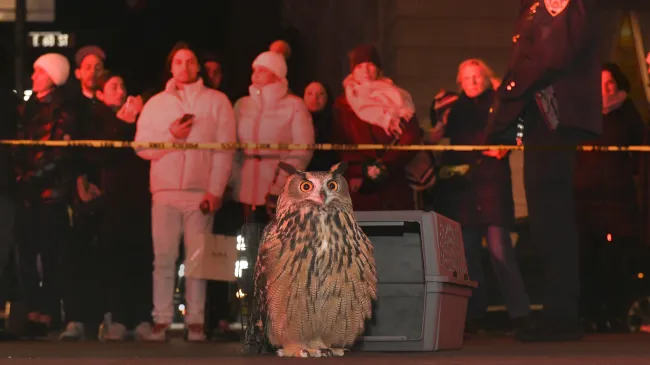
It is with that same spirit that documentarian Penny Lane — herself of course a birder — tackles the story of Flaco the Eurasian eagle-owl, who became an even bigger celebrity than Barry when he landed on Fifth Ave. on February 2, 2023. It was Lane who first alerted me to Flaco’s arrival, thanks to her tweets on that chilly evening, including pictures that showed a massive owl sitting in the middle of the sidewalk, just steps away from the Plaza Hotel. He was gorgeous and stunned, striking and out of place.
If you, like me, are a birder or an animal lover or a news junkie, you most likely already know the broad strokes of Flaco’s story. It was soon revealed that he had been a resident of the nearby Central Park Zoo, and that he’d been somehow freed, taking his chance of escape and somewhat clumsily flying with it. While the zoo initially tried to retrieve him, Flaco stunned everyone when he — a creature who had been bred, born, and raised in captivity — learned how to hunt, fly, and thrive on his own. The zoo eventually gave up their attempts at capture (all of them staggeringly inept, most of them horrifying), and Flaco spent the next year zipping around Central Park and beyond.

He became a major star, a bona fide celebrity, and the spark bird for innumerable fans. He inspired people, a real New York City success story (very “if you can make it here, you can make it anywhere”). Of course, I loved him. So did Lane, and so did the many colorful characters she uses to kit out her wonderful new film “Wild Inside,” which doesn’t just chart Flaco’s wondrous life, but the impact he had on the people around him. Once people stopped to look at Flaco, it changed them. They couldn’t help but see so much more.
I’ve known that Lane was working on her documentary for many months (I even sent her some of my own photos of Flaco, as she wisely and ingeniously crowdsourced a staggering array of footage, edited together here gorgeously by Hannah Buck). That Lane, an animal lover who excels at cracking open crazy stories with humor, heart, and a litany of perspectives, would follow Flaco is no surprise. It’s also no surprise that Lane puts so much of herself into the film — this is, after all, the same filmmaker who documented her own altruistic kidney donation for her “Confessions of a Good Samaritan.”
Lane doesn’t attempt to distance herself from the material at hand, and we often hear her asking probing questions of the various talking heads she’s assembled to tell Flaco’s story, including those she doesn’t personally agree with. Flaco’s escape was fraught from the start, as few people — even the dazzled birders who appear throughout the film, many of whom I know — initially thought that he should be free. Flaco didn’t eat for days after he escaped, and it wasn’t known if he was capable of hunting at all. Could he even fly?
Lane meticulously tracks Flaco’s story in real time, moving from those scary early moments to the joyous reveal that, oh yeah, this apex predator knows what he’s doing. Flaco’s fans grow myriad, his impact on the city is lovingly dramatized (with Lane’s peppy brand of humor on full display), and we see the joy he brings to so many. I remembered it all keenly, and “Wild Inside” catapulted me back to those many months in a way that felt both shocking and good. Watching the film during its outdoor premiere on the Great Hill in Central Park earlier this week, just steps away from where I first met Barry, felt like seeing an old friend, or watching a documentary about my own beloved pet.
But Flaco was, of course, not a pet. And Lane, who delights in thorny ethical questions, doesn’t skimp on the implications of his freedom. Her talking head birders grapple with their concerns throughout the film. We meet broken-hearted wildlife rehabbers who know far too well what city life can do to a bird. Even the same people who bred Flaco for captivity stumble through answers about why keeping wild animals in confinement is, somehow, the right choice for them. The birders visit Flaco faithfully, delight in antics, but can’t help but worry about what comes next.

Knowing Barry, I couldn’t either. When Barry died in August 2021, the primary cause of death was a collision with a truck inside Central Park. A major contributing factor, however, was the potentially lethal amount of rodenticide present in her body, ingested as she snacked on the many rats she hunted in the park. It was horrifying, the realization that the very place she had made her home was killing her. When Flaco started hunting his own food, it was met with joy. But there was also fear.
This is all to say that Lane lovingly, warmly, and thoughtfully tracks Flaco’s incredible year of freedom with her latest doc. While the film will inevitably cause those who loved Flaco to revisit the pain of losing him — I am crying while typing this — it also approaches his adventure with a truly happy spirit. Lane worries about anthropomorphizing Flaco, and many of the people we meet in the film still struggle to determine what was best for him, but the film frequently lands on Flaco’s behavior as our best metric.
When his cage was cut open, he chose to leave. He chose to hunt and fly and explore. He chose to perch in place where he could see people (a later section about Flaco’s time as a “peeping Tom” is a personal favorite). He chose, it seems, to be wild. During his year in the city, he inspired countless people and changed so many lives. Lane’s film reminds us that that journey doesn’t have to end, and really, should only push us to look closer, to look deeper, and to marvel at not just what we’ve lost, but what we have.
HBO Documentary Films and Sandbox Films will release “Wild Inside” at New York City’s IFC Center on Friday, July 31 and play at over 40 theaters nationwide, including a series of one-off screenings for International Owl Awareness Day on August 4 along with standard theatrical engagements.