Mark Cuban sees a problem with the AI spending spree
Drive past enough American commercial real estate and you start to notice the second acts.
The bowling alley that became a church. The Sears that became a self-storage warehouse. Somebody put up the building for one reason, the reason expired, and the concrete found a new job.
That pattern is not a failure of imagination. It is what happens when capital gets committed years before the demand it was built for actually shows up, which is most of the time.
Right now the largest version of that bet in corporate history is being poured into the ground across Texas, Ohio, Wisconsin and Louisiana.
Alphabet (GOOGL), Microsoft (MSFT), Meta Platforms (META) and Amazon (AMZN) are on pace to spend close to $700 billion this year, the bulk of it on artificial intelligence (AI) data centers, according to CNBC.
Wall Street has treated every upward revision to those budgets as a buy signal. Bigger capital plan, bigger conviction, bigger stock.
Mark Cuban looked at the same construction schedule and saw the strip mall.
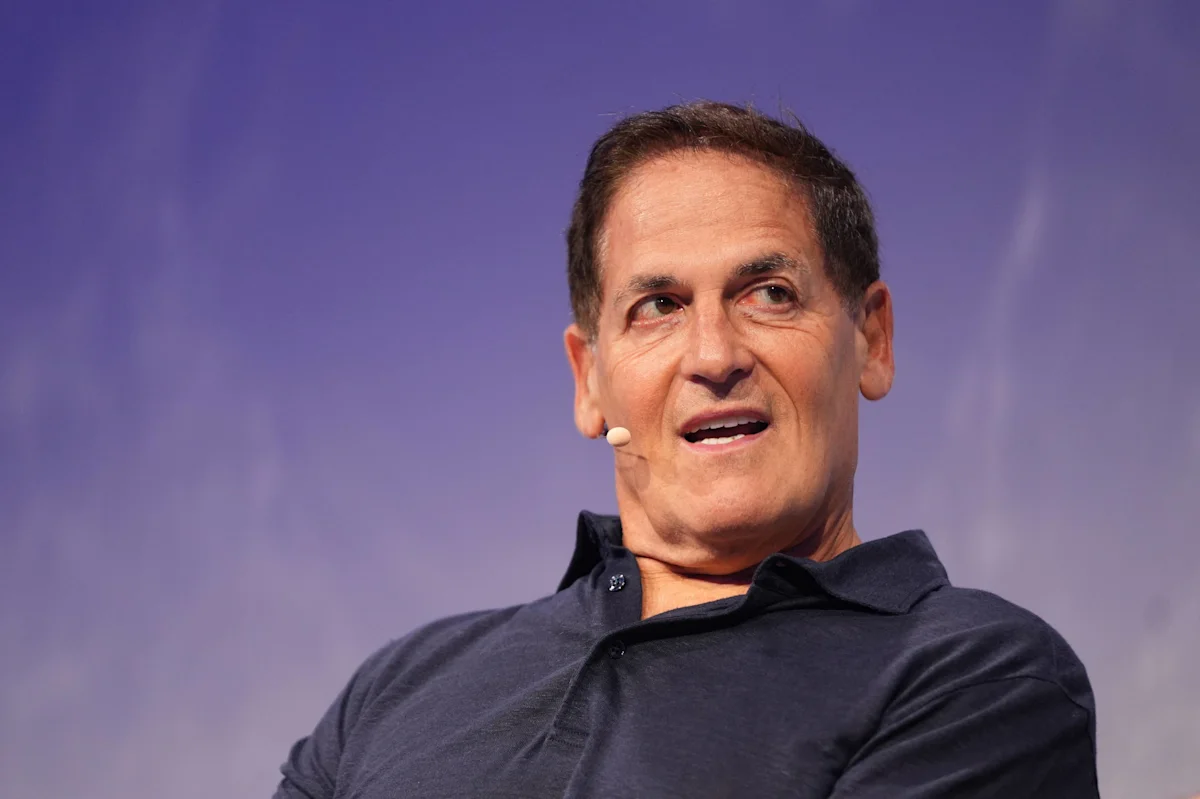
Mark Cuban says today’s AI data center buildout could leave much of it idle.PixeloneStocker / Getty Images
Why the AI data center boom rhymes with the fiber boom
Cuban has an unusual claim on this particular argument, because he was on the winning side of the last one.
He sold Broadcast.com to Yahoo for $5.7 billion in April 1999, roughly 11 months before the Nasdaq peaked. The buyer eventually shut the service down.
More Wall Street:
The analogy he keeps returning to is not the dot-com stock mania. It is the fiber-optic buildout that ran underneath it.
Telecom carriers trenched enormous amounts of long-haul capacity on the assumption that demand for bandwidth would keep outrunning supply. Then compression and optics improved faster than traffic did, and the bandwidth problem quietly stopped being a problem.
Much of that glass sat unlit for years and later changed hands for a fraction of what it cost to install. The technology was real. The timing of the spending was wrong.
I went back through this year’s capital expenditure guidance from the four largest spenders, and the thing that stands out is not the size of the numbers. It is the duration. These are multi-year commitments to physical assets, funded increasingly with debt, in a business where the useful life of the hardware inside the building is measured in single-digit years.
The power commitment runs just as long. Global data center electricity consumption is set to more than double to around 945 terawatt hours by 2030, slightly more than Japan’s total consumption today, according to the International Energy Agency.
Substations, transmission lines and gas turbines get ordered against that forecast. They do not come back down if the forecast is wrong.
That is a very specific kind of risk, and it has almost nothing to do with whether AI works.
Speaking with Jason Calacanis on the All-In podcast, Cuban said the hyperscalers are correct that AI usage will keep climbing. His disagreement is about efficiency.
If breakthroughs make models cheaper and less power-hungry, he argued, a large share of the capacity being built today becomes redundant. In that scenario there will be plenty of data centers “turned into pickleball courts,” according to Business Insider.
The line landed partly because Cuban co-owns the Dallas Flash, a professional pickleball team. The argument underneath it is less comfortable.
Committing tens of billions of dollars to facilities meant to run for a decade or two is, in his framing, “planning for perfection,” according to 24/7 Wall St. Nobody forecasts technology that well.
Where the AI bubble damage would actually land
Cuban does not think this looks like 2000. Few companies are going public at absurd valuations with no revenue, and there is no retail mania to speak of.
The exposure sits with the institutions. Venture capital firms, private equity funds, and infrastructure backers have gone “all in,” according to Benzinga, and they are the ones who would absorb the write-downs.
His proposed fix is more companies going public at smaller sizes, in the $50 million to $100 million range, which would spread both the upside and the losses across ordinary investors instead of concentrating them in private funds.
Three numbers frame how large the bet has become.
Combined 2026 capital spending by Alphabet, Microsoft, Meta and Amazon is tracking toward roughly $700 billion, up more than 60% from last year’s record, according to CNBC.
Hyperscalers may understate depreciation by about $176 billion between 2026 and 2028 by stretching the assumed useful life of AI servers, a practice Michael Burry called “one of the more common frauds of the modern era,” according to TipRanks.
The Magnificent Seven now account for roughly 34% of the S&P 500, up from about 12% a decade ago, according to Forbes.
That third number is where my analysis parts company with Cuban’s.
What the AI capex bet means for your retirement account
If the pain really were confined to venture capital and private equity, most readers could watch this from a safe distance. The index math says otherwise.
Roughly a third of the S&P 500 by weight is now the same handful of companies signing the construction contracts. A standard target-date fund or S&P 500 index fund in a 401(k) is, functionally, a concentrated position in AI capital spending.
You do not have to own a single share of Nvidia (NVDA) to be long this trade. You already are.
There is a second bill in this story, and it does not show up in a brokerage statement. Utilities recover the cost of new generation and transmission through rates, which is why data center load has turned into a standing fight in the communities hosting them, as TheStreet highlighted.
Cuban’s warning about persuasion and AI business models got attention earlier this year, but this argument has a cleaner tell attached to it. Watch the depreciation schedules in the next round of annual filings, and watch whether capital spending guidance stops rising.
Here is the part the fiber story usually leaves out. The dark fiber eventually got lit, and it made streaming video possible for everyone who came later.
The buyers of those distressed assets did extremely well. The companies that dug the trenches did not.
If Cuban is right, the buildings get finished either way. The open question is who owns them when the demand finally arrives, and whether the people paying for them today are still holding the paper.