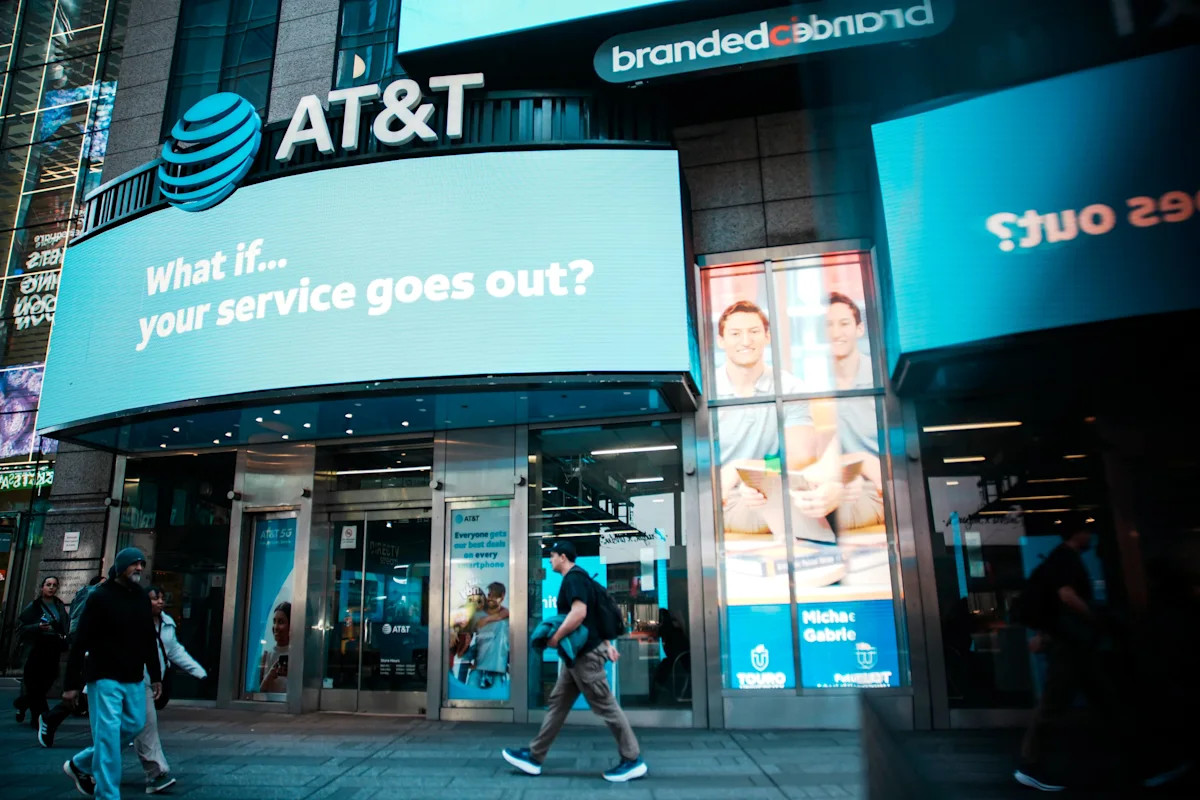
AT&T leaves rivals flat-footed as bankrupt carrier folds
Dish DBS, the satellite TV and wireless subsidiary of EchoStar, filed for prepackaged Chapter 11 bankruptcy on June 30 in federal court in Houston.
The filing ends months of speculation about the future of the industry’s would-be fourth wireless carrier.
More than 88% of Dish’s bondholders backed the filing, which was triggered when the company could not repay $2 billion in senior secured notes carrying a 7.75% interest rate, due July 1.
There is a twist in this story, and it works in AT&T’s favor.
AT&T’s spectrum deal sits at the center of the story
EchoStar took on roughly $25 billion in debt after merging with Dish in 2024. It had been counting on a cash infusion from AT&T (T) to bridge the gap between its debt payments and its available cash.
Back in August 2025, AT&T agreed to buy about 50 megahertz of nationwide spectrum from EchoStar for $23 billion.
That includes around 30 MHz of 3.45 GHz mid-band airwaves and 20 MHz of 600 MHz low-band spectrum, spread across more than 400 markets.
The deal was expected to close by mid 2026, but regulatory delays pushed the timeline back, which left EchoStar short of the cash it needed to make its July 1 payment.
In plain terms, AT&T’s own pending spectrum purchase is the deal whose delay helped push Dish DBS into bankruptcy court.
And once that sale finally closes, AT&T stands to gain from it twice over.
John Stankey, Chairman and CEO of AT&T inked a spectrum deal with EchoStarBill Pugliano/Getty Images
AT&T’s network already leans on this strategy
AT&T CFO Pascal Desroches has repeatedly described the company’s approach as playing the long game rather than chasing quick wins.
Speaking at the Mizuho Technology Conference on June 9, Desroches said:
“So we are building a network, not simply for today, we are building it — a network for the future. And that network is going to be AI-ready for whatever workloads it produces.”
The CFO pointed to rising demand for bandwidth from AI, autonomous vehicles and smart devices.
More AT&T:
Once the sale closes, AT&T adds a large amount of low-band and mid-band capacity, the type of spectrum it has trailed Verizon and T-Mobile on in recent years.
Under a companion agreement, EchoStar is also winding down parts of Boost Mobile’s radio network and shifting to a hybrid setup where AT&T’s network carries Boost’s traffic.
Boost, which has roughly 7.6 million subscribers today, down from more than nine million when EchoStar acquired it, is not part of the bankruptcy filing. Neither is sister brand Gen Mobile.
Both will keep operating. But increasingly, their signal will travel over AT&T’s network rather than a rival’s.
Telecom stocks fell on Dish bankruptcy news
The market’s first reaction was not a clean win for AT&T. Shares slid more than 5% on July 1 as Dish’s bankruptcy filing became public.
That erased roughly $8 billion in market value in a matter of hours, as investors weighed the $23 billion cash outlay against the risk of dealing with a bankrupt counterparty.
Shares of Verizon and T-Mobile also dipped following the bankruptcy news, a sign that spectrum deals of this size carry execution risk for everyone involved, not only the seller.
T-Mobile has its own reasons to welcome the news. As Dish exits the wireless race as an independent, price-cutting competitor, the pressure to undercut on price eases across the market.
T-Mobile has also separately extended its mid-band lead by folding in UScellular’s spectrum and subscribers.
Still, it is AT&T that walks away with the spectrum, the Boost traffic, and a would-be rival sidelined for good, even while its stock digests the near-term cost.
The core business keeps growing regardless
AT&T’s underlying operations have not skipped a beat.
The carrier added 294,000 postpaid phone subscribers in the first quarter of 2026, alongside a record 584,000 net additions in fiber and fixed wireless.
That marked the company’s sixth straight quarter above half a million.
AT&T Chairman and CEO John Stankey told investors at the J.P. Morgan Global Technology, Media and Communications Conference on May 19 that the company’s fiber and wireless buildout gives it “a structural advantage over time in how you handle networking and network loads,” a point he has repeated across multiple investor events this year.
Dish expects to emerge from Chapter 11 by the end of the third quarter. EchoStar says Dish TV and Sling TV customers should see no disruption to their service.
But the wireless ambitions that once made Dish DBS a genuine fourth carrier threat appear to be over.
What began as a challenge to the industry’s biggest players has instead folded into the very incumbent it once hoped to compete against.
A few years back, subscription cars were tagged as the next big thing for the automotive industry. Despite its appeal, the subscription model — bundling […]
LONDON, July 27 (Reuters) – Elon Musk’s Tesla on Monday won its bid to revive a London lawsuit brought against U.S. technology firm InterDigital and […]
Quick Read The Goldman Sachs Retirement Survey 2025 reveals that 68% of workers are confident about meeting retirement goals while 58% fear they’ll outlive their […]