A decade has passed since Conner4Real first exploded onto the scene in “Popstar: Never Stop, Never Stopping,” and a lot has changed.
Created by “Saturday Night Live” stars and life-long pals Andy Samberg, Akiva Schaffer, and Jorma Taccone (aka gag-rappers The Lonely Island), the project marked the trio’s most ambitious outing to date. At its center was Conner (Samberg), an out-of-touch pop megastar who crashes back down to earth when his career takes a stumble, forcing him to reconnect with his Beastie Boys-like former bestie bandmates Owen (Taccone) and Lawrence (Schaffer).
Under the guidance of producer and comedy mensch Judd Apatow, the threesome threw everything at the wall to create a big-screen vehicle that harnessed both their comedy chops and the earworm digital shorts that made them SNL standouts and artists in their own right. The end result was a fully-stuffed smorgasbord of funny — one that was quite literally bursting at the seams of its scant 87-minute running time.


Despite this, “Popstar” somehow failed to connect with fans upon its 2016 release, recouping less than half of its budget at the box office. However, as with many beloved comedies, Samberg, Schaffer, and Taccone’s movie has since aged like a fine wine. Not only has it been embraced by fans who now consider it a modern comedy classic, but its highly quotable jokes have been seamlessly adopted into their day-to-day vocabulary.
To mark this birthday moment, Samberg, Schaffer, and Taccone take us inside Conner’s world to talk pressure, real-life pop-stars, zombie penises, and the film’s unexpected afterlife.
These interviews have been edited for clarity and brevity.
Andy Samberg (writer, played Conner4Real): We were more experienced [after “Hot Rod”]. We knew we wanted as much creative control as possible, and working with Judd [Apatow, Producer] was really helpful in that regard. We’d also made three albums at that point and so many digital shorts on “SNL.” The intention going into it was: “What is a film vehicle that allows us to do the comedy music we love making, where it doesn’t feel forced and makes sense?”
Akiva Schaffer (director, writer, played Lawrence): The whole movie is a culmination of a lot of the skills we’d been honing throughout our careers. It was everything we always said we wanted to do, but all at once. The positive is that you’re always happiest when you feel like you’re where you’re supposed to be, but on the other hand, it’s a little nerve-wracking because you want it to come out good. You’re like, “Oh my God, this is putting all the eggs in one basket.”
Jorma Taccone (director, writer, played Owen): We were really nervous about focusing it on the three of us and our friendship. Judd was always very good at redirecting us. He was like, “No, this is what the movie [should be] about. It’s good. Don’t worry.”
Schaffer: We were really excited to have somebody of Judd’s caliber in our corner. We’d write all week and have, say, four good new scenes, but we wouldn’t know where they were going to go. The fact that on Friday we could be like “Hey Judd, see what you think of these,” and he’d say, “These are excellent, keep going,” really refilled our gas tank, creatively.

Samberg: It was really fascinating to behold how [Judd] operates. Sometimes the most straightforward suggestion is the [right] thing, especially with comedians. We were always trying to out-think ourselves, and he’d be like, “No, make it about you guys and your friendship. That’s what I’m interested in. I like that you guys have known each other your whole lives and you’re still friends, work together, have fun together, and have your own language.”
Taccone: It was almost like hand-holding, honestly. Just letting us know we were on the right track — which is invaluable.
Samberg: So much of it is based on our own experiences having worked at “SNL” and seeing so many musicians and how their lives are. All these pop stars are talented as fuck. Then, as people discover how much reach they have, they get put into the machine, and once you reach a certain level of success, you rely on that machine to keep you out there. There’s a lot of that in the movie, where you don’t have people being honest with you or saying “no.” It can warp your sense of reality, corrupt your spirit, and kill your joy. We were fascinated by that, especially in the context of friendship.
Schaffer: Judd encouraged us not to worry about overall stuff and to just start writing scenes we thought would be funny in a movie like this. We knew very quickly that it should be that the three of us were in a group, and then Andy became the Justin Timberlake, or the person that moves on. We knew that if we made it about the three of us, it wouldn’t feel current. We wanted to satire modern pop music, and the big stars of that time were all solo artists.
Taccone: We naturally fall into the Alvin, Simon, and Theodore camps [laughs]. I’m very much Theodore, Andy’s Alvin, and Akiva’s Simon. They’re almost cliched character traits, but they create defined lines for how our characters would behave in situations. A lot of humor comes out of that.
Inspired, the trio began writing Conner4Real songs as the script was fleshed out, resulting in an organic process that produced an abundance of both music and humor.
Samberg: We started writing songs almost immediately after we decided we were going to try and write the movie, before we had a script or anything. I think the very first song Akiva and I wrote was “I’m a Weirdo,” which didn’t end up in the movie.
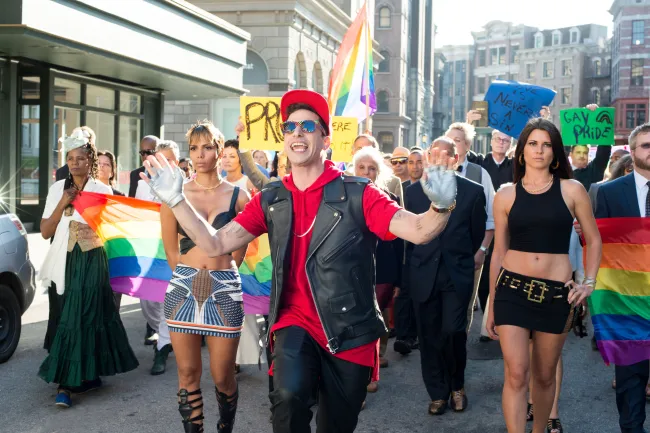
Schaffer: When we got bored of writing, we’d go into the studio and try to come up with songs. We’d come up with say, “Equal Rights,” but wouldn’t know where it was going to fit. We just knew it was a song this idiot would sing. It freed us up to just collect funny stuff. As we started to put together the real story, we had all these things to pick from.
Samberg: We’d go into the studio and think of ideas we’d want to do as Lonely Island songs, but then start steering them gently into the direction of the story we were putting together. Some didn’t even end up in the movie, like “Fuck Off” — but a lot of people really love that one.
Schaffer: We had “Mona Lisa” fairly early on and “Finest Girl,” the Bin Laden one. As we went along, we knew we didn’t want [Conner] to just rap. All the biggest rappers of the moment sang and rapped, so we were like, “He’s got to sing.” I downloaded Auto-Tune because we’re not great singers. For songs like “Mona Lisa” and “Finest Girl,” we just sat there and figured it out. We’d never made songs that sounded quite like that before.
Taccone: I did the original version of [the catchphrase verse from “Turn Up The Beef”]. We went through so many iterations. Three of my original lines made it in there; “Turn up the Meds!” was one. We’re always focused on writing visually. You do the joke, and hopefully the audio is funny, but when the visual hits, you hope it’s even funnier.
Samberg: There were probably four or five that we knew [we’d put in the movie]. We’d play them for friends, and you’d start to feel a consensus about which ones everyone likes the most. “Finest Girl,” “Mona Lisa,” “I’m So Humble” … We knew we wanted “Incredible Thoughts” for the end. Those were the ones that felt like “singles” that we could hang set pieces on.
Taccone: It’s so cool to make pretty much an entire album before you make a movie. In the writing process, we had a Google Doc that we were all adding to. The shooting script was maybe a normal 155 pages, but we had an additional 300-page version of it. It was this bible with all this other shit [in it], and no joke, I think we got all of it.
When shooting began, Conner’s world exploded. His colorful entourage became real, his songs brought to vivid life, and his fans filled arenas…
Taccone: There’s crazy good improvisers in this movie. If you hire someone who’s good at what they do, let them shine — and they do. Even if you haven’t been around people’s crazy entourages, you can imagine these 20 fucking people that are all draining his bank account.
Schaffer: Sarah Silverman [who played Paula, Conner’s publicist] and Tim Meadows [who played Harry, Conner’s manager] were great. I didn’t know Tim would bring this kind of wounded heart to the character. I felt like we saw a different shade of him we hadn’t seen in other things. He really elevated and brought depth to a goofy comedy in a really surprising way.
Taccone: Tim is like Christopher Walken or Nic Cage in the way he speaks is almost wrong sometimes [laughs]. He did this joke on set, where he kept saying, “The kids love it!” Even though we wrote the line, it still comes out weirder when he says it. We felt gifted to be around these people.
Schaffer: We loved working with James Buckley [who played Sponge] and Eddie Blackmon [who played Eddie]. They were so funny, but got cut down the most, just due to the momentum of the movie. The same way “Mona Lisa” is one of my favorite songs, and in the film for 10 seconds.
Taccone: Our buddy DJ Nu-Mark from Jurassic 5 is our DJ, which is a little nod to Beastie Boys and Mix Master Mike. He came down [and did this for us] like a champ for like $0 — then in the edit, we make it that he fucking hunts dolphins “like a dickhead.” He saw the movie and was like, “What the fuck? You guys made me hunt dolphins? I did you a favor!” [Laughs]. That kind of thing just makes me smile, knowing the backstory of it.
Schaffer: We were able to rent the Forum in Los Angeles for 11 days in a row because it was new. We realized arenas around the world all look the same and nobody was going to notice, so that arena is our whole world tour. It has so many rooms. Production design dressed them in different motifs so it looked like we were backstage in Europe. We used every nook and cranny to feel like it was lots of different places.
Samberg: It was like a week and half straight of just performing the songs all day, over and over. It was undeniably super cool, but by the end of it, I was like “This is not tenable.” Even lip-syncing a full performance of one song is a lot of energy. I definitely got really sick at a certain point and just had to power through. They gave me an IV — but it was really fun. Akiva and Jorm shot the shit out of it.
Schaffer: Adam Levine was so nice and did the cameo [in “I’m So Humble”]. Before we shot, he said, “Why doesn’t Andy come out in character and introduce Maroon 5 at the Honda Center?” Andy got in hair and makeup for the first time, and me and Jorm had to go on stage in front of 20,000 people and be like “Andy’s about to come out dressed in character for a movie we’re going to make. Please act like he’s the biggest star in the world — and don’t yell Andy!” We got incredible footage. It looked perfect because it’s real.
Samberg: That Maroon 5 show was psychedelic… [shooting the live performances] felt really cool. The dancers, choreography, and graphics were great. We had hundreds of extras. It felt like a dream come true.
Taccone: I don’t think you’d be surprised to learn that we came up with the Donkey Roll pretty quickly. It was very kneejerk… like, “What about this?” I don’t think it’s a particularly clever name. It was one of those moments where you come up with the stupidest dance you can, and now Usher’s going to do it with you with Michael Bolton belting it out ,and Justin Timberlake comes in, dressed as a fish. It was just like, “What is happening in our lives?”
Schaffer: We really loved Morgan Spurlock’s One Direction documentary, so Judd asked Sony if they had any footage of its crowds. They sent us a folder full of crowds going crazy, holding up signs. All we had to do was VFX them to say Conner instead of One Direction. All the shots of crowds outside hotel rooms? That’s all One Direction stuff.

Soon, Conner’s famous fans began to make themselves known as Samberg, Schaffer, and Taccone filmed hours of candid interviews, all while the movie’s many memorable gags piled up…
Samberg: We had like 25 talking heads of some of the most famous people in the world. Part of that was personal relationships, and part was just people being like “Whoa, it’s Judd Apatow? Fuck yeah, I’ll come do it!”
Taccone: We had these wildly famous people come through. I remember sitting across from Mariah Carey, who I’ve had the biggest crush on since I was like 12, and being like, “Can you say that you like our stuff?” Nas is one of the best rappers alive, and we were all giggling going, “Can you say that we influenced you?”
Schaffer: We shot in LA because we knew we wanted cameos and we had to be on their schedule. Some were shot during prep whenever someone was free, others during filming at the Forum. We’d have a full shooting day, go and shoot Ringo Star at lunch, then come back. We had to be really flexible.
Taccone: [Ringo] was all thanks to Judd. He was like, “How can I get to be around Ringo Starr?” The sheer tonnage [of footage we captured]… I shot with Norah Jones and made Ed Sheeran play Conner4Real songs, and we didn’t put it in. It was so fucking dope. I still feel bad.
Samberg: I don’t think I’ve ever even seen that footage; that’s how crazy it was. Ed Sheeran, that sucks. I love you.
Schaffer: [Conner’s pet turtle Maxiumus] was a trope taken from [Michael Jackson’s pet] Bubbles the Chimp and pop stars with their odd pets that they’re very attached to.
Samberg: That was ripped from the headlines of my childhood: I had a turtle growing up that I did love very much.
Taccone: We shot a lot for this movie. The amount of times we looked at each other and were like, “I guess that’s a wrap?” We just kept going and going, partly because of the ease of shooting. Like, we could have Conner get on his Snapchat. It made for a much harder edit.
Samberg: Akiva would text me and be like, “We need Conner saying this,” and I’d climb under my table. When we were writing, the shameless self-promotion of social media was a new concept, and now it’s sort of standard. Today, when you watch Conner telling everyone he’s just jerked off, you’re like, “I don’t get what the joke is.”
Taccone: There’s a big chunk of the movie involving Conner’s downfall that we cut but was so funny. His girlfriend breaks up with him, and she’s having orgies with Ryan Phillippe and Lily Collins. Natasha Lyonne is pegging [Connor] at a party… but in the edit, there was a moment where Akiva and I looked at each other and were like, the moment I leave is the moment that friendship arc is over.
Schaffer: Before we started shooting, we asked our assistant to organize every joke we’d written, so when we shot, we had like 50 jokes from different drafts that didn’t make it into the final script. There were always ones I’d highlight and try to get during shooting. The Thirty Seconds to Mars joke was one of those. It’s one of the best jokes in the movie and so easily could just not have been done at all.
Taccone: Judd was really good at suggesting tentpole moments, like the flaccid penis on the limousine window.
Samberg: Judd said he wanted to see a scene in the middle of the movie of the three of us together that goes bad. Akiva and I wrote the limousine scene, and it was by far one of the most discussed and liked. There were other versions that were even crazier. In one, it became like a “Night of the Living Dead” of dicks where everyone started doing it and ended with one slowly lowering down through the sunroof. I think what we went with was plenty for audiences. Sometimes you’ve got to scale it down to just one dick.
Taccone: I remember our lawyers saying, “So let us get this straight… You want us to ask Academy Award-winning director Steven Spielberg if we can use his tripod sound from ‘War of the Worlds’?” And we were like, “Yeah!” Two days later, we got an email back from Spielberg being like, “Yeah, it’s cool.” You just gotta ask!
Samberg: [Connor’s disguise make-up] ended up looking very similar to how we were hoping [it would]. There were a lot of alts that I thought were really funny. We were just like, “Make me look terrifying in a very subtle way.”
Schaffer: [On setting wolves on Seal] We actually had no connection to him, but we wrote it for him. I don’t know why. We were just like, “That’s who it should be.” Judd called him and was like, “Yeah, Seal’s down.” It was great.
Taccone: We were all obsessed with “The Jinx,” but I feel Akiva really wanted to use it as inspiration for [the bee joke].
Schaffer: That documentary came out right around the same time. We were like, “Oh, that’s such an interesting move, to have a camera switch off and still hear the words on screen.”
Taccone: On the DVD extras, we did a version of the ending where the bees come back. There’s a mother bee, and our bodies form into one being to defeat it. It was a lot of audio editing.

The amount of footage captured almost spiraled out of control, leading to a crazy and difficult edit…
Schaffer: We got to the edit and were like, “I can’t even watch all of this stuff.” Between the stuff we shot, the concert footage, and the talking heads, we had like 300 hours.
Samberg: We recut that movie a thousand times… because it was mockumentary style, there were infinite ways to cut it. We had a glut of usable, really funny stuff with cool people. Everything was good. The whittling down process was much more complicated than it would’ve been on another movie.
Taccone: We’ve been friends with Phil Lord and Chris Miller since they produced our first thing, “Awesometown,” and they’re the most meticulous people I know in filmmaking. We were talking through the first act, and Phil pitched 10 reorders to us. We were like, “We’ve tried every single one of those…” Knowing that, we were like, “I think we’re good.”
Schaffer: [On how they knew when they had a final cut] Honestly? When the money ran out, I guess.
Upon release, Popstar stumbled at the box office, gaining positive reviews but failing to recoup its budget. That said, in the decade since its debut, it has emerged as a firm-fan favorite and a quotable comedy classic…
Schaffer: We got kind of sad when the marketing made it feel like a Justin Bieber thing. “Never Stop, Never Stopping” is a very funny title, and we didn’t say no to it — but they added that. Our title was “Conner4Real.” There were also like two outfits in the movie that were very similar to ones Bieber once wore. We’d always hoped that if he ever did see it, he would not feel attacked by it. We were — and continue to be — fans of his.
Taccone: We’ve had enough things come out and become cult-status-y. If you stick to a purity of tone, then you’re going to find your audiences. I knew the people who like it would find it. I’m certainly pleased that the people who like it, really like it. You can tell we fought for the things that were important to us.
Schaffer: I was so relieved when it got good reviews. I thought at least we’d done our job. The fact it didn’t make money wasn’t a surprise to us, but it was sad still. We still do things together and make our podcast, but I do think if it’d been a hit, Judd would’ve immediately said, “All right, let’s brainstorm until we have our next movie idea.” It would’ve been a different trajectory.
Samberg: On a personal level, it’s incredibly special to me. It’s something I made with my two best friends, and it’s ultimately about how much we love each other, how important we are to each other, and how much harder it’d be being in the business without each other. We appreciate that we’re not alone in it.
Taccone: It’s a love letter to our friendship. I think l’ll look back on it more and more fondly as I age into a decrepit old man.
Schaffer The fact that people thought it was good was the most important thing to me. It’s great that people have found it over the last 10 years. I’m really proud of it.
Samberg: The music enduring too is just as exciting to me as the movie enduring. The fact that it has resonated and is still being discussed 10 years later is all we ever could’ve dreamed of.