In US-Canada trade spat, Washington left out a key lever: Canadian oil
A breakdown in trade negotiations between the US and Canada over the weekend led Washington to impose a 50% tariff on a wide range of Canadian goods, including furniture, dairy, electrical products, and plywood.
But the tariffs specifically exclude one of the most critical products crossing the border between the two countries: crude oil.
The US is by far the largest buyer of Canadian crude, accounting for 90% of Canada’s crude exports in 2025, or roughly 126 billion Canadian dollars of a total CA$140 billion. The dependence runs in both directions: Canada supplied roughly 63% of all US crude imports last year.
The US remains the largest export destination for Canadian crude oil. Chart: Canada Energy Regulator ·Canada Energy Regulator
Those figures reflect a North American oil industry that has become deeply integrated over decades, particularly between Alberta’s oil fields and US refineries.
Alberta holds massive deposits of bitumen, an extremely heavy form of petroleum found mixed with sand, clay, and water in the province’s oil sands. As Canada developed those resources, refiners across the US Midwest invested billions of dollars expanding their capacity to process heavy crude, with growing supplies from Alberta increasingly accessible through pipelines projects that ran cross-border.
Along the Gulf Coast, refineries built and expanded in the 1980s and 1990s to process heavy crude from Venezuela and Mexico were also well suited to processing Alberta’s heavy barrels as Canadian supply expanded.
That refining system has created an unusual mismatch with America’s own oil production.
The shale boom has made the US the world’s largest crude producer, but much of its production is light, sweet oil. Many US refineries, meanwhile, are configured to process heavier crude profitably. The US, therefore, exports large quantities of domestic light crude even as it imports millions of barrels of heavier Canadian oil each day.
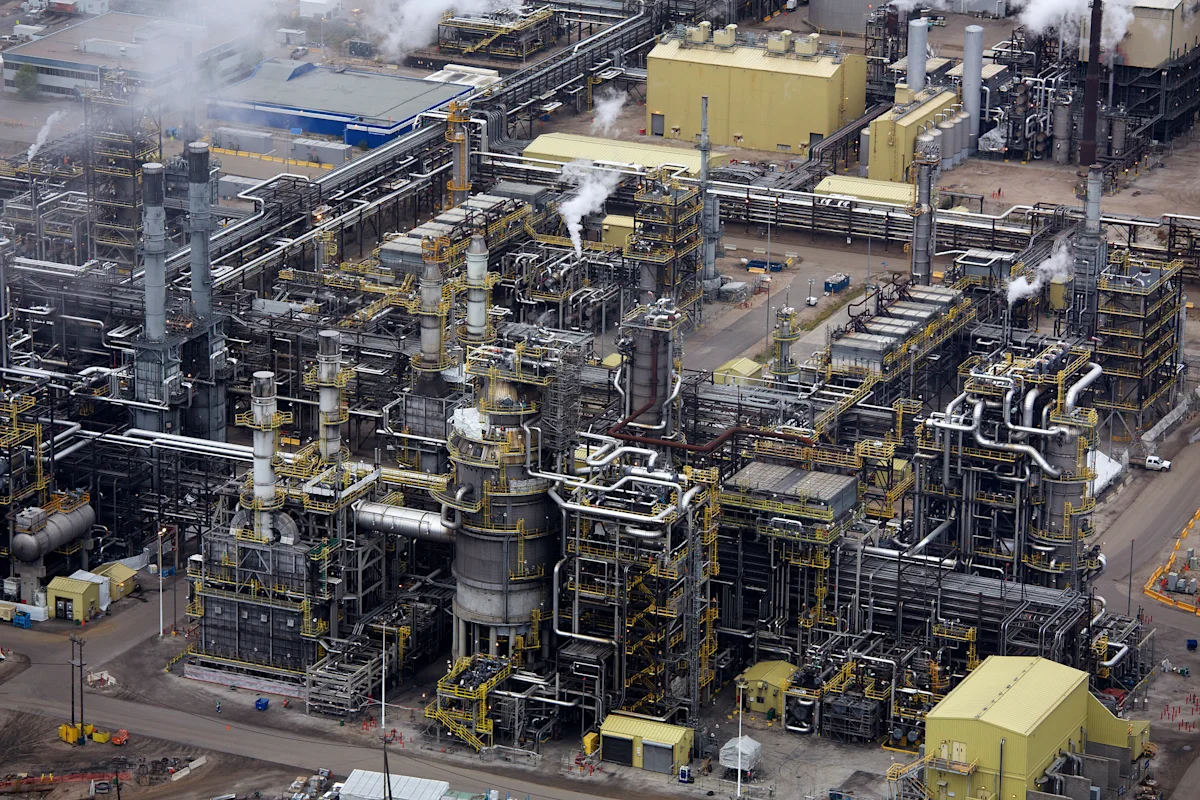
A view of the Canadian Natural Resources Limited’ (CNRL) Horizon oil sands project, north of the indigenous community of Fort McKay in Alberta, Canada, on May 5, 2026. (Daphné LEMELIN / AFP via Getty Images) ·DAPHNE LEMELIN via Getty Images
The decision to leave that trade out of the new US tariffs — while Ottawa has so far refrained from publicly threatening to retaliate by cutting oil exports — exposes a central dilemma for both countries: the US can’t easily replace the Canadian barrel, and Canada can’t easily replace the American buyer.
That mutual dependence means bringing oil into the trade fight could inflict high costs on both sides of the border.
Canadian energy isn’t entirely exempt from US tariffs. Energy exports have faced a 10% tariff since March 2025, though some Canadian crude can avoid the levy if it qualifies for preferential treatment under the US-Mexico-Canada Agreement. But the subsequent tariff actions — including the latest 50% levies — have exempted energy trade.
If Washington imposed an additional tariff on Canadian crude, US refiners would be responsible for paying the levy as the importers, though the cost would likely be ultimately shared. To offset that impact, refiners could demand lower prices from Canadian producers, potentially widening the discount on Canadian crude, while higher feedstock costs could squeeze US refining margins and ultimately raise prices for fuels like gasoline and diesel.
Canada, meanwhile, has limited ability to simply send its oil elsewhere. The expanded Trans Mountain pipeline has given Alberta producers greater access to overseas markets through Canada’s Pacific coast, but its roughly 890,000 barrels-per-day capacity is dwarfed by the approximately 3.9 million barrels of Canadian crude shipped to the US each day last year.
President Trump wrote in a Truth Social post on Monday that “Without the United States, Canada couldn’t survive … Remember, much of the Electricity, Oil, and Gas that Canada gets is transported through the U.S.A. Someone should get these clowns to ‘fall in line’ or, the consequences for Canada will be far WORSE!”
The US leader appears to be referring in part to Canada’s reliance on US infrastructure to move some of its own energy supplies between provinces. Enbridge’s Line 5, for example, carries Canadian oil from western Canada through Wisconsin and Michigan before crossing back into Canada to supply refineries in Ontario, with some crude ultimately moving onward to Quebec, giving the US leverage over a key transport line for Canada.
Taken together, the close energy ties between the US and Canada make oil a powerful but potentially self-destructive weapon for Ottawa as well. An export tax or restriction could raise costs for US refiners, particularly in the Midwest, but could also leave Canadian producers scrambling for buyers and force down the price they receive for their crude.
Jake Conley is a breaking news reporter covering US equities for Yahoo Finance. Follow him on X at @byjakeconley or email him at jake.conley@yahooinc.com.
Employees at a Nestlé plant in Spain have agreed to carry out work stoppages this week, continuing their protest against planned layoffs at the site. […]