Ambiently queer and awash in rapturously uncertain feeling, Avalon Fast’s ultra-accomplished “Camp” is a micro-budget Canadian movie that invokes a handful of recognizable horror tropes without ever succumbing to the mode altogether. Eerie in a way that feels more seductive than scary, the film isn’t bewitched by its demons so much as the process of transubstantiation by which a (self)tortured young woman can transform them into grace.
“Camp” might begin with a premise that seems ready-made for some post-horror trauma fun in the vein of “Midsommar,” but the “Honeycomb” director’s second feature — shot at a Tim Horton soccer camp in the forests of Alberta, and set at the spiritual crossroads between Panos Cosmatos, Louise Weard, and Jane Schoenbrun, whose “Teenage Sex and Death at Camp Miasma” could be cast as this movie’s long-lost older sister — soon unmoors itself from the gendered expectations of a legible genre plot. Teenage and/or early twentysomething sex and death are both on the menu, but only as two of the key ingredients Fast needs to conjure a hazy woodland dreamscape where strength is endowed through human sacrifice, the moon cries tears into the lake at night, and even the most haunted of people might find the power to take flight of their pain.


If Emily can do it, anyone can. Played by newcomer Zola Grimmer, who inhabits the role with a raw and searching realness that shifts to accommodate this movie’s quicksilver tone (scenes are liable to pingpong between Omnes-like archness and hyper-vivid sincerity), Emily is just starting to heal from the worst hurt of her life when “Camp” rips the wound open twice as wide in its opening minutes. It starts, as many terrible nights do, with a game of truth-or-dare at a moribund house party. When Emily opts for the former, someone asks her to name her biggest regret. Did you ever get a bad haircut or hook up with your friend’s ex? Tee-hee-hee and whatnot. Willfully misreading the vibe and/or desperately hoping for some much-needed support from her peers, Emily confesses that — by no fault of her own — she hit and killed a little kid with her car a few years earlier. Party foul. Awkward glances. What a freak.
One girl suggests that this isn’t the right place for that kind of thing — that Emily should talk to a professional, as if that might be a helpful piece of advice. Emily bails with her best friend Charlie and a few baggies of cocaine for the car ride home, but they’re barely on the road before Charlie dies of a (presumably fentanyl-induced) overdose in the passenger seat. Emily was already the guiltiest college dropout in all of Western Canada. Now she feels like a serial killer.
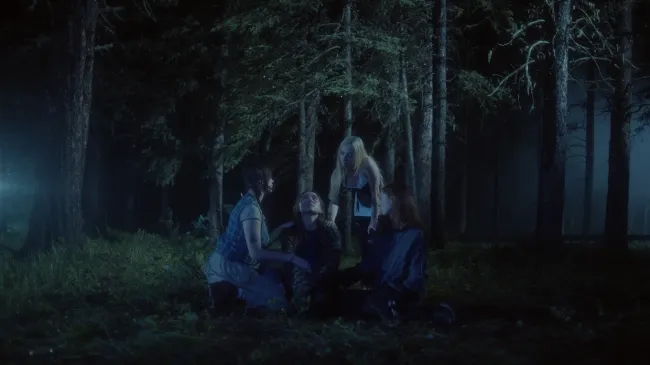
When her dad recommends Emily for a job as a counselor at a sleepaway camp for damaged kids, she has no choice but to accept the opportunity. She’s either the worst possible candidate for the job or uniquely well-qualified to knock it out of the park, and there’s only one way to find out. We never really do. While campers do eventually show up (one of them even has their first period under Emily’s watch), they mostly flitter in and out of the movie like white noise, as Fast prefers to focus on the coven-like bond that Emily develops with the other counselors — a group of “gorgeous weirdos” who swan around the woods like joyful goths.
Rosie (Cherry Moore) teases the “hot and loose energy of the summer” and casually slips into conversation that she had a kid of her own once, as if exalting in the safety of a place where no one would find that information relevant to their friendship. Nev (Lea Rose Sebastianis) fantasizes about fucking ultra-Christian camp leader Dan (Austyn Van de Kamp), less out of lust than a desire to offer his virginity to the darkness. Jo (Sophie Bawks-Smith) seems to be in tune with an unseen force, while Clara (Alice Wordsworth) resembles Emily just enough to suggest her doppelganger; the movie kindles the underplayed sexual tension between them, but only so far as it foists Emily back upon herself as she looks into the moonlight for a way to absolve her guilt.
All of these girls know what it’s like to be lost, and “Camp” so completely trusts in what its characters find in each other that it disregards any other means of orientation. Eliding the specific questions that its set-up would seem to invite (What relationship do the counselors have with the occult? Why are the campers damaged? Is the camp itself rooted in a shameful or sinister past of its own?), the film asserts its queerness by foraging around for more heterodox ways of settling Emily’s soul — not therapy, not Jesus, and certainly not the skeevy boy that she meets at a campfire one night. “Camp” even takes pains to reject, or at least pass over, the notion that killing men would be a viable way for women to reclaim their power, as Fast’s interests lie solely in the sisterhood that Emily shares with her colleagues (who are never anything but kind to each other, even in violence).

It’s the spectral essence of that sisterhood, and how evocatively Fast and her collaborators are able to suffuse it into the sinews of Emily’s guilt, that provide the source of the film’s drone-like pull. Clumsy and airless as they can be, the disarmingly lo-fi dialogue scenes peel back the surface of the movie in a way that sharpens your attention to its abstracted strengths, as if Fast were offering “Camp”’s superficial amateurishness as a kind of blood sacrifice to attune their audience to the more intuitive power of its moods.
However DIY the film might seem at the start, it soon becomes enthrallingly obvious that cinematographer Eily Sprungman is a master of their craft, the glossy crispness of the movie’s “normality” smearing into a softly enchanted blur as Emily comes to feel at home with her coven. By the end of the movie, even something as natural as daylight has become suffused with a heavenly glow, and the beads of sweat on a dying body sparkle with a beauty that Emily had never been able to find anywhere else in her tragedy of a life.
Furnished by the sounds of Max Rubin’s spare and reverb-heavy synth and guitar score (reminiscent of the music Alex G has written for Schoenbrun’s films, at least so far as the fugue-like state of self-discovery that it carves from a world of white noise), Fast’s images rely on a hypnotic meshwork of thick gels, billowing fog, and gorgeous dashes of animation to reforge the most fucked up parts of Emily’s life into a viable path towards forgiveness. Towards the same clearing where God once brought Clara to the devil so that the devil could bring her to her closest friends — the only people capable of returning her to herself. This defiantly conceived, vividly textured, and enormously resonant work of cost-effective witchcraft is spirited along by its hypnotic faith in the course it charts to heal someone who should never have felt so broken in the first place.
Grade: B+
Dark Sky Films will release “Camp” in theaters on Friday, June 26.
Want to stay up to date on IndieWire’s film reviews and critical thoughts? Subscribe here to our newsletter In Review by David Ehrlich, in which our Chief Film Critic and Head Reviews Editor rounds up the best new reviews and streaming picks along with some exclusive musings — all only available to subscribers.