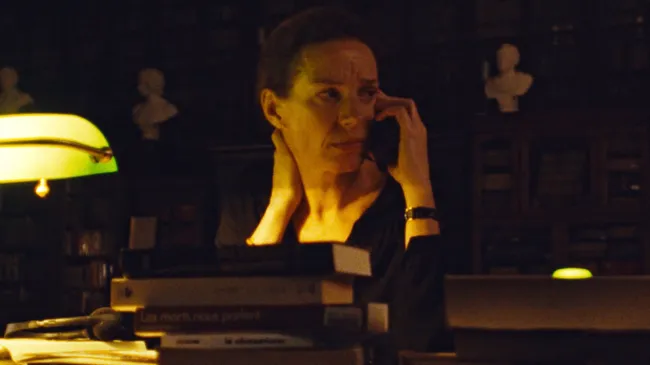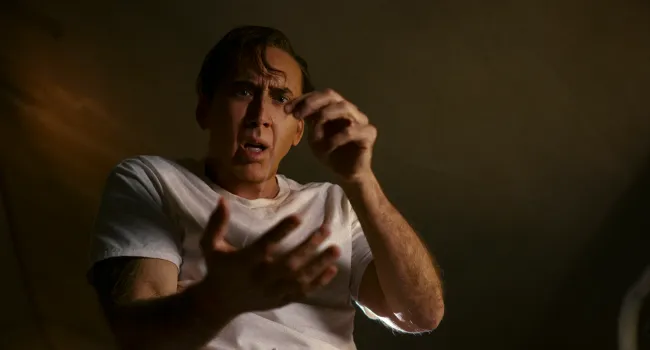
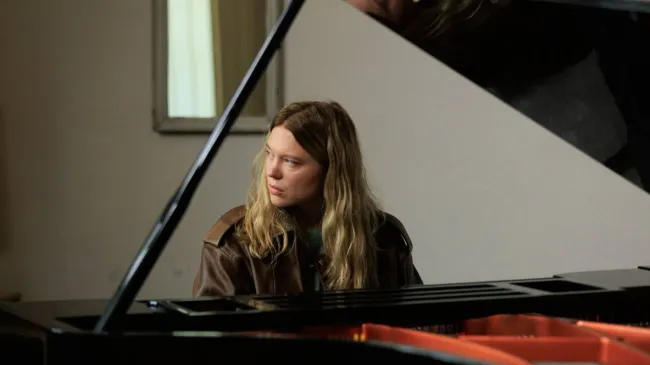
Marie Kreutzer’s “Gentle Monster” opens with virtuoso musician Lucy Weiss (Léa Seydoux) sitting at the piano in her Munich apartment and plunking out a stilted but affecting cover of Charles & Eddie’s neo-soul classic “Would I Lie to You?”
This is before her Austrian husband Philip (Laurence Rupp) — a documentary TV producer of marginal success — comes home in a burnout panic that spurs them to permanently relocate their family to a cottage in the German countryside. Before the authorities bang on their door with a warrant for Philip’s arrest, forcing Lucy to ride the elevator up to the clearly designated “child porn” floor of the local police station in order to learn the facts of his case. Before she begins to wonder, in rage and terror and desperate layers of self-protective doubt, whether the father of her young son Johnny (Malo Blanchet) might actually be capable of preying on other kids, or even his own.


Among other things, this tough and unflinching social drama is a study in how painful it can be for a rhetorical question — like “Would I lie to you, baby?,” for example — to sour into the stomach-churning stuff of an urgent mystery. For the terms of a relationship to change faster than the facts of the matter are able to keep up with, let alone the feelings that might attend to them. “There is no ‘off button’ for pedophilia,” someone explains to Lucy at one point. There isn’t an “off button” for love either.
Perhaps that’s why Lucy was able to ignore the signs for so long, some of which the audience is given the chance to see in a dark and disquieting flashback that Kreutzer cleverly interjects during the movie’s second act. Perhaps, despite the less intimate nature of their relationship, that’s why Kreutzer herself was so inclined to believe the male lead of her previous film (“Corsage”) when he privately disputed the rumors that he was guilty of similar crimes. Actor Florian Teichtmeister ultimately pleaded guilty to possessing more than 76,000 child sexual abuse files, more than half of which showed children under the age of 14.
While Kreutzer surely laments that situation on several different levels, this is neither a penitent film nor a self-exculpatory one (its origins trace back to before the production of “Corsage,” when the director read a newspaper article about a pedophile ring in North Rhine-Westphalia). It’s safe to assume that most people will feel sick to their souls on Lucy’s behalf, but “Gentle Monster” — its title pointedly depriving us of Lucy’s natural doubt — doesn’t make any overt pleas for sympathy, just as it doesn’t render Philip as the kind of demon that anyone might see coming a mile away.
In the context of such a terrible crime, Kreutzer is naturally less concerned with right and wrong than she is with the way that even the most sordid type of abuse is able to disguise itself in domesticity. If victims are our friends and neighbors, then it stands to reason that perpetrators are too.
Hard-nosed and realistic as far as these things go, “Gentle Monster” only makes a few concessions to movie logic. The first and most obvious of those is that Lucy is a fantastically chic public figure of some renown, a Jacob Collier-like pianist known for deconstructing famous pop songs written by men — everything from George Michaels’ “Freedom” to The Cure’s “Boys Don’t Cry.” The latter bop proves especially instructional, as Lucy is fascinated by the fact that men are so much more honest about their emotions in music than they are in real life. Her mission is to take apart their words and question the meaning behind them, a semi-credible gimmick that Seydoux is able to sell on the strength of her confidence alone.
It’s true, of course, that men should never be trusted, but Lucy will soon find that her own feelings are just as liable to lead her astray. First, she convinces herself that relocating to the sticks might fix whatever’s going on with Philip — a choice that inspires her mom, played by an underwritten Catherine Deneuve, to crack that, “For a female artist, there’s only one thing worse than having children: moving to the countryside.” Then, once Philip is brought up on charges, Lucy does what she can to downplay the evidence of his deviancy. All fathers take videos of their sons, after all. Most of them don’t shoot on 8mm film or frame close-ups of their kids for the length of a portrait sitting, but Philip still imagines himself as an artist (which explains why he seems to be so cucked by his wife’s success), and he’s prone to saying things like “Faces say so much only after you’ve looked at them for some time.”
There are no histrionic scenes in which Lucy screams at people for doubting her husband’s innocence, and Seydoux’s implosive performance makes it seem as though — a little less with every passing detail she discovers — Lucy is only mad at herself for believing Philip’s rationalizations. He was doing it for a documentary. He only uploaded a video of Johnny to earn trust from the pedophile community. He was just acting as a fence for illicit content because he felt emasculated by his lack of income. Whatever he can say to convince this woman that it’s easier to blame herself for overreacting than it would be to contend with the true nature of his crimes. Nothing much really happens in this movie after Philip’s initial arrest, but the world viscerally shudders under Lucy’s feet every time one of her husband’s alibis falls apart.
Lucy’s image of Philip — the one she loves and clings to — is like a song that’s stuck in her head, and deconstructing that song turns out to be a challenge of a different sort. Her only potential ally in that process is special investigator Elsa Kühn (Jella Haase), who’s caught more pedophiles like Philip than she can count. As unmovable as Lucy is unmoored, the working-class Elsa is defined by the relative calm with which she navigates her own personal crisis: a senile father who keeps harassing his nurses.
The obviousness with which Kreutzer introduces Elsa into this story as a foil is offset by the uncertainty of the character’s purpose. On the one hand, Elsa could also be seen as collateral damage — as another casualty of a man whose inner life has betrayed the role he was meant to play in his family. On the other hand, Elsa’s permissive reaction to her father’s abuse introduces a less gendered hypocrisy into the mix, as the lack of sympathy she feels towards Lucy is undercut by her refusal to confront the rot in her own house.
In a film that refuses to “resolve” any of its drama, or to glibly suggest that there’s anything constructive we can do about any of this aside from staring it in the face, Elsa’s subplot is left to awkwardly jut out from the side of the central story, a semi-effective distraction from the fact that Lucy has little to do but wait for the other shoe to drop and worry if she can contain the social blowback. “Gentle Monster” doesn’t quite get that far, as Kreutzer limits the drama to a slow drip of despair, its queasy suspense rooted in the question of how sick the revelations about Philip will have to get before Lucy is finally able to see him for what he is — to hear the man behind the song, so to speak.
And so the ugliness of pedophilia itself, rather than the specifics of how Lucy comes to grips with it, assumes center stage as Kreutzer’s primary subject. Full of feeling but starved of an outlet for it, Lucy is gradually woven into the fabric of Judith Kaufmann’s widescreen framing, which invites natural beauty into this grimdark story at the same time as it makes its subject feel inescapable. The world assumes the texture of a gilded cage; life goes on, some of it as sparkling as her in-laws’ picturebook summer house in the Austrian Alps, but Lucy remains trapped in the discordant hell that surrounds her, and that no one else can seem to hear. If only she had always known how to listen so closely.
Grade: B
“Gentle Monster” premiered at the 2026 Cannes Film Festival. It is currently seeking U.S. distribution.
Want to stay up to date on IndieWire’s film reviews and critical thoughts? Subscribe here to our newsletter In Review by David Ehrlich, in which our Chief Film Critic and Head Reviews Editor rounds up the best new reviews and streaming picks along with some exclusive musings — all only available to subscribers.