Although director Michael Dinner often originates and develops his own projects (as he did recently on the FX series “Justified: City Primeval“), when showrunner Graham Yost asked him to step in as a producer/director on Season 2 of Apple TV‘s “Silo,” it didn’t take long for him to say yes. Aside from the appeal of reuniting with Yost, with whom Dinner had worked on the original “Justified,” there was the chance to delve into a sophisticated sci-fi world courtesy of novelist Hugh Howey’s source material.
“I’ve been fortunate to have a career where I keep reinventing myself, and I never want to feel like I’m being redundant,” Dinner told IndieWire on the latest episode of the Filmmaker Toolkit podcast. “Television has given me the ability to do a new project every year.” That said, Dinner ended up staying on “Silo” for three seasons, watching what he thought would be a “six-month gig” turn into three years as Dinner worked on seasons 2, 3 (which just concluded), and 4 (which Dinner has already shot).


The complexity of the series kept Dinner and the other directors on their toes, especially since each season was cross-boarded in a way that meant the filmmakers would be jumping back and forth in time at a dizzying speed on any given day. “It was an unusual way to work,” Dinner said. “There’s a huge backstory, and you’d have to constantly remind yourself of what happened in the past. Sometimes I would call up Graham, or talk to the actors, and say ‘What did you do in the first season when I wasn’t here?’”
Typically, Dinner would spend the first 15 minutes of each day on a “history lesson” with the actors, in which they’d all find the context for the day’s work. “ Let’s remember what happened in the novel, [let’s talk about] where we’re going,” Dinner said. “Let’s talk about where we were when we shot half of this scene six months ago. It was a really complicated process, so for the director and the actor, you had to have each other’s backs.”
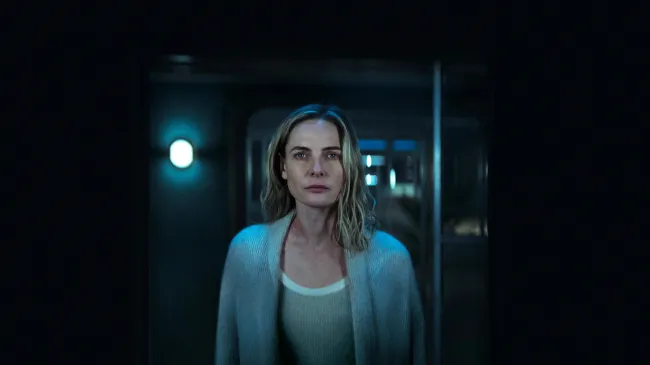
As a director, part of Dinner’s job was keeping track of the history of what happened in the actual silos where much of the story takes place. “You have to map it out,” Dinner said, describing the hierarchy in the silos as a variation on Victor Hugo’s “Les Misérables.” “There are the grunts that work there, and the people up above them, and you have to create visual cues because the sets all kind of look the same. Some are grungier and dirtier than the others, but sometimes it was the decision about how to light them — there’s less light or more light depending on where you’re at geographically in the silo.”
For Dinner, one of the great pleasures of “Silo” was living and working in London, where he found there were different ways of working that he had to adapt to. “I didn’t go in saying, ‘I’m the cowboy from Hollywood, let me show you how it’s done,’” Dinner said. “What I did say was, ‘Here’s how I normally do it. How do you do it here?’ There was a lot of give and take, and we had fun with it. They’re really good at what they do. It’s no different than being in Hollywood, in that anything you need is at your disposal.”
In terms of Dinner being able to try new things and push himself, the water work and visual effects on “Silo” posed new challenges beyond what he had done in his previous forays directing action. “I just got the tally for the final season, and there are 4,000 visual effects shots,” Dinner said. “I’d done visual effects before, but not to this extent. It will take six months to turn over these shots if we’re lucky. So I’m still learning.”
The fear that comes with directing a show like “Silo,” which is on such a large scale and has so many moving parts, is part of the fun for Dinner. “I still feel close to vomiting on the first day I’m on set for something new,” Dinner said. “But I use it to push myself forward — it’s a good motivator. That’s the fun of directing. When you stop learning or feeling butterflies on your first day, it’s time to hang it up.”
“Silo” is currently streaming on Apple TV. To hear the entire conversation with Michael Dinner and make sure you don’t miss a single episode of Filmmaker Toolkit, subscribe to the podcast on Apple, Spotify, or your favorite podcast platform.