
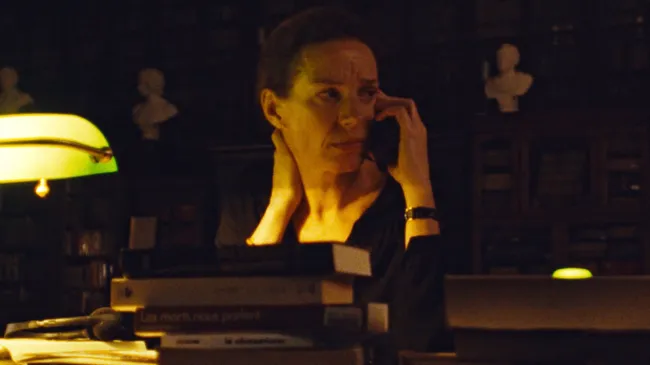
Watching a character alone at a desk reading a book is not, traditionally speaking, the most cinematically exciting activity of all time. But in the indie film “Chronovisor,” it’s an addicting, compulsively watchable rabbit hole. As main character Béatrice (Anne-Laure Sellier), an academic at Columbia University’s Zuckerman Institute of brain research whose field of study focuses on historical theories of memory, digs deeper and deeper into the story of the titular occult instrument, the dusty academic texts she pores over translate in front of our eyes, sections at a time lighting up into white subtitles.
Every zoom-in and camera movement across the pages becomes a new revelation, a new piece of the swirling research mystery surrounding Béatrice to unlock. We see the magazine articles she pores over from her point of view, as if we’re the ones spending hours and hours diving further into this strange maybe-conspiracy. Her obsession becomes the audience’s own.


There’s a slight sense of metafiction to “Chronovisor,” which is less a traditional narrative than it is the creative team crafting a vehicle to get the audience as equally wrapped up in their own historical fascination. Directing duo Jack Auen and Kevin Walker, making an impressive and fully realized feature debut, spent almost a year researching the story of the Chronovisor, a device created by the real Italian Catholic priest Pellegrino Ernetti in 1972, who alleged he used its ability to capture signals from past times to obtain a photograph of Jesus nailed to the cross.
The vast majority of archival material that Béatrice discovers about the Chronovisor throughout the film — books, magazines, newspapers, VHS tapes, audio recordings — is genuine, blurring the lines between fiction and documentary into something much more hazy and unpredictable. The results, though, play as an unconventional but wildly compelling academic thriller, one that owes way less to populist works like “The Da Vinci Code” than it does to the writing of essayists and philosophers like Jorge Luis Borges and Umberto Eco, both of whom receive thanks in the closing credits.

Very nearly a one-hander, “Chronovisor” opens with Béatrice giving a long-winded explanation of her research and field of study to an unseen colleague, kept out of sight of the camera at the restaurant table they’re eating at. For the vast majority of the film, most of the people Béatrice glancingly interacts with in between reading sessions are similarly unseen, or voices on the end of phone calls tracking down new documents or clues to the story of Ernetti’s life, inventions, and his uncertain fate after the Chronovisor’s validity was seemingly debunked. We learn essentially nothing about Béatrice’s background or life outside of this current stretch of increasingly fanatical research — her entire existence seems to be consumed by the questions she’s so desperate to find answers for.
A real-life academic who serves as a professor of behavioral sciences at HEC Paris, Sellier brings a stoic intelligence and command to a part that’s half meant as something of an audience insert. Much of the film relies on the way her eyes light up at a new research breakthrough, or widen in shock at an unexpected discovery. As the fascination with Ernetti grows into something unhealthy, Béatrice subtly grows more tired, more distracted, more irritable and desperate for answers, small changes Sellier conveys with a smart sense of restraint.
Béatrice’s research takes her across New York City libraries and universities, shot in 16mm film by cinematographer Leo Zhang, who creates a sense of claustrophobia fitting for a story about losing yourself in conspiracy. The environments are basked in a warm yellow light that’s gorgeous, grainy, and slightly anachronistic and analog, as if it belongs to the world of Ernetti rather than the modern day. The bombastic classical score, renditions of compositions by late English composer Gustav Holst, further adds to the sense that “Chronovisor” is a bit out of time, and imparts further gravity on the acts of reading and thinking.
None of “Chronovisor’s” aesthetic strengths would be enough to compel the audience if the central subject wasn’t interesting to learn about on its own. But the history of Enretti is wild, full of scandal and lies and obscure facts you can’t easily find on the internet, with Enretti himself emerging as a wildly compelling character. Although the film smartly never directly comments on it, the nature of the Chronovisor itself feels oddly prescient and applicable to our modern age, where people spend as much time on screens and recording their lives as they do actually living them.
Across 90 minutes, “Chronovisor” never quite makes it clear where its twisting mystery will bring the audience. Is Béatrice’s investigation going to bring her to something concrete, something real, or is it just an unsolved urban legend with no conclusion to be found? When the film arrives at an eventual destination, it doesn’t so much offer answers as it raises new questions of what happens when you spend too long looking into the past. In that sense, “Chronovisor” makes the audience feel once again like Béatrice, desperate to comb through its every frame and uncover its secrets.
Grade: A-
Grasshopper Film will release the film in select theaters on Friday, September 4.