
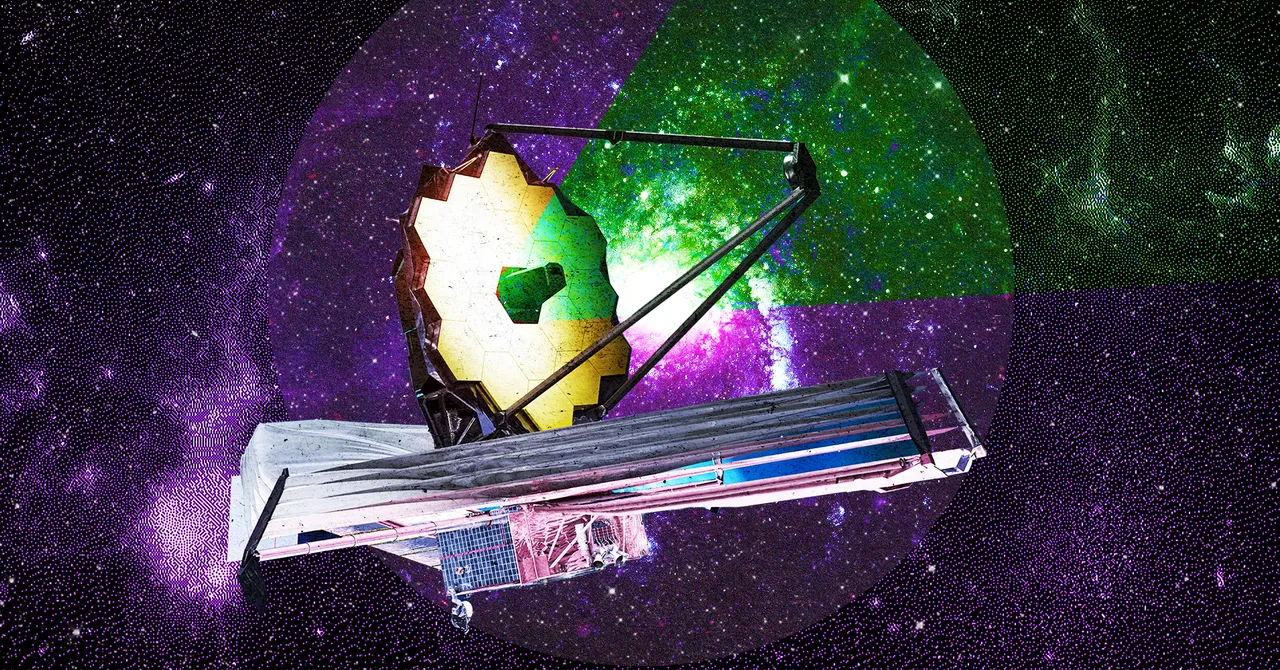
“If we consider what the James Webb Space Telescope is doing, it’s optimized towards looking at the very distant universe … but just a tiny patch of the sky,” says astrophysicist Rachel Mandelbaum of Carnegie Mellon University. “In contrast, Roman is able to look at a large area of the sky at once.”
That broad view will allow Roman to scour hundreds of millions of stars in search of planets. Similar to previous missions, the space observatory will find most of its targets by looking for planets that transit in front of their host stars. This is a highly effective technique to find large planets with short orbits, but to look for different kinds of worlds, Roman will use another trick called microlensing.
When two stars line up one in front of the other, the light from the background star is warped and magnified by the gravity of the star in the foreground. If that foreground star happens to host a planet, Roman will be able to detect how the planet’s gravity further magnifies the starlight coming from behind.
“This method can detect planets that are farther away from their stars than other methods,” says Matthew Penny, an exoplanet researcher at Louisiana State University. “You don’t need the planet to complete an entire orbit before you see it.”
Roman is so sensitive to these microlensing effects that it should be able to detect planets with less mass than Mercury. It will also have the ability to spot free-floating “rogue” planets that have been cast away from their stars or that formed alone in the void.
By studying these new populations of planets, scientists can learn more about the conditions that may produce a system like our own and, by extension, a life-bearing planet like Earth.
“Our solar system is potentially quite unique, although we don’t really know at this point,” Penny says. “There’s a lot of potentially lucky coincidences in the solar system that make life possible.”
Probing the outer regions of planetary systems will provide key missing pieces to this puzzle. For example, the formation of large planets farther from a star may allow smaller planets to form closer in, Penny says, near the habitable zone where liquid water could form.
“Without a complete census of the whole range of possible planets, we don’t really know how common planets like Earth are,” Penny says, “or planetary systems like our own.”
The Dark Universe
In addition to many new worlds, Roman’s gaze will fall upon more than a billion galaxies. In particular, it will focus on a population of galaxies between about 2 billion and 6 billion years after the Big Bang.
“One of the things that we try to study is the history and growth of cosmic structure,” Mandelbaum says. “In the very early universe, the matter was almost uniformly distributed. But there were tiny perturbations or tiny regions that were just a fraction more dense or less dense.”
Those slightly denser regions attracted more and more material over time, eventually forming immense clumps of dark matter that scientists call halos. Gas was then driven to the center of these dark matter haloes, where it ignited stars that swirled together to form galaxies.