In 1996, Tim Burton directed one of his best — and certainly most underrated — films when he unleashed the deliciously subversive and hilarious sci-fi film “Mars Attacks!” into theaters around the globe. An alien invasion movie that boasts one of the best ensembles of Burton’s (or anyone else’s) career, “Mars Attacks!” is a wild hybrid of its cinematically omnivorous director’s disparate influences, mashing up 1950s sci-fi, Kubrickian satire, and 1970s disaster flicks to create a singular spectacle as entertaining as it is ambitious.
According to screenwriter Jonathan Gems, the whole thing began with a fluke. Gems, who had become friends with Burton after working on “Batman” in 1989, was looking for a birthday present for the director when he stumbled across some “Mars Attacks!” trading cards in a store on Melrose Avenue in Los Angeles. “They were these beautiful little oil paintings of demonic Martians wreaking havoc,” Gems told IndieWire. He gave Burton the cards, and a week later got a call.


“Tim thinks about movies all the time,” Gems said. “He doesn’t really think about anything else. So anything you put in his eyeline is a potential movie.” Burton proposed he and Gems turn the cards into a film, and gave the screenwriter a template they could use for their story. “He said, ‘Do it like an Irwin Allen disaster film where the Martians invade, and everything gets destroyed.’ We used the Irwin Allen formula where different types of people — rich, middle, poor — all go through the same disaster, and all react differently.”
Burton would ultimately assemble an ensemble every bit as star-studded as the one in Allen’s “The Towering Inferno,” with Jack Nicholson (playing two roles), Annette Bening, Pierce Brosnan, Danny DeVito, Glenn Close, Martin Short, and many others signing on — most of them with the understanding that their characters would be obliterated. That too came from “The Towering Inferno,” specifically from a viewing Gems and Burton had while smoking a joint that sent them into paroxysms of laughter.
“I advise you to watch that movie stoned, because if you do it’s really hilarious,” Gems said. One scene he and Burton found particularly funny was a shocking moment when Richard Chamberlain crashes out a window and plunges to his death in a big ball of flames; they weren’t expecting a star to die like that, and it gave them an idea. “It was so bizarre and oddly funny that it gave us this concept: we would kill all the movie stars. We’d get as many movie stars as we could into the film, have them play fatuous characters, and then we’d give them all death scenes and make each death scene as funny as possible.”
Gems went through 14 drafts of the script, partly because the studio was never happy with his and Burton’s desire to upend convention. “They were kind of against it from the beginning,” Gems said. “At the time there was this weird phony morality, which caused a problem for me because the whole point of the film is you’ve got these demonic Martians killing everyone.” Gems was fired at one point and brought back on again, and while the process was arduous, he said the multiple drafts ultimately made the movie better. “It was good for me and good for the movie, because every time you do another draft you bundle in more stuff.”

Of course, Gems’ multiple drafts were only the beginning; once the script was ready to green-light, Burton’s design and effects teams had to figure out how to actually bring Gems’ outrageous flights of imagination to life. “It was pretty challenging,” visual effects supervisor Michael Fink told IndieWire. “It was the early days of full-on digital effects, and we were inventing almost everything we did movie by movie.”
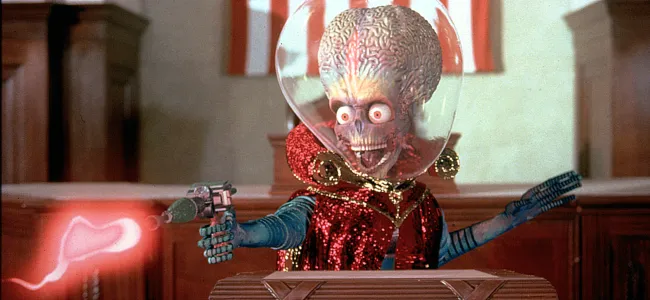
“Mars Attacks!” was filled with complicated effects sequences — starting with the 5400-frame opening title sequence depicting a flying saucer armada — but one of the biggest challenges came in creating the Martians themselves. “The original intention was to create the Martians with stop-motion animation,” Fink said, referring to the technique of creating models that would be repositioned incrementally one frame at a time to give the impression of movement. It quickly became apparent to the filmmakers that stop-motion wouldn’t work, however, for a variety of reasons.
”They had these 18-inch tall Martians, and their helmets were shaped like a light bulb,” Fink said. “They were smaller at the bottom than at the top. So if you wanted to change the Martians’ expressions, you’d have to take the helmet off to have access to the head, and have a seam in the helmet, which I don’t think anybody wanted.” Additionally, there was the issue that the Martians interacted with human actors in several scenes, which made stop-motion virtually impossible. “It was never going to work, because the moving camera shots would have made it hugely difficult.”
The transition from stop-motion to digital moved gradually, with the initial idea being that digital helmets could be put on stop-motion Martians. When visual effects supervisors James Mitchell and David Andrews shot tests of an all-CG Martian that worked, however, the die was cast. “That’s when Tim saw it in his head,” Mitchell said. The visual effects artists and animators then got to work creating digital Martians that would have the handmade, idiosyncratic style Burton originally intended to achieve with stop-motion.
While the Martians were digital, “Mars Attacks!” relied on a hybrid approach that incorporated the Martians into quarter-scale practical sets, which were shot by director of miniature photography Pat Sweeney. “Everything was in camera except for the CG Martians,” Andrews said, with Sweeney adding that he didn’t see the movie any differently than he would have had it been made in stop-motion. “I treated ‘Mars Attacks!’ as a stop-motion show,” Sweeney said. “I was already on board with Tim’s approach to that style, because I had worked on ‘The Nightmare Before Christmas.’”

Sweeney took some of the stop-motion puppets that had been built before the decision to switch to CG and used them as reference guides to help him light the miniatures. “I would walk them through the scene so the computer graphics people could see their action and the lighting,” Sweeney said. One of the innovations on “Mars Attacks!” came from Sweeney’s need to integrate data from a motion control camera into the computer, something that had previously been difficult.
“We had never figured out why the data from our motion control on the stage didn’t translate into computer graphics, and I figured it out,” Sweeney said. “It had to do with differences between how our camera moved and where it started and their virtual camera. I made them pretty much the same so that they could take my data into the computer without spending a week match-moving it perfectly. They could start animating almost immediately.”
The interior spaceship set that Sweeney shot was 11 feet tall by 18 feet wide, and only had about four feet of room underneath. “My gaffer was really good at contorting his body underneath the set,” Sweeney said. “He found some great angles for the lights and some cool colors to illuminate the tanks that held an odd assortment of things like eyeballs, shoes, even a clown.” Although the miniature was only half-built when the stop-motion plan was abandoned, the decision was made to complete it rather than paint the rest of the set in in CG — a decision that gives the environment a weight and texture that helps sell the digital Martians as living, breathing beings.
That tactile quality is part of what makes “Mars Attacks!” so pleasurable and timeless — though it was utilizing cutting-edge technology of the day, its spirit comes from sci-fi of an earlier era. “We didn’t play into it being a big digital movie,” Mitchell said. “Even the digital stuff had to feel like somebody had made it by hand. The ray gun was like something out of a campy 1950s space movie.”
1950s sci-fi was a touchstone for production designer Wynn Thomas as well, as he found himself excited by older films’ combination of clear, simple lines and zany style. “Tim and I came to the conclusion that we would try to use a lot of color, but make the graphics in each set very simple,” Thomas said. “So instead of there being a lot of busy scenery, we would try to reduce it to the simplest architectural elements. I had a great deal of fun incorporating those lines and looks from those fantastic 1950s outer space films.”
Cinematographer Peter Suschitzky already had an impressive background in science fiction, having shot “The Empire Strikes Back” and “Krull,” but he came to “Mars Attacks!” without preconceived notions of how the film should look or feel. “I need to see the concepts for the production design and costumes to start imagining how I’m going to do my work,” Suschitzky said. “I subconsciously try to absorb the elements of the film and then not transform it, but become part of the whole.”
To that end, Suschitzky tried to key off of the many extraordinary performances to find a visual language for the movie. “The work of a cinematographer is not to impose a style, but to be in harmony with the rest of the film,” Suschitzky said, adding that if the overall tone of “Mars Attacks!” is one of infectious fun, that stems largely from the film’s director. “Tim would chuckle every day at what he was doing and seeing, and that gave me a lot of enthusiasm and pleasure as well.”

Indeed, one thing that everyone who worked on “Mars Attacks!” seems to agree on is that Burton was a generous collaborator skilled at synthesizing everyone’s ideas and skill sets. “ The great thing about working with Tim is that Tim is an artist, and he understands and has an appreciation for what the other artists are bringing to the project,” Thomas said. “You would think that he would be involved in every decision, but he’s not. He lets his collaborators go ahead and bring their artistry to the film, and then once you start showing him the work, he gets involved with the process and tweaks things.”
Given the bold tone Burton was going for, and the abundance of characters and subplots, editor Chris Lebenzon had his work cut out for him. “I didn’t know the tone of the movie at the beginning,” Lebenzon said. “Tim’s not the kind of guy that’ll sit down and say, ‘This is what I’m doing.’ I didn’t really know what genre we were doing until a month into shooting, and I thought, ‘Oh my God, this is the most original, subversive dark sci-fi comedy.’ It was challenging because everything was bigger than life — everything was overstated or understated.”
The originality of the movie may have been a detriment when it came out, at least in America, where it flopped. The movie broke even thanks to success overseas, but its perception as a failure in its home country had significant repercussions for Gems. “That was the end of my career, really,” Gems said. “My phone stopped ringing, I couldn’t get arrested. Before that I was writing scripts for Steven Spielberg, for Oliver Stone.” Gems remains proud of the movie though, and is delighted by its long shelf life. (A new 4K UHD edition comes out today.)
“I’m utterly delighted by it,” Gems said of the movie’s cult reputation, and everyone else who spoke to IndieWire for this piece agreed that “Mars Attacks!” was a high point of their career, both artistically and personally. “Every day was an adventure,” Lebenzon said. “There were no two days the same. We knew we were doing something special. I remember one time with Jack Nicholson and Glenn Close, before Tim said, ‘Action!’ she was talking and saying, ‘I’m having just the best time here. I can’t believe how fun this is.’ And that pretty much encapsulates my feelings with the movie.”
The special edition “Mars Attacks!” 4K UHD is now available from Warner Home Video.